
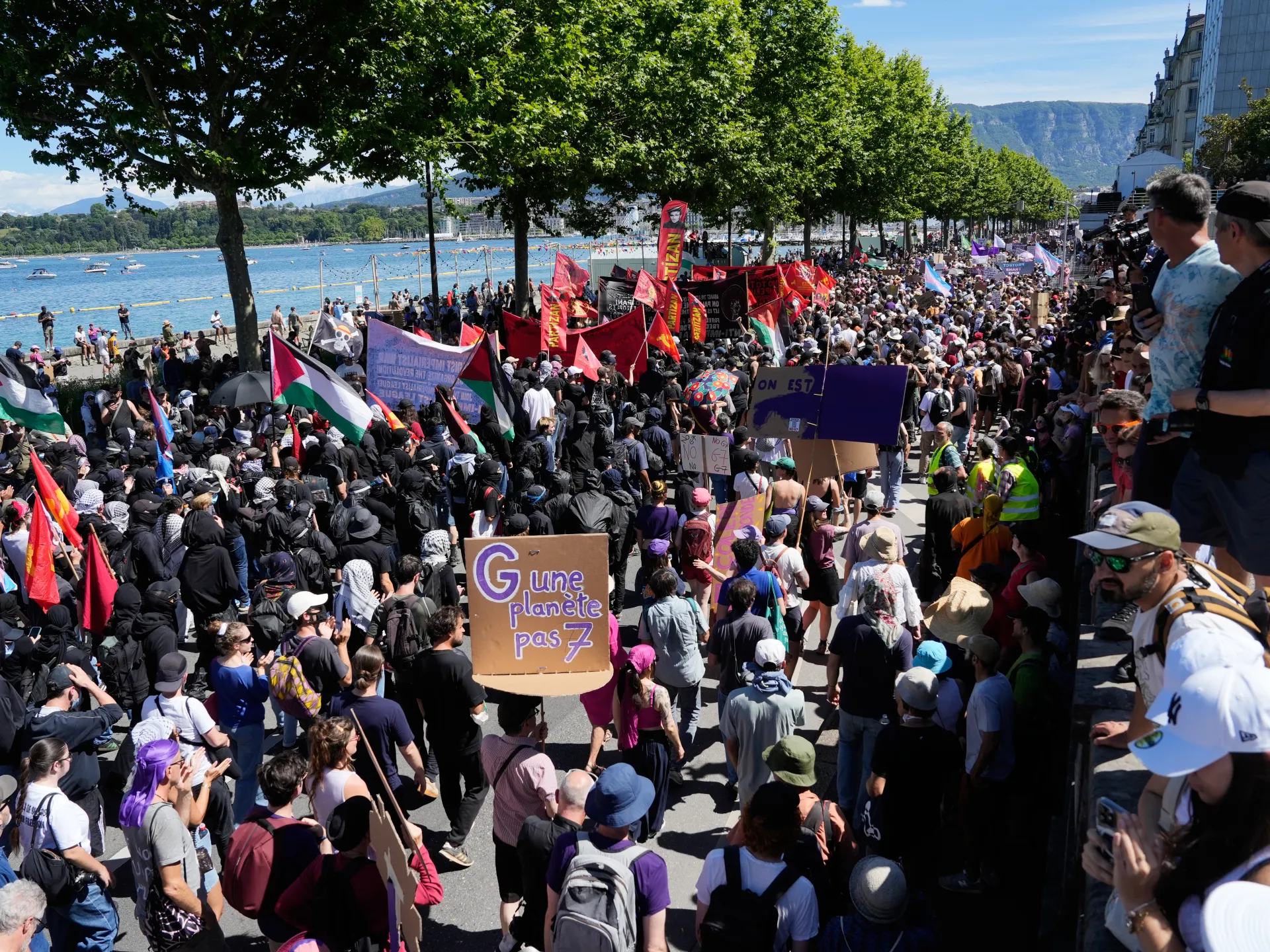
The air in Geneva crackled with defiance on Friday as tens of thousands of demonstrators filled the streets, their voices rising in unison against the policies of the world’s most powerful economies. Banners fluttered above the crowd, bearing slogans that cut to the heart of global inequities: “No more empty promises,” “Climate justice now,” and “Tax the rich.” The protests marked the opening salvo in a week of unrest that would stretch from the Swiss lakeside to the corridors of power in France, where the Group of Seven—comprising the United States, Canada, Japan, Germany, France, Italy, and the United Kingdom—prepared to convene for their annual summit.
The timing was no coincidence. As the G7 leaders finalized their itineraries and security protocols, activists saw an opportunity to force the world’s attention onto issues that had long simmered beneath the surface of diplomatic niceties. Climate change, economic inequality, and the unchecked influence of multinational corporations had become the flashpoints of a new era of global dissent. Geneva, with its reputation as a hub for international diplomacy, was the perfect stage for this confrontation.
Why the G7 summit draws global scrutiny—and outrage
The G7, often criticized as an exclusive club for wealthy nations, has faced growing skepticism in recent years. Critics argue that its policies—from trade agreements to climate commitments—frequently prioritize the interests of elites over the needs of the global majority. The summit in France, set against a backdrop of rising temperatures and economic instability, promised to amplify these tensions.
In Geneva, protesters carried signs depicting the faces of G7 leaders alongside statistics on carbon emissions, wealth disparities, and corporate tax avoidance. One demonstrator, a university student from Senegal, held a hand-painted placard that read: “Our future is not for sale.” The message resonated with a broader sentiment spreading across Africa and the Global South, where the impacts of climate change and economic policies dictated by distant capitals are felt most acutely.
The protests were not confined to Geneva. In cities across Europe and beyond, activists organized parallel actions, linking local struggles to the global agenda. In Berlin, farmers marched against agricultural subsidies that undercut small producers. In London, healthcare workers rallied against austerity measures that had gutted public services. The message was clear: the G7’s deliberations would not be allowed to unfold in a vacuum.
The human cost behind the diplomatic theater
Behind the polished rhetoric of G7 communiqués lies a stark reality. For millions in Africa, Asia, and Latin America, the policies debated in these summits determine whether their families will have food on the table, clean water to drink, or a habitable planet to inherit. The summit’s location in France—amidst rolling vineyards and historic châteaux—contrasted sharply with the lived experiences of those protesting in the streets.
In Mali, where desertification has swallowed entire villages, farmers watched as their crops withered under a relentless sun. In South Africa, communities in Johannesburg and Cape Town grappled with water shortages exacerbated by industrial pollution. In Kenya, small-scale fishermen faced collapsing fish stocks, a direct consequence of unchecked carbon emissions from the world’s wealthiest nations. These stories were not part of the official agenda in France, but they were the driving force behind the protests.
The activists in Geneva knew that their demands would likely be ignored by the G7’s closed-door meetings. Yet they pressed forward, driven by a conviction that silence would only embolden the status quo. “We are not here to beg for scraps,” declared a spokesperson for a coalition of African climate justice groups. “We are here to demand a seat at the table—and a fair share of the world’s resources.”
The security crackdown and the illusion of safety
As the protests swelled, so did the response from authorities. Riot police in full gear lined the streets of Geneva, their shields reflecting the summer sun. Tear gas canisters arced through the air, and water cannons sprayed streams of water to disperse the crowds. The scene was a stark reminder of the gulf between the G7’s professed values and the reality of its enforcement.
Critics condemned the heavy-handed tactics as an attempt to silence dissent rather than protect public order. In a statement, Amnesty International called the crackdown “a betrayal of democratic principles.” The organization pointed to reports of arbitrary arrests and excessive use of force, including against journalists covering the protests. The message was unmistakable: the G7’s commitment to human rights did not extend to those challenging its authority.
Meanwhile, in France, preparations for the summit reached a fever pitch. Security perimeters were expanded, and drones patrolled the skies above the venue. The contrast between the militarized response to peaceful protesters and the lavish hospitality extended to world leaders was not lost on observers. As one French political analyst noted, “The optics are terrible. You can’t preach global solidarity while treating your own citizens like threats.”
What’s at stake for Africa—and the world
The G7 summit’s agenda was packed with weighty topics: climate finance, global health, and the war in Ukraine. Yet for many in Africa, the most pressing issue was climate change—a crisis for which the G7 nations bear significant responsibility. Despite pledges to reduce emissions, the world’s richest economies continue to subsidize fossil fuels and lag behind in meeting their financial commitments to poorer nations.
Africa, which contributes the least to global carbon emissions, is projected to suffer some of the worst impacts of climate change. Rising temperatures, erratic rainfall, and extreme weather events threaten to reverse decades of progress in poverty reduction and food security. The continent’s leaders have repeatedly called for reparations from the G7 nations, arguing that historical emissions have created an existential crisis for their people.
During the summit, African delegations pushed for concrete commitments on climate finance. One proposal under discussion was a “loss and damage” fund, designed to compensate vulnerable nations for the irreversible impacts of climate change. However, progress remained uncertain, with wealthy nations often dragging their feet on financial pledges. As a negotiator from Ethiopia remarked, “We cannot eat promises. We need action.”
Beyond climate, the summit also addressed global health, with a focus on pandemic preparedness. The COVID-19 crisis had laid bare the inequalities in access to vaccines and medical supplies, and African nations were determined to ensure that future responses were equitable. Yet skepticism lingered about whether the G7 would deliver more than empty commitments.
The protests that refused to be ignored
The demonstrations in Geneva were not the only challenge facing the G7 leaders. In France, a coalition of labor unions and civil society groups organized a nationwide strike, paralyzing public transport and shutting down key infrastructure. The action was a direct challenge to President Macron’s economic policies, which protesters argued favored the wealthy at the expense of workers and the poor.
The strike highlighted a growing rift between the G7’s economic model and the needs of ordinary people. In cities like Marseille and Lyon, thousands took to the streets, their chants echoing through the boulevards. “Macron, écoute! Le peuple se lève!” (“Macron, listen! The people are rising!”) became a rallying cry. The protests underscored a simple truth: the G7’s legitimacy was no longer a given. It would have to be earned.
Meanwhile, in the digital realm, activists launched a coordinated campaign to flood social media with demands for climate justice. Hashtags like #G7Fail and #PayYourDues trended globally, amplifying the voices of those who felt excluded from the summit’s deliberations. The online mobilization complemented the street protests, creating a multi-front challenge to the G7’s authority.
What comes next? The long shadow of the summit
As the G7 summit drew to a close, the world waited to see what—if anything—would change. The protesters in Geneva had made their voices heard, but the real test would be whether their demands resonated in the halls of power. History suggested that the outcome was unlikely to satisfy the critics. Past G7 summits had produced lofty declarations that were quickly forgotten once the leaders returned home.
Yet the protests had already achieved something significant: they had exposed the fragility of the G7’s consensus. Divisions among member states—particularly on climate and trade—had been laid bare. The United States, under pressure from domestic climate activists, pushed for stronger commitments, while other nations resisted. The summit’s final communiqué was expected to be a carefully worded compromise, falling short of the bold action demanded by protesters.
For Africa and the Global South, the summit was a reminder of the uphill battle ahead. The fight for climate justice, economic equity, and democratic accountability would continue long after the G7 leaders had departed. As one Ugandan activist put it, “We are not waiting for the G7 to save us. We are building our own solutions.”
The protests in Geneva may have been a fleeting moment in the news cycle, but their impact would linger. They had forced the world to confront uncomfortable truths about power, privilege, and the future of the planet. And in doing so, they had set the stage for the next chapter of global resistance.
The road ahead: Can the G7 reform—or will it fade into irrelevance?
The G7’s future hangs in the balance. On one hand, the group remains a powerful forum for coordinating policy among wealthy nations. On the other, its exclusionary nature and failure to address global crises have eroded its credibility. Some analysts argue that the G7 must evolve—or risk becoming a relic of a bygone era.
A potential path forward could involve expanding the group to include representatives from Africa, Asia, and Latin America. Such a move would acknowledge the shifting dynamics of global power and ensure that the voices of the most affected communities are heard. However, entrenched interests within the G7 make this unlikely in the near term.
For now, the focus remains on the immediate aftermath of the summit. Will the G7’s promises on climate finance materialize? Will the protests inspire lasting change, or will they be dismissed as mere noise? The answers will shape the trajectory of global governance in the years to come.
One thing is certain: the world is watching. And it is no longer willing to accept the status quo.
Copyright notice: Images and source material are credited to their respective owners/source (original source where available). If you are the copyright owner and want an image or content removed, please contact us at topix.news/contact-us; we will review and remove it promptly.

Topix News Desk is a digital editorial team focused on delivering clear, timely, and useful news coverage for readers worldwide. Our reporting highlights African news with global context, including politics, business, economy, technology, health, sports, entertainment, travel, and culture. We aim to publish accessible, well-structured, and informative articles that help readers understand the stories shaping Africa and the world.