
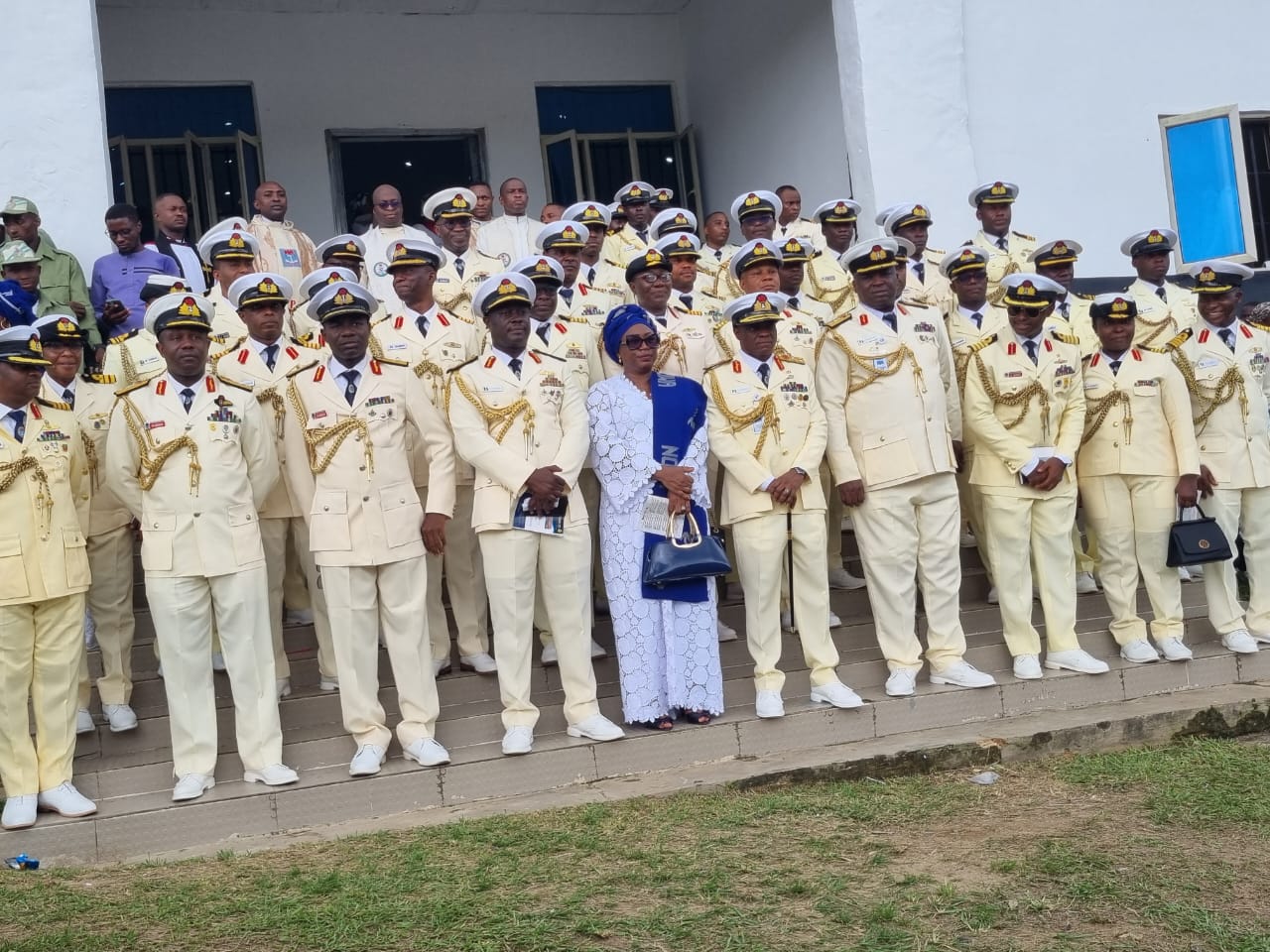
The rhythmic hum of patrol boats cutting through the Gulf of Guinea’s turquoise waters has long been the soundtrack to Nigeria’s economic heartbeat. But as the country’s oil and gas assets face mounting threats—from piracy to sabotage—the Nigerian Navy is turning up the volume on its security operations. In a bold declaration made during a landmark interdenominational service celebrating the 70th anniversary of the naval force, Vice Admiral Idi Abbas sent a clear message: Nigeria’s energy lifelines will no longer be left vulnerable.
Speaking at the Navy Protestant chapel in Calabar, the Chief of Naval Staff didn’t mince words. “The protection of our oil and gas infrastructure is not just a military obligation—it is a national imperative,” he stated, his voice resonating through the hall. The pledge comes at a time when Africa’s largest economy is grappling with the dual pressures of plummeting global oil prices and escalating security challenges in its maritime domain. With billions of naira in revenue hanging in the balance, the stakes couldn’t be higher.

Nigeria’s oil and gas sector, which accounts for over 90% of the country’s export earnings, has become a magnet for criminal syndicates seeking to exploit weak points in the supply chain. In recent months, reports of illegal bunkering, pipeline vandalism, and armed attacks on offshore platforms have surged, prompting urgent calls for a more robust naval presence. The Nigerian Navy, already stretched thin by its peacekeeping commitments in West Africa, is now doubling down on its surveillance capabilities, deploying advanced radar systems and unmanned aerial vehicles to monitor the vast expanse of the Niger Delta’s waterways.
But the challenges are not just external. Internal dynamics within the region add another layer of complexity. The Niger Delta, home to the country’s oil wealth, has long been a hotbed of militancy, with armed groups demanding greater resource control and economic justice. While the federal government has made strides in amnesty programs and development initiatives, the scars of past conflicts linger. “We cannot afford to repeat the mistakes of the past,” a senior naval officer, who requested anonymity, told reporters. “This is about more than just securing pipelines—it’s about restoring trust and stability in a region that has borne the brunt of decades of neglect.”

Why Nigeria’s Energy Security Matters for Africa
The stakes extend far beyond Nigeria’s borders. As Africa’s largest oil producer, the country plays a pivotal role in stabilizing global energy markets. Disruptions in Nigerian supply can send ripples across the continent, affecting everything from fuel prices in neighboring Benin and Togo to the economic fortunes of landlocked nations like Niger and Chad. The Economic Community of West African States (ECOWAS) has repeatedly warned that maritime insecurity in the Gulf of Guinea could undermine regional integration efforts, stifling trade and investment.
Moreover, the crisis in Nigeria’s energy sector comes at a critical juncture for Africa’s energy transition. While the continent races to diversify its energy mix with renewables, oil and gas remain the backbone of many economies. Nigeria, with its vast reserves and strategic location, is uniquely positioned to lead this transition—but only if its infrastructure is secure. “Africa cannot afford to gamble with its energy future,” said Dr. Ngozi Okonjo-Iweala, former Nigerian finance minister and current Director-General of the WTO. “The security of our oil and gas assets is inextricably linked to our ability to fund development, create jobs, and lift millions out of poverty.”
The Navy’s New Playbook: Technology and Community Engagement
To tackle the multifaceted threat, the Nigerian Navy is adopting a two-pronged strategy: technological innovation and community collaboration. On the technological front, the force is rolling out a $500 million modernization program funded by the federal government and international partners. The upgrades include state-of-the-art sonar systems, AI-driven threat detection software, and satellite-linked command centers capable of tracking vessels in real time. “We’re moving from a reactive force to a predictive one,” explained a naval engineer involved in the project. “Every vessel entering Nigerian waters will now be scanned, logged, and assessed before it even comes into view.”
But technology alone won’t solve the problem. The Navy is also ramping up its community engagement initiatives, partnering with local leaders, fishermen, and youth groups to create a network of “eyes and ears” along the coast. In the creeks of the Niger Delta, where the terrain is as treacherous as it is remote, traditional rulers are being trained to report suspicious activities to naval authorities. “The people who live here know these waters better than anyone,” said Chief Emeka Nwosu, a community leader in Bayelsa State. “If they see something unusual, they’ll call us before the criminals even have a chance to act.”
The approach mirrors successful models used in other high-risk maritime zones, such as the Strait of Malacca and the Gulf of Aden, where community policing has proven instrumental in reducing piracy. However, analysts caution that Nigeria’s efforts must be accompanied by broader economic reforms to address the root causes of instability. “Security is only half the battle,” said Dr. Funmi Olonisakin, a security expert at King’s College London. “Without inclusive growth and equitable resource distribution, the cycle of violence will persist.”

The Regional Response: ECOWAS and Beyond
Nigeria’s security challenges have galvanized action across West Africa. In a recent summit held in Abuja, ECOWAS leaders approved a $200 million fund to bolster maritime security in the Gulf of Guinea. The initiative, dubbed the “ECOWAS Integrated Maritime Security Strategy,” aims to harmonize naval patrols, share intelligence, and prosecute offenders under a unified legal framework. “This is not just Nigeria’s fight—it’s a regional fight,” said ECOWAS Commission President Omar Touray. “We must stand together or fall apart.”
Neighboring countries are also stepping up their game. Ghana, which shares a maritime border with Nigeria, has deployed additional patrol vessels to its western flank, while Cameroon has intensified joint exercises with Nigerian forces. Even non-coastal nations like Mali and Burkina Faso, which rely on Nigerian oil for their energy needs, have pledged support, recognizing that instability in one part of the region threatens all.
Yet, challenges remain. Corruption, underfunding, and bureaucratic inefficiencies continue to hamper regional cooperation. In 2025, a report by Transparency International revealed that nearly 30% of funds allocated for maritime security in West Africa never reached their intended targets. “We cannot talk about security without talking about governance,” said a senior ECOWAS official, who spoke on condition of anonymity. “If we don’t clean up our institutions, no amount of technology or funding will save us.”
What’s Next for Nigeria’s Energy Sector?
The coming months will be critical for Nigeria as it seeks to balance security imperatives with economic recovery. The federal government has already approved a supplementary budget of $1.2 billion to fast-track the deployment of the Navy’s new surveillance systems, with the first phase expected to be operational by the end of 2026. Meanwhile, international oil companies operating in the Niger Delta are being urged to enhance their own security protocols, including the use of private maritime security firms and satellite monitoring.
For the millions of Nigerians who depend on the oil and gas sector for their livelihoods, the stakes could not be clearer. “This isn’t just about protecting pipelines—it’s about protecting our future,” said Aisha Mohammed, a market trader in Port Harcourt. “If the oil stops flowing, our children go hungry. It’s that simple.”
As the Nigerian Navy charts its course forward, one thing is certain: the eyes of Africa—and the world—are watching. The success or failure of this mission will shape not just Nigeria’s economic trajectory, but the stability of an entire region. And in a world where energy security is synonymous with national security, there is no room for failure.

The Human Cost of Inaction
Behind the strategic maneuvers and budget allocations lie the human stories that often go untold. In the creeks of the Niger Delta, communities that once thrived on fishing and farming now struggle to survive amid the constant threat of violence. Children in these areas grow up knowing the sound of gunfire better than the sound of a classroom bell. Women, who traditionally manage local markets, find their livelihoods disrupted by roadblocks and curfews imposed by militant groups and security forces alike.
A recent survey by the National Bureau of Statistics revealed that over 60% of households in the Niger Delta have experienced some form of economic hardship due to insecurity in the past year. “We are not just fighting for oil—we are fighting for dignity,” said Mrs. Ifeoma Okoro, a community health worker in Warri. “When the pipelines are bombed, it’s not just the pipes that break—it’s our hope.”
The Nigerian Navy’s pledge to tighten security around oil and gas assets is more than a military strategy—it is a lifeline for millions. But as Vice Admiral Abbas himself acknowledged during the 70th-anniversary service, true security will require more than just patrols and technology. It will demand political will, regional unity, and a commitment to addressing the grievances that have fueled instability for generations. Only then can Nigeria—and Africa—hope to turn the tide on this crisis and secure a future where energy wealth translates into shared prosperity.

Topix News Desk is a digital editorial team focused on delivering clear, timely, and useful news coverage for readers worldwide. Our reporting highlights African news with global context, including politics, business, economy, technology, health, sports, entertainment, travel, and culture. We aim to publish accessible, well-structured, and informative articles that help readers understand the stories shaping Africa and the world.