
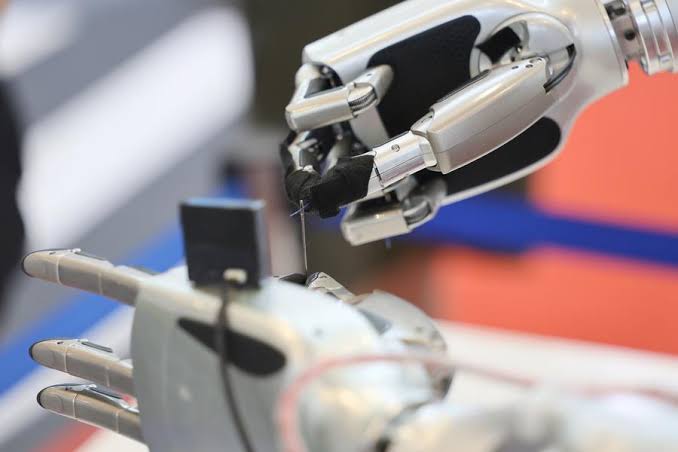
The hum of factory floors in Shenzhen, once dominated by the clatter of manual assembly lines, now echoes with the quiet precision of machines that learn, adapt, and decide. China’s relentless march toward embodied artificial intelligence isn’t just a technological milestone—it’s a tectonic shift that could redefine the global innovation landscape, with ripple effects felt from Lagos to Nairobi. As Beijing accelerates its AI ambitions, the question on the lips of policymakers and entrepreneurs across Africa is no longer *if* this wave will reach the continent, but *how* to ride it before the opportunity slips away.
From Factories to Futures: The AI Revolution Taking Shape in China
Embodied AI—systems that interact with the physical world through sensors, robots, and autonomous machines—is the next frontier of technological evolution. Unlike its digital-only predecessors, this breed of AI doesn’t just crunch data; it *moves through the world*. China’s manufacturing might, long the backbone of its economic ascent, has become the perfect proving ground. Factories that once relied on human hands now deploy AI-driven robots that optimize production lines in real time, predict maintenance needs before machines fail, and even collaborate with human workers in seamless harmony.

The numbers tell a story of exponential growth. By 2026, China’s AI market is projected to surpass $150 billion, with embodied AI accounting for a significant slice of that pie. What makes this expansion remarkable isn’t just the scale—it’s the *ecosystem* China has built to support it. Traditional manufacturers, hungry for efficiency, are merging with cutting-edge tech firms in a symbiotic dance. The result? A full-chain manufacturing base where raw materials, design, production, and distribution are all interconnected by AI-driven intelligence. This isn’t just automation; it’s a reimagining of industry itself.
But China’s AI ambitions extend beyond its borders. The country has aggressively pursued international partnerships, sharing datasets and collaborating on projects that blur the lines between domestic innovation and global influence. For African nations watching from the sidelines, this presents a paradox: an opportunity to leapfrog decades of industrial lag, tempered by the risk of becoming mere consumers of foreign technology rather than co-creators.
The African Equation: Can the Continent Keep Pace?
Africa’s relationship with technological leapfrogging isn’t new. Mobile money revolutionized financial inclusion; solar power bypassed unreliable grids; and digital platforms connected millions to markets and services in ways unimaginable a generation ago. Yet when it comes to embodied AI, the stakes are higher. The continent’s manufacturing sector, though growing, still grapples with infrastructure gaps, skills shortages, and regulatory hurdles. Can Africa afford to miss this wave—or will it be swept away by it?
Consider Nigeria, where small and medium enterprises (SMEs) contribute nearly half of the country’s GDP. For these businesses, the rise of embodied AI could mean the difference between stagnation and survival. Imagine a Lagos-based textile manufacturer deploying AI-driven looms that adjust to market demand in real time, reducing waste and boosting profits. Or a Nairobi-based agribusiness using autonomous drones to monitor crop health across vast fields, ensuring food security in a climate of uncertainty. The potential is staggering—but so are the challenges.
Governments and private sector leaders are beginning to take note. Rwanda’s Kigali Innovation City, for instance, has positioned itself as a hub for AI research and development, attracting global talent and investment. Meanwhile, South Africa’s Council for Scientific and Industrial Research (CSIR) is investing in robotics and automation to revitalize its manufacturing sector. Yet these efforts remain fragmented. Without a cohesive continental strategy—one that prioritizes education, infrastructure, and policy alignment—Africa risks falling into a new kind of dependency, where its economic future is shaped by decisions made in Beijing, Silicon Valley, or Brussels.
Datasets and Diplomacy: The Geopolitics of AI Collaboration
China’s push for open, co-creative ecosystems in AI isn’t just about technology; it’s about influence. By sharing datasets and fostering international collaborations, Beijing is positioning itself as a leader in the global AI race. For African countries, this presents a delicate balancing act. On one hand, partnerships with China could accelerate technological adoption and economic growth. On the other, they risk deepening reliance on a single foreign power for critical infrastructure and innovation.
The implications are particularly acute in sectors like healthcare and agriculture, where AI-driven solutions could transform lives. In Ethiopia, for example, AI-powered diagnostic tools are being tested to combat rural healthcare shortages. In Ghana, startups are exploring AI to optimize cocoa production, the backbone of the country’s economy. But as these projects scale, questions arise: Who owns the data? Who controls the algorithms? And how can African nations ensure that the benefits of these technologies accrue to their citizens rather than being siphoned off by external entities?
This is where the conversation shifts from *adoption* to *ownership*. Africa’s tech ecosystem must move beyond being a passive recipient of foreign innovation to becoming an active participant in its creation. That means investing in local AI research, nurturing homegrown talent, and developing ethical frameworks that prioritize transparency and accountability. It also means diversifying partnerships—not just with China, but with Europe, the Americas, and other African nations—to avoid the pitfalls of over-reliance on a single ally.
China’s embodied AI revolution is a wake-up call for Africa. The continent has a choice: double down on its strengths—its youthful population, its entrepreneurial spirit, and its untapped resources—or cede ground to those who will dictate the terms of the next industrial era.
The Human Factor: Skills, Jobs, and the AI Divide
Amid the excitement over AI’s potential, a sobering reality looms: the jobs of tomorrow may not resemble those of today. As embodied AI systems take over repetitive and dangerous tasks, entire industries will transform. For Africa, where youth unemployment hovers around 20% in many countries, this presents both a threat and an opportunity. The threat is clear: if African workers aren’t equipped with the skills to work alongside AI, they risk being left behind. The opportunity? To create entirely new categories of employment—roles that blend human creativity with machine intelligence, from AI-assisted design to robotics maintenance.
Education will be the great equalizer—or the great divider. Vocational training programs, coding bootcamps, and university partnerships must pivot to meet the demands of an AI-driven economy. Countries like Kenya and Mauritius are already making strides, with initiatives like the African Institute for Mathematical Sciences (AIMS) and the Rwanda Coding Academy producing the next generation of tech leaders. But the scale of the challenge is immense. Millions of young Africans need access to affordable, high-quality education that prepares them for a world where AI is as ubiquitous as electricity.
There’s also the question of cultural adaptation. AI systems trained on Western datasets may not perform optimally in African contexts—whether it’s language barriers, local customs, or unique environmental challenges. African researchers and engineers must lead the development of AI solutions tailored to the continent’s needs, ensuring that technology serves as a tool for empowerment rather than erasure.
Infrastructure: The Silent Backbone of AI Ambitions
No technological revolution, no matter how groundbreaking, can succeed without the right infrastructure. For embodied AI to thrive in Africa, the continent must address its digital divide head-on. Reliable electricity, high-speed internet, and robust cloud computing capabilities are non-negotiable. Yet in many parts of the continent, these remain luxuries. According to the International Energy Agency, nearly 600 million Africans still lack access to electricity. How can AI-driven industries flourish in such an environment?
The answer lies in a two-pronged approach: leapfrogging outdated infrastructure and building new systems from the ground up. Renewable energy sources like solar and wind are already transforming energy access in rural areas. Meanwhile, initiatives like the African Development Bank’s *New Deal on Energy for Africa* aim to close the continent’s power gap by 2030. But infrastructure isn’t just about hardware; it’s about policy. Governments must streamline regulations, reduce bureaucratic red tape, and create incentives for private sector investment in tech infrastructure. Only then can Africa truly compete in the AI arena.
Another critical piece of the puzzle is data localization. As embodied AI systems rely on vast datasets to function, African nations must ensure that their data is stored, processed, and governed within their borders. This isn’t just about protecting privacy—it’s about retaining control. Without data sovereignty, African countries risk becoming mere data colonies, feeding the algorithms of foreign powers while losing the ability to shape their own digital futures.
Ethics and Equity: Ensuring AI Works for All Africans
The promise of embodied AI is undeniable, but so are the risks. Algorithmic bias, privacy violations, and the concentration of power in the hands of a few are real concerns. In a continent where colonial legacies still cast long shadows, the last thing Africa needs is another form of technological extraction. Ethical AI isn’t just a buzzword; it’s a necessity.
African policymakers and civil society groups are already sounding the alarm. In 2025, the African Union adopted the *African Union Data Policy Framework*, which emphasizes the importance of ethical data governance and digital rights. Meanwhile, organizations like *AfriCHI* are advocating for inclusive design practices that center African perspectives. But progress is slow, and the pace of AI development shows no signs of slowing down. The time to act is now.
One area of particular concern is surveillance. As embodied AI systems become more pervasive, so too does the potential for misuse. Governments and corporations could leverage these technologies to monitor citizens, suppress dissent, or manipulate public opinion. Africa has seen firsthand the dangers of unchecked surveillance—from colonial-era censorship to modern-day digital authoritarianism. The continent must establish robust legal frameworks to prevent AI from becoming a tool of oppression rather than liberation.
A Call to Action: What Africa Must Do Next
The road ahead is fraught with challenges, but the stakes couldn’t be higher. Africa stands at a crossroads: will it be a spectator in the AI revolution, or will it seize the moment to redefine its economic and technological future? The answer lies in three critical steps:
- Invest in human capital: From coding schools to university partnerships, Africa must equip its youth with the skills to thrive in an AI-driven world. This means not just technical training, but also critical thinking and ethical reasoning to navigate the complexities of a digital future.
- Build resilient infrastructure: Reliable energy, high-speed internet, and local data centers are the backbone of any AI ecosystem. Without them, the continent will remain on the sidelines of the global tech revolution.
- Demand equity and transparency: African nations must advocate for fair partnerships, data sovereignty, and ethical AI practices. This means engaging in global dialogues, pushing for inclusive policies, and holding both local and foreign actors accountable.
China’s embodied AI push is a reminder that the future isn’t something that happens *to* Africa—it’s something Africa must shape for itself. The continent has the talent, the resources, and the resilience to lead. What it needs now is the vision to seize the moment.
As the sun sets over the skyline of Addis Ababa or the bustling markets of Accra, the question lingers: Will Africa be a consumer of AI, or its architect? The choice will determine not just the continent’s economic trajectory, but its place in the world for generations to come. The AI revolution is here. The question is, will Africa ride the wave—or drown beneath it?
For those willing to take the leap, the rewards could be transformative. For those who hesitate, the cost may be far greater than they imagine.
The Bottom Line: Africa’s AI Moment
China’s embodied AI ambitions are a clarion call for Africa. The continent has a narrow window to position itself as a leader in this new era—not as a bystander, but as an innovator. The ingredients for success are already in place: a young, dynamic population; a growing tech ecosystem; and a deep well of untapped potential. What’s missing is the collective will to act.
African governments must prioritize AI in their national development strategies. Private sector leaders must invest in homegrown solutions. And civil society must hold power to account, ensuring that technology serves the people, not the other way around. The stakes are high, but the rewards are higher. In the race to define the future of embodied AI, Africa cannot afford to be a spectator.
The time to act is now. The future is being written today—and Africa must have a seat at the table.
Copyright notice: Images and source material are credited to their respective owners/source (original source where available). If you are the copyright owner and want an image or content removed, please contact us at topix.news/contact-us; we will review and remove it promptly.

Topix News Desk is a digital editorial team focused on delivering clear, timely, and useful news coverage for readers worldwide. Our reporting highlights African news with global context, including politics, business, economy, technology, health, sports, entertainment, travel, and culture. We aim to publish accessible, well-structured, and informative articles that help readers understand the stories shaping Africa and the world.