
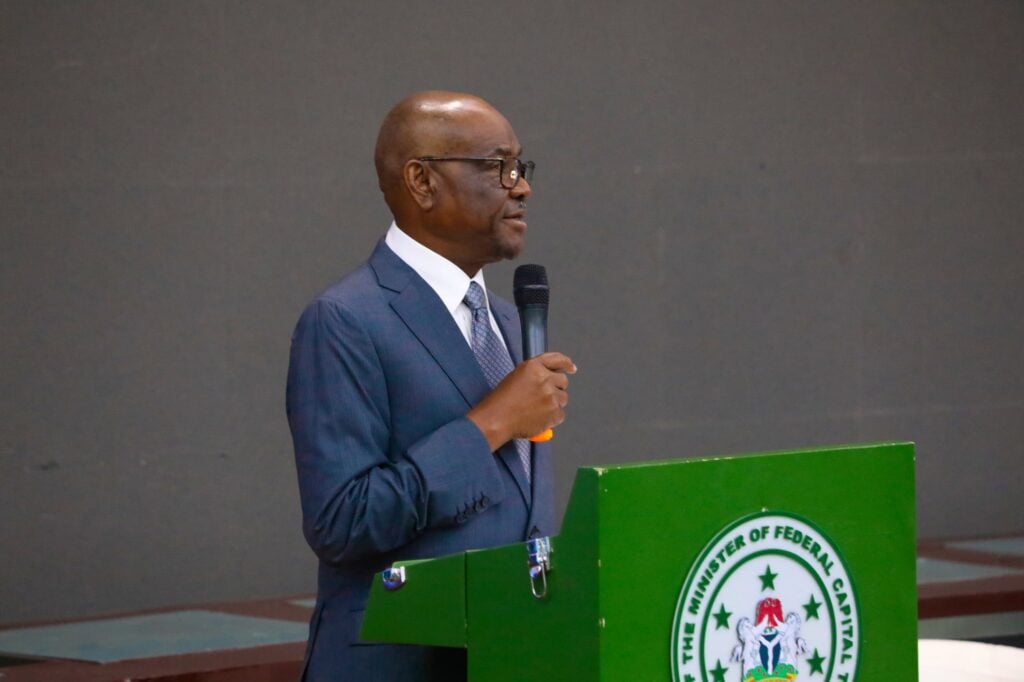
In the high-stakes chessboard of Nigerian politics, Rivers State has long been a battleground where loyalty and power collide. But as the 2027 elections loom, a surprising narrative is unfolding—one that suggests Rivers may have no choice but to rally behind President Bola Tinubu’s reelection bid. The man driving this shift is none other than Nyesom Wike, the Federal Capital Territory Minister, whose recent remarks have sent ripples through the Niger Delta’s political establishment.

Wike’s argument isn’t rooted in blind allegiance. Instead, it’s a calculated assessment of Rivers State’s economic and infrastructural fortunes under Tinubu’s administration. Since 2023, the state has witnessed a surge in federal allocations, accelerated road construction projects, and unprecedented investments in healthcare and education. These tangible gains, Wike contends, make continued support for Tinubu not just strategic but necessary for Rivers’ survival in a rapidly changing political climate.
From Friction to Alignment: The Unlikely Reconciliation
Rivers State’s relationship with the federal government has been fraught with tension for years. The state’s political elite, led by former Governor Wike himself, once stood as fierce opponents of the All Progressives Congress (APC). Yet today, the narrative has flipped. The shift isn’t merely political—it’s economic. Federal projects worth billions of naira now crisscross the state, from the expanded Port Harcourt-Maiduguri highway to the revamped Rivers State University Teaching Hospital. These developments, Wike argues, are too significant to ignore.

Critics, however, remain skeptical. They point to the state’s historical marginalization under past administrations and question whether Tinubu’s government has truly prioritized Rivers’ interests. But Wike’s response is blunt: “Rivers has never had it this good. The numbers don’t lie.” He cites data showing a 40% increase in federal infrastructure funding to the state since 2023, alongside a 25% rise in allocations for education and healthcare. Whether these figures tell the full story is debatable, but their impact on public perception is undeniable.
The Opposition’s Dilemma: Can Rivers Afford to Turn Back?
The political opposition in Rivers State faces a daunting challenge. With the APC’s machinery now firmly entrenched in the state’s governance, any attempt to reverse course could risk alienating key stakeholders who have benefited from recent federal investments. The People’s Democratic Party (PDP), once the dominant force in Rivers, now finds itself playing catch-up in a game where the rules have been rewritten.
For the opposition, the dilemma is clear: Do they double down on resistance, risking further isolation, or do they adapt to the new reality? Wike’s stance suggests the latter is the only viable path. “Politics is about survival,” he recently remarked. “And in Rivers, survival now means playing by the rules of the game as they exist today.”
This isn’t just about federal projects, either. The state’s security landscape has also shifted. With Tinubu’s administration investing heavily in the Niger Delta’s security architecture, Rivers has seen a marked reduction in militant activities and pipeline vandalism. For a state that once bore the brunt of economic sabotage, these developments are nothing short of transformative. The question now is whether Rivers’ political class can reconcile these gains with their long-standing grievances against the federal government.
The Economic Imperative: Why Rivers Can’t Afford to Walk Away
At the heart of Wike’s argument lies a simple truth: Rivers State’s economy is inextricably linked to the federal government’s policies. The state’s oil and gas sector, its primary revenue source, operates under licenses and regulations set by Abuja. When the federal government approves new exploration deals or adjusts subsidy policies, Rivers feels the impact immediately. In this context, political alignment isn’t just a matter of ideology—it’s a matter of economic survival.
Consider the state’s recent push for the establishment of a federal refinery in Rivers. For years, local leaders have demanded greater control over their resources, but progress has been glacial. Under Tinubu, however, the project has gained serious traction, with feasibility studies already underway. If realized, this refinery could generate thousands of jobs and billions in revenue for the state. The message is clear: Rivers’ future prosperity depends on its ability to navigate the federal government’s priorities—not resist them.
Yet, the economic argument cuts both ways. Critics warn that Rivers’ growing dependence on federal largesse could erode its autonomy. They point to other Niger Delta states that have seen their local industries wither under the weight of federal patronage. Will Rivers follow the same path, or can it strike a balance between cooperation and self-determination? The answer may well determine the state’s political trajectory for decades to come.
The 2027 Elections: A Test of Loyalty and Strategy
As Nigeria gears up for the 2027 elections, Rivers State finds itself at a crossroads. The APC’s dominance in the state is undeniable, but the PDP isn’t going down without a fight. The opposition’s strategy will likely hinge on two fronts: mobilizing grassroots support and exposing perceived federal failures. Yet, with Wike’s vocal endorsement of Tinubu, the APC has gained a powerful ally—one whose influence in Rivers is second only to the state’s governor.
For the PDP, the challenge is twofold. First, they must counter Wike’s narrative with their own vision for Rivers’ future. Second, they must reconcile their past opposition to the APC with the reality of the state’s new political landscape. It’s a delicate balancing act, one that could define the party’s relevance in the Niger Delta for years to come.
Meanwhile, Tinubu’s camp is keenly aware of the symbolic importance of Rivers’ support. The state’s 2023 election results were a major talking point, with the APC securing a slim victory amid allegations of irregularities. A repeat performance in 2027 could solidify Tinubu’s reelection bid, while a PDP resurgence could reignite old tensions. The stakes couldn’t be higher.
For Rivers’ electorate, the choice may come down to pragmatism over principle. With federal projects reshaping the state’s infrastructure, many voters may prioritize immediate economic benefits over long-standing political grievances. This shift in public sentiment could be the final nail in the coffin for the PDP’s traditional stronghold in the region.
Beyond Politics: The Human Impact of Federal Investments
The debate over Rivers’ political alignment isn’t just a matter of party loyalty—it’s about real lives and livelihoods. Take the case of Chima Okonkwo, a 34-year-old mechanic in Port Harcourt. For years, his workshop struggled to stay afloat due to erratic power supply and high fuel costs. But in 2024, the federal government’s intervention in the state’s power sector brought a new transformer to his neighborhood, slashing his electricity bills by half. “I don’t care who’s in power,” Okonkwo says. “I just care about the light staying on.”
Stories like Okonkwo’s are playing out across Rivers State. From farmers benefiting from new irrigation projects to students gaining access to better-equipped schools, the tangible effects of federal investments are impossible to ignore. For many residents, the question isn’t about political ideology—it’s about survival. And in that context, Wike’s argument carries significant weight.
Yet, the human impact isn’t uniformly positive. Critics argue that federal projects often come with strings attached, favoring certain contractors and political allies over local communities. They point to the controversial awarding of road contracts to firms with ties to the APC as evidence of a system rigged in favor of the ruling party. For these skeptics, Rivers’ newfound alignment with Tinubu’s government is less about progress and more about political patronage.
The Road Ahead: Can Rivers Find Its Own Path?
As Rivers State navigates this period of political realignment, one question looms large: Can the state carve out its own identity within the framework of federal dominance? The answer may lie in the balance between cooperation and resistance. On one hand, Rivers must leverage its strategic importance to secure maximum benefits from Abuja. On the other, it must guard against becoming a mere extension of the federal government’s agenda.
For Wike, the path forward is clear. “Rivers has always been a state of possibilities,” he asserts. “And under this administration, those possibilities are finally becoming realities.” Whether this vision holds true for all residents remains to be seen. But one thing is certain: the political calculus in Rivers has changed, and with it, the state’s role in Nigeria’s broader power dynamics.
As the 2027 elections approach, all eyes will be on Rivers State. Will it solidify its alliance with Tinubu’s APC, or will the opposition mount a surprising comeback? Whatever the outcome, one thing is clear: Rivers’ political future will be shaped not just by the choices of its leaders, but by the aspirations of its people—and the promises of a federal government that has finally begun to deliver on its commitments.
Copyright notice: Images and source material are credited to their respective owners/source (original source where available). If you are the copyright owner and want an image or content removed, please contact us at topix.news/contact-us; we will review and remove it promptly.

Topix News Desk is a digital editorial team focused on delivering clear, timely, and useful news coverage for readers worldwide. Our reporting highlights African news with global context, including politics, business, economy, technology, health, sports, entertainment, travel, and culture. We aim to publish accessible, well-structured, and informative articles that help readers understand the stories shaping Africa and the world.