

Introduction: The Dual Role of Multinationals in Africa’s Environmental Crisis
As environmental degradation intensifies in developing regions, multinational corporations (MNCs) occupy a paradoxical position—potential agents of sustainable transformation or accelerators of ecological harm. While these firms are often hailed for their capacity to introduce cleaner technologies and sustainable practices to emerging economies, a growing body of evidence suggests they may also exacerbate environmental degradation by relocating polluting industries to regions with weaker regulatory frameworks. Africa, in particular, faces a stark dilemma: its vast natural resources and economic potential make it a prime target for foreign investment, yet the continent’s environmental systems are increasingly under siege due to industrial expansion.
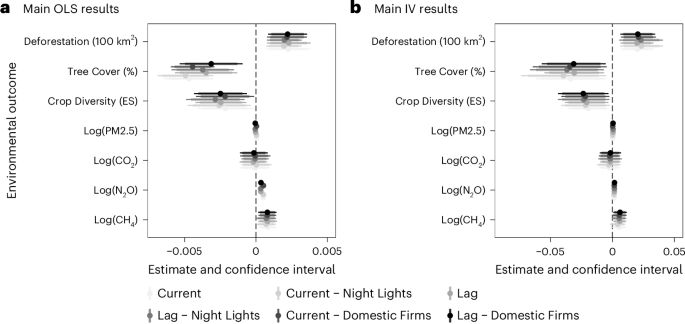
A groundbreaking study, published in Nature Climate Change, examines the geospatial and economic impacts of multinational firms in Africa over a decade (2007–2018). Using proprietary firm-level data from Moody’s Orbis—a comprehensive database of millions of companies—researchers quantified how MNCs contribute to forest loss, crop diversity erosion, and greenhouse gas (GHG) emissions, while also comparing their environmental footprint to that of domestic firms. The findings reveal a troubling reality: multinational activity correlates with severe ecological degradation, far surpassing the impact of locally owned enterprises.
Key Findings: How Multinationals Reshape Africa’s Environment
1. Accelerated Deforestation and Forest Cover Loss
Africa’s forests, critical for carbon sequestration, biodiversity, and climate resilience, are under unprecedented pressure. The study’s high-resolution geospatial analysis reveals that the expansion of multinational corporate activity is directly linked to significant deforestation across the continent.
Map A: Mean levels of tree cover loss in Africa (2007–2018), highlighting regions with the highest multinational corporate presence. Darker shades indicate greater deforestation.
The data underscores that MNCs are not merely passive observers of environmental decline—they are active contributors. Unlike domestic firms, which may operate on smaller scales with localized impacts, multinationals often drive large-scale land acquisitions for agriculture, mining, and infrastructure projects. These activities fragment ecosystems, disrupt wildlife corridors, and reduce forest carbon sinks.
A 2020 study in Nature Geoscience further corroborates this trend, demonstrating that large-scale land acquisitions—often facilitated by foreign investors—enhance tropical forest loss by displacing traditional land uses. In regions like the Congo Basin and West Africa, where MNCs dominate timber and palm oil industries, satellite imagery shows alarming rates of deforestation coinciding with corporate expansion.
2. Erosion of Agricultural Biodiversity: A Silent Ecological Crisis
Beyond deforestation, the study highlights how multinational corporate influence undermines agricultural biodiversity, a cornerstone of food security and ecosystem stability. Monoculture farming—frequently imposed by MNCs through supply chain contracts—reduces genetic diversity in staple crops, making agricultural systems more vulnerable to pests, climate shocks, and nutritional deficiencies.
Map B: Air pollution (PM2.5 concentrations) in Africa, with superimposed data on multinational firm density. Higher pollution levels correlate with regions hosting major industrial MNC operations.
Research from the NBER (2017) and Nature (2019) confirms that crop diversity declines when agricultural land is consolidated under corporate control. In South Africa, for instance, large-scale commercial farming—often driven by foreign investors—has led to a 30% reduction in indigenous crop varieties over the past two decades. This shift not only threatens nutritional stability (as documented in Nature Communications, 2021) but also reduces soil resilience, increasing the need for chemical inputs and further degrading ecosystems.
3. Greenhouse Gas Emissions: The Hidden Carbon Footprint of Multinationals
While many MNCs market themselves as sustainability leaders, the study reveals that foreign-owned firms in Africa contribute disproportionately to GHG emissions. Unlike domestic enterprises, which may adhere to local environmental standards (however weak), multinationals often exploit regulatory loopholes in host countries, leading to higher energy intensity and emissions per unit of output.
Graph: Comparison of GHG emissions intensity between multinational and domestic firms in Africa (2007–2018). Multinationals exhibit significantly higher emissions per dollar of revenue.
A 2023 World Bank report on the Belt and Road Initiative (BRI) found similar patterns, where foreign-backed infrastructure projects increased carbon emissions by 20–30% due to inefficient energy practices. In Africa, this dynamic is exacerbated by mining and oil extraction—sectors where MNCs dominate but face minimal enforcement of environmental safeguards.
Why Multinationals Have a Greater Environmental Impact Than Domestic Firms
The study’s most striking revelation is that the environmental harm caused by MNCs far exceeds that of domestic companies. Several factors explain this disparity:
-
Scale and Scope of Operations
Multinationals typically operate across multiple sectors and regions, leading to cumulative environmental damage that domestic firms cannot match. For example, a single MNC may control entire supply chains—from deforestation for cattle ranching to industrial agriculture—while local firms operate in isolated, smaller-scale markets. -
Weaker Regulatory Oversight
Developing countries often lack the institutional capacity to enforce environmental laws against MNCs. A 2017 study in the American Economic Review found that mining companies with foreign ownership in Africa pollute water sources at rates 40% higher than locally owned firms due to lower compliance costs. -
Supply Chain Externalities
MNCs frequently outsource production to subcontractors, many of which operate in legal gray areas. A 2023 Environmental Research Letters study on Ivorian cocoa supply chains revealed that foreign-owned agribusinesses indirectly drive deforestation by pressuring smallholders to clear forests for cocoa plantations. -
Technology and Innovation Gaps
While MNCs are often credited with transferring green technologies, the study found that many African-hosted MNCs adopt “brown” technologies (high-emission, resource-intensive processes) due to lower operational costs. A 2019 Journal of International Economics paper showed that foreign-owned factories in Africa use 25% more energy per unit of output than domestic ones.
The Pollution Haven Hypothesis: Does Africa Become a “Dumping Ground”?
The concept of the “pollution haven”—where MNCs relocate dirty industries to countries with lax environmental standards—has been debated for decades. Early research (e.g., Eskeland & Harrison, 2003) suggested that developing nations might attract polluting industries, but newer evidence from Africa suggests a more nuanced reality:
- Some MNCs do exploit weak regulations, leading to higher local pollution (e.g., PM2.5 levels spike near multinational mining sites, as seen in
 ).
). - However, others bring limited green technology transfers, meaning the environmental benefits are not proportional to the harm caused.

Satellite-derived PM2.5 pollution hotspots in Africa, with overlaid multinational firm locations. Darker red areas indicate regions where MNCs correlate with elevated air pollution.
A 2024 HAL Open Science study on water pollution from mining leaks in Africa found that foreign-owned mines were three times more likely to contaminate drinking water sources than local operations. This reinforces the idea that MNCs do not necessarily “clean up” industries—they often relocate the worst offenders.
Policy Implications: Can Africa Mitigate the Environmental Cost of Foreign Investment?
The study does not present a bleak outlook without hope. Several policy interventions could help Africa harness foreign investment while minimizing ecological damage:
- Stronger Environmental Enforcement
- Mandatory environmental impact assessments (EIAs) for all foreign direct investment (FDI) projects.
- Stricter penalties for non-compliance, including financial sanctions and project revocation (as seen in EU-Mercosur trade disputes).
-
Independent oversight bodies to monitor MNC compliance (e.g., Africa’s proposed “Green Growth Commission”).
-
Green Technology Mandates
- Requiring MNCs to adopt low-carbon technologies (e.g., renewable energy in mining operations).
-
Subsidizing green innovation for foreign firms to incentivize sustainability (similar to China’s “Made in China 2025”).
-
Supply Chain Transparency
- Mandatory deforestation-free supply chain policies (as proposed in the EU Deforestation Regulation).
-
Blockchain-based tracking of raw materials (e.g., cocoa, timber, minerals) to prevent indirect land-use change.
-
Carbon Border Adjustments
- Taxing high-emission imports from countries with weak climate policies (as discussed in 2022 Conversation analysis).
-
Rebating carbon revenues to host nations to offset leakage risks.
-
Local Capacity Building
- Training African firms in sustainable practices to reduce reliance on foreign expertise.
- Supporting cooperative models where MNCs partner with local communities (e.g., fair-trade certifications).
Methodological Rigor: How the Study Was Conducted
The research leveraged proprietary firm-level data from Moody’s Orbis, combined with satellite imagery (Copernicus Land Cover Service), air quality models (van Donkelaar et al., 2021), and crop diversity datasets (You et al., 2014). Key analytical approaches included:
- Geospatial regression models to link MNC presence with forest cover loss.
- Difference-in-differences (DiD) analysis to isolate the causal impact of multinational expansion.
- Event studies to track emissions changes before and after MNC entry.

Figure: Share of multinational firms in economic activities (NACE Section 56) across Africa. The chart shows that agriculture, mining, and manufacturing—sectors with high environmental risks—are dominated by foreign ownership.
Limitations and Data Constraints
While the study provides unprecedented insights, it acknowledges data privacy restrictions. The proprietary nature of Moody’s Orbis prevented full public sharing of firm-level identifiers, though replication materials (including R code and anonymized datasets) are available via Figshare (DOI: 10.6084/m9.figshare.31242547).
Broader Global Context: Africa’s Role in the Global Environmental Debate
Africa’s environmental challenges are not isolated—they reflect global trade dynamics where resource-rich nations often bear the brunt of industrial pollution. Recent studies highlight:
- The “Green Paradox”: Countries with stronger climate policies may lose FDI to nations with weaker regulations (Fischer & Fox, 2012).
- Supply Chain Leakage: Even “green” MNCs indirectly contribute to deforestation through commodity demand (e.g., palm oil, beef, and cocoa, as seen in Zu Ermgassen et al., 2022).
- Conflict and Resource Exploitation: Mining and oil extraction by MNCs have been linked to increased violence in regions like the DRC and Nigeria (Berman et al., 2017).

Infographic: The “Environmental Trade-Off” in Africa. Multinationals bring capital but often at the cost of ecological degradation, biodiversity loss, and increased emissions.
Conclusion: A Call for Responsible Globalization
The evidence is clear: multinational corporations in Africa are not neutral actors—they actively shape environmental outcomes, often for the worse. While foreign investment is essential for economic growth, unregulated corporate expansion risks turning Africa into a “sacrifice zone” for global industry.
The solution lies in smart policy design:
✅ Stronger environmental laws with teeth.
✅ Green technology mandates for MNCs.
✅ Supply chain transparency to prevent indirect harm.
✅ Rebalancing power dynamics so that local communities benefit from foreign investment.
As Africa navigates its economic transformation, the continent must demand accountability from MNCs while empowering domestic firms to adopt sustainable practices. The alternative—a future of deforestation, pollution, and biodiversity collapse—is simply unacceptable.
References (Key Studies Cited)
– Noack, F., Rohner, D., & Sonno, T. (2026). The environmental impact of multinational firms in Africa. Nature Climate Change.
– Davis, K. F. et al. (2020). Tropical forest loss enhanced by large-scale land acquisitions. Nature Geoscience.
– Renier, C. et al. (2023). Transparency, traceability, and deforestation in the Ivorian cocoa supply chain. Environmental Research Letters.
– Steenbergen, V., & Saurav, A. (2023). The Effect of Multinational Enterprises on Climate Change. World Bank Publications.
– Gittard, M., & Hu, I. (2024). MiningLeaks: Water Pollution and Child Mortality in Africa. HAL Open Science.
