

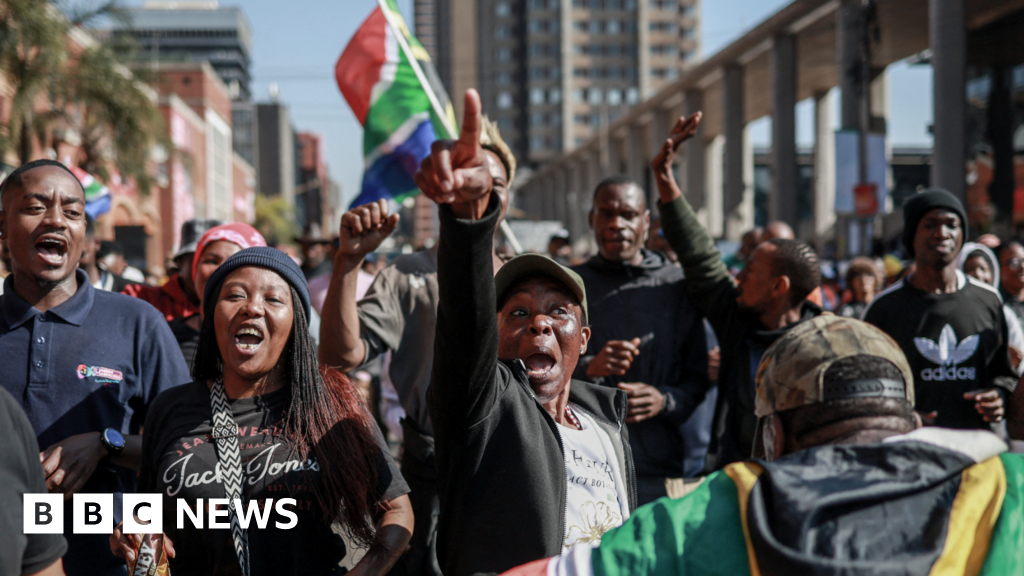
Massive Anti-Migrant Demonstrations Sweep South Africa as Deadline Looms
Thousands of South Africans have taken to the streets in coordinated protests across the country’s major cities, demanding the immediate deportation of undocumented migrants. The demonstrations, which unfolded under heavy police surveillance and private security presence, mark a sharp escalation in anti-immigrant sentiment, with authorities warning of potential violence. Organizers had set Tuesday as the final deadline for all foreign nationals without legal documentation to leave the country voluntarily, though many have already fled amid escalating hostility.
Police Minister Firoz Cachalia confirmed that the South African National Defence Force (SANDF) has been deployed on a contingency basis in high-risk areas, including parts of Johannesburg and Durban, following reports of escalating tensions. The move comes after isolated incidents of looting, arson, and clashes between protesters and migrants, leaving at least two people injured in Hillbrow, a Johannesburg suburb with one of the highest concentrations of foreign nationals.
Violence and Retaliation: Clashes Leave Injuries and Arrests
Tensions reached a boiling point in Hillbrow, where three individuals were arrested after allegedly opening fire on protesters during a march. In retaliation, demonstrators set fire to the suspects’ vehicle, injuring a 17-year-old bystander in the process. Police confirmed the arrests, stating that the suspects were later apprehended by security forces.
Further unrest erupted in Yeoville, another migrant-heavy suburb, where protesters threw bricks at residential homes, shattering windows and causing property damage. Businesses in Johannesburg’s central business district remained shut down as police maintained a high visibility presence on major thoroughfares. Meanwhile, in Germiston, a suburb near Johannesburg, demonstrators raided homes, forcibly evicting suspected foreign nationals and handing them over to police for documentation checks.
Arrests have surged across the country, with five individuals detained for looting a foreign-owned shop in Soweto, Johannesburg’s largest township. In KwaZulu-Natal province, police reported 10 arrests for looting, while a woman was charged with assaulting an officer and another man with intimidation following reports of a foreign national being beaten. Businesses in central Durban, the province’s economic hub, also closed as protests intensified.
Protest Leaders Demand Systematic Deportations
Leaders of anti-migrant groups have vowed to escalate their campaign, with Jacinta Ngobese-Zuma, spokesperson for March and March, declaring that protests would continue every Thursday for the next six months. Her group, along with Operation Dudula, has pledged to pressure police into arresting undocumented migrants, arguing that their presence undermines local employment opportunities.
President Cyril Ramaphosa attempted to de-escalate tensions by meeting with protest leaders the night before the marches, urging them to avoid violence while acknowledging the need for immigration reform. In his latest address, Ramaphosa reiterated that lawful foreign nationals—who contribute to South Africa’s economy through work, education, and investment—deserve protection under the law. However, he warned that threats, intimidation, and vandalism would not be tolerated, emphasizing the constitutional right to protest without resorting to unlawful acts.
Humanitarian Crisis: Thousands Flee as Repatriations Accelerate
The protests have triggered a mass exodus of undocumented migrants, with over 25,000 individuals repatriated so far, according to South African police. Most of those deported are from neighboring African nations, including Malawi, Nigeria, and Zimbabwe. Many have fled voluntarily, fearing violence, evictions, and arbitrary arrests.
One Malawian migrant, speaking to the BBC, described his bittersweet departure: “I am happy to be going back, but my heart is broken—leaving my four children behind.” The Malawian government has already repatriated 7,000 citizens, with more evacuations expected. Nigeria has also evacuated 269 of its nationals, bringing the total to around 600, while Ghana, Mozambique, and Zimbabwe have followed suit with air and land repatriations.
In Durban, where protests have been particularly intense, temporary transit camps housing thousands of Malawian migrants have been dismantled as authorities rush to facilitate departures. Women and families, some waiting for weeks in makeshift shelters, boarded buses under heavy security, their belongings bundled in colorful sarongs. Nelson Mbewe, a 30-year-old laborer, explained his plight: “We came for work, but now they call us ‘makwerekwere’—a derogatory term—and say we must leave. What choice do we have?”
Stranded and Struggling: Migrants Trapped in Mozambique
The exodus has left hundreds of migrants stranded in Mozambique, unable to reach Malawi due to financial and logistical barriers. A group of 200 Malawians in Maxixe, a southern Mozambican town, reported being cut off from transport, food, and shelter. One long-term migrant, who had worked in South Africa for over 20 years, pleaded for assistance: “We have no money for anything. We need both governments to help us return home.”
A History of Xenophobia: Violence and Systematic Discrimination
Anti-immigrant sentiment in South Africa is not new, with xenophobic violence erupting periodically since the end of apartheid in 1994. The most deadly outbreak occurred in 2008, when over 60 people were killed in coordinated attacks across the country. This year alone, the African Centre for Migration and Society (ACMS) has recorded two fatalities linked to xenophobic incidents.
The current crisis stems from high unemployment (over 30%), economic strain, and perceived competition for jobs and resources. Many African migrants arrived in South Africa in the 1990s and early 2000s, hoping for economic opportunities, but now face systematic exclusion, including denial of services, evictions, and police harassment.
Police and Protesters Clash Over Traditional Weapons
Authorities had initially banned traditional weapons from the protests, fearing clashes with police. However, many demonstrators—particularly Zulu ethnic groups—have historically carried shields, whips, and sticks during marches. Despite warnings, police allowed most traditional weapons to be carried, seizing only one machete during a Durban protest. This decision has raised concerns about escalating confrontations, as some protesters may use these tools in violent confrontations.
Global Response and Long-Term Implications
The situation has drawn international attention, with human rights groups condemning the systematic targeting of migrants and calling for government intervention to protect vulnerable populations. South Africa’s immigration system, already strained, faces urgent reforms to address both undocumented migration and the root causes of xenophobia, including economic inequality and job scarcity.
As the protests continue, the human cost of South Africa’s anti-migrant wave grows—families torn apart, livelihoods destroyed, and communities fractured. The question remains: Will this crisis lead to lasting change, or will it deepen divisions in one of Africa’s most diverse nations?

Protesters march through Johannesburg’s streets, demanding the deportation of undocumented migrants. (Photo: South African Police Service)

Police officers maintain a heavy presence in Hillbrow, Johannesburg, following clashes between demonstrators and migrants. (Photo: SA News Agency)

Malawian migrants wait in line at a transit camp in Durban before being repatriated. (Photo: Malawian Ministry of Home Affairs)

Women and children pack their belongings in colorful sarongs as authorities prepare to evacuate the camp. (Photo: BBC Africa)

A bus filled with repatriated Malawians departs Durban for Malawi. (Photo: South African Department of Home Affairs)

Stranded Malawian migrants in Mozambique await transport to Malawi. (Photo: Mozambican Red Cross)

Protesters in Durban carry traditional Zulu shields during a march. (Photo: eNCA News)

Police seize a machete from a protester in Durban, amid concerns over weaponized confrontations. (Photo: SABC News)

A repatriated Nigerian migrant boards a flight back to Lagos, one of hundreds evacuated ahead of the protests. (Photo: Nigerian Ministry of Foreign Affairs)
