

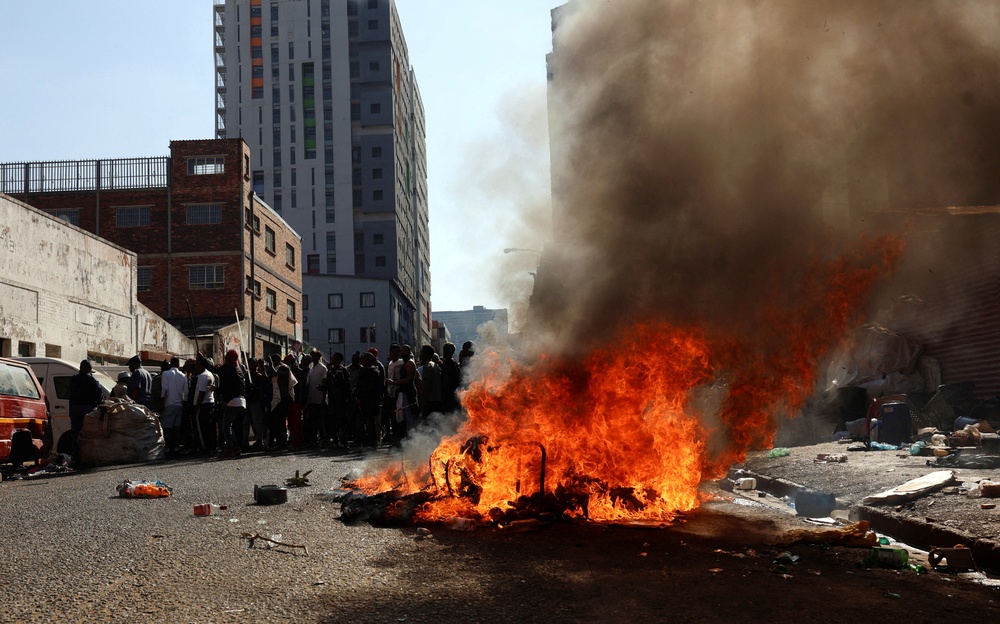
South Africa’s democratic experiment, once hailed as a beacon of reconciliation and non-racialism, now confronts a profound crisis of belonging. The mass exodus of migrants in early 2026—where tens of thousands abandoned homes, schools, and livelihoods under pressure from organized anti-immigrant campaigns—has exposed the fragility of the country’s post-apartheid social contract. Unlike past outbreaks of xenophobia, which were often spontaneous and localized, this wave was meticulously orchestrated, with activists issuing ultimatums, coordinating nationwide protests, and even conducting door-to-door raids in Johannesburg. The result was not just displacement but a deliberate redefinition of who is permitted to reside within South Africa’s borders, challenging the very foundations of its democratic identity.
A New Form of Xenophobia: From Spontaneous Outbursts to Structured Mobilization
Historically, South Africa has grappled with periodic waves of anti-immigrant violence, most notably in 2008, 2015, and 2019, when foreign nationals—regardless of legal status—were targeted in coordinated attacks. These episodes were often fueled by economic desperation, misinformation, and a climate of impunity. However, the events of June-July 2026 marked a qualitative shift. Rather than erupting from grassroots anger, the mobilization was planned, publicized, and weaponized as a tool of political pressure.
A coalition of anti-immigrant groups, including Operation Dudula, issued a 30-day ultimatum to undocumented migrants, warning of unspecified consequences if they did not leave by June 30. When the deadline passed, the group escalated its campaign with 120 simultaneous protests nationwide, followed by weekly demonstrations until their demands were met. Activists reportedly conducted door-to-door searches in certain Johannesburg neighborhoods, handing over suspected undocumented migrants to police—a blurring of lines between civic protest and state enforcement.
The South African government, while dismissing the ultimatums as unlawful, found itself in an awkward position. President Cyril Ramaphosa responded by announcing a “Comprehensive Approach for Migration Management”, which included:
– Strengthened border security with expanded surveillance capabilities.
– Fast-track deportation courts to expedite removals.
– 10,000 additional labor inspectors to crack down on illegal employment.
Critics argue that this policy shift normalized the anti-immigrant agenda, effectively legitimizing the demands of vigilante groups. Meanwhile, embassies from neighboring countries—such as Zimbabwe, Mozambique, and the Democratic Republic of Congo—rushed to evacuate their nationals, even those with valid residency permits or refugee status. The fear of violence was so pervasive that schools, businesses, and families preemptively evacuated, creating a humanitarian crisis.
The Hollow Promise of Post-Apartheid Progress
The irony of South Africa’s current predicament is stark. The country’s 1994 democratic transition, led by Nelson Mandela and the African National Congress (ANC), remains one of the 20th century’s most remarkable political achievements. Unlike many post-colonial states, South Africa rejected revenge in favor of constitutionalism, non-racial democracy, and reconciliation. The 1996 Constitution—often cited as one of the world’s most progressive—guaranteed fundamental rights, established an independent judiciary, and enshrined principles of equality, dignity, and social justice.
Yet, three decades later, the gap between these ideals and reality has widened dramatically. Economic stagnation, systemic corruption, and governance failures have eroded public trust, leaving many South Africans questioning whether the post-apartheid settlement has delivered on its promises.
Economic Disillusionment: The Unfulfilled Promise of Liberation
Critics like Sisonke Msimang, a South African-Australian author and political analyst, argue that the ANC’s focus on political liberation overshadowed the need for economic transformation. Since 1994, South Africa has struggled with:
– Chronic unemployment, with youth unemployment hovering at 60% as of 2025.
– Stagnant GDP per capita, which has declined for over 15 years according to Harvard University’s Growth Lab.
– Deteriorating public services, including frequent power outages, water shortages, and crumbling infrastructure in cities like Johannesburg.
– Rampant corruption, exposed in the Zondo Commission, which detailed how state institutions were infiltrated by criminal syndicates.
The 2024 Ipsos survey revealed that 80% of South Africans believe their country is moving in the wrong direction—a level of pessimism rarely seen in a democracy of its age. The ANC’s liberation narrative, once a source of unassailable legitimacy, has lost its luster as younger generations demand results, not just remembrance.
The Generational Divide: When Liberation Fails to Deliver
A critical factor in South Africa’s current unrest is the generational shift in political consciousness. Nearly 60% of South Africans were born after apartheid, meaning they have no firsthand memory of racial oppression. For them, apartheid remains a historical explanation for inequality, but not a political framework for addressing contemporary governance failures.
This disconnect became evident in the 2024 general election, where the ANC lost its parliamentary majority for the first time since 1994, forcing it into a coalition government. More troubling was the record abstention rate—over 11 million registered voters stayed home—suggesting apathy, disillusionment, or outright rejection of the political establishment.
The question no longer revolves around who liberated South Africa but who can govern it effectively. The ANC’s moral authority, once untouchable, has been undermined by corruption scandals, economic mismanagement, and failed service delivery.
Migrants as Scapegoats: Redirecting Frustration Inward
While South Africa’s economic and political crises are deeply rooted in systemic failures, migrants—particularly those from Zimbabwe, Mozambique, and the DRC—have become convenient targets. Their visibility in informal economies, competition for housing, and perceived strain on public services make them easy scapegoats for a population grappling with unemployment, poverty, and declining services.
The June-July 2026 exodus—estimated to have displaced 13,000 to 25,000 people—was not merely a reaction to economic hardship but a deliberate political strategy. Activists exploited fear and misinformation, portraying migrants as economic burdens, criminals, or threats to national security. Police reported over 900 arrests linked to the protests, indicating that the backlash had crossed into criminalization.
This trend is particularly ironic given South Africa’s regional history. During apartheid, neighboring states like Zambia, Mozambique, and Zimbabwe played a crucial role in hosting ANC exiles, training fighters, and providing diplomatic support. Today, many of those same countries’ citizens are fleeing intimidation in democratic South Africa—a bitter reversal of historical alliances.
The Moral Hypocrisy of a Nation Built on Resistance
South Africa’s democratic identity was forged through resistance to exclusion. The country’s global moral authority was reinforced by its 2023 case against Israel at the International Court of Justice, where it argued that nations shaped by apartheid’s injustices had a special responsibility to oppose genocide.
Yet, the hypocrisy of this stance is evident when juxtaposed with its treatment of migrants. While South Africa condemns foreign regimes for exclusionary policies, it now practices a new form of exclusion—one that questions the very right to belong based on documentation, citizenship, or perceived threat.
This contradiction was starkly highlighted by Breyten Breytenbach, the Afrikaner poet and anti-apartheid activist, who spent seven years in prison for his opposition to the regime. In his writings, Breytenbach warned against political complacency, arguing that freedom was never permanent but required constant vigilance against new forms of exclusion.
The Unfinished Project of Post-Apartheid Belonging
South Africa’s constitutional settlement of 1994 dismantled institutionalized racial domination and established one of the world’s most progressive democratic orders. However, it could not guarantee economic opportunity, administrative competence, or social cohesion.
As governance weakened, public frustration redirected inward, targeting the most vulnerable—migrants, refugees, and informal workers—rather than addressing structural inequality, corruption, and institutional decay.
The June-July 2026 crisis was not just about fear and displacement but about the erosion of a nation’s moral compass. South Africa has already shown the world that political liberation is possible. Its next challenge is ensuring that the universal ideals of anti-apartheid resistance—equality, dignity, and belonging—shape everyday life within its borders as powerfully as they have shaped its global moral authority.
Without addressing economic stagnation, governance failures, and systemic inequality, the risk remains that South Africa will repeat the mistakes of its past—this time not through legalized apartheid, but through a new politics of exclusion. The unfinished promise of post-apartheid South Africa is not just about surviving democracy but proving that liberation is not an endpoint, but a continuous struggle.
