
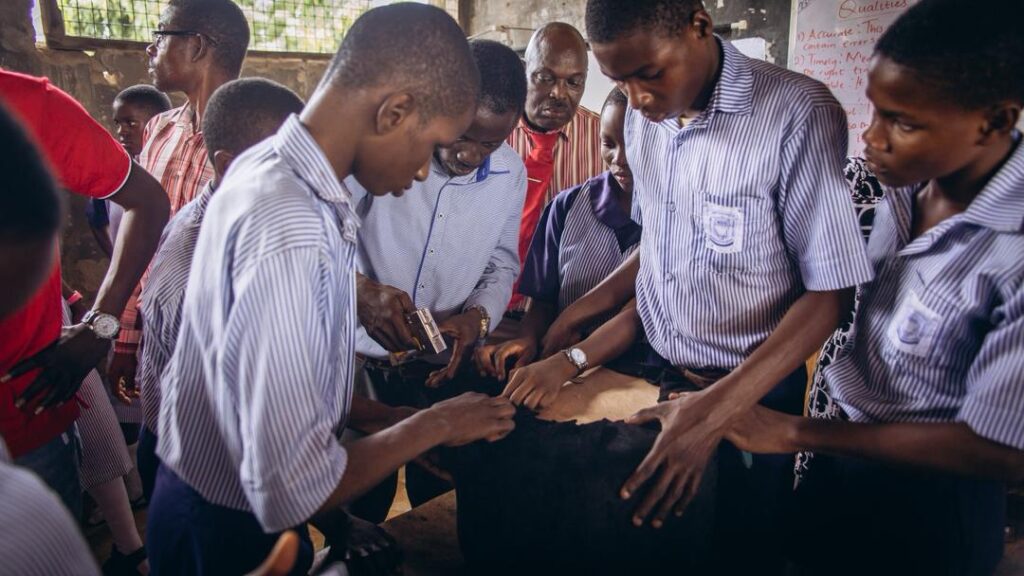
Across Africa’s most populous nation, a quiet revolution is brewing—not in the halls of power, but in the classrooms and playgrounds of secondary schools. In a bold move that could redefine Nigeria’s climate narrative, the EcoSmart Club has launched a week-long, student-driven campaign to embed sustainability into the fabric of national discourse. This isn’t just another environmental awareness drive; it’s a strategic mobilization of the next generation of leaders, equipped with data, tools, and the unshakable belief that their voices matter.
From Awareness to Action: The Birth of a Student-Led Movement
Founded in 2023 by a coalition of young environmentalists, educators, and climate scientists, EcoSmart Club wasn’t content with passive advocacy. The organization’s founders—many of whom cut their teeth in university sustainability circles—recognized a critical gap: while Nigeria’s youth were vocal about climate issues on social media, few had the infrastructure to translate passion into tangible impact. Their solution? A nationwide network of student-led sustainability clubs, designed to operate as decentralized hubs of innovation, education, and activism.
The initiative’s timing couldn’t be more urgent. With Nigeria ranked among the world’s most vulnerable countries to climate change—despite contributing less than 1% to global emissions—the need for grassroots solutions has never been clearer. Coastal erosion in the Niger Delta, devastating floods in the north, and the creeping desertification of the Sahel region have already displaced thousands. Yet, for too long, the response has been top-down, leaving communities—and especially young people—on the sidelines of decision-making.
EcoSmart Club’s founders saw an opportunity to flip the script. By targeting secondary schools, they could reach students at a pivotal age—old enough to grasp complex issues, young enough to be unburdened by institutional inertia. The goal? To create a generation of climate-literate citizens who don’t just recycle or plant trees, but who can lobby for policy changes, design local adaptation strategies, and hold leaders accountable.
Week-Long Intensive: What Students Will Actually Do
The centerpiece of the campaign is a seven-day intensive program, tailored to each school’s context. No two schools will run identical initiatives; instead, the curriculum is modular, allowing students to focus on the climate challenges most relevant to their communities. Here’s a snapshot of what’s in store:
- Energy Audits: Teams will conduct walk-throughs of their schools, identifying energy waste—leaky windows, inefficient lighting, uninsulated roofs—and proposing low-cost fixes. In pilot schools, students have already slashed electricity bills by 20% simply by recommending motion-sensor lights and solar-powered fans.
- Waste-to-Wealth Workshops: With Nigeria generating over 32 million tons of waste annually, students will learn to turn trash into resources. From converting plastic bottles into vertical gardens to producing biogas from organic waste, the focus is on circular economy principles that can be scaled at home.
- Climate Justice Debates: Students will research and debate real-world cases—such as the impact of multinational oil companies on local ecosystems or the displacement of fishing communities due to rising sea levels. The goal isn’t just to inform, but to equip them with the rhetorical tools to advocate for systemic change.
- Policy Simulations: In a mock legislative session, students will draft, present, and debate climate policies, mirroring the National Assembly’s process. The most compelling proposals will be submitted to local government representatives for consideration.
- Citizen Science Projects: Using low-cost sensors, students will collect data on air quality, water purity, and soil health in their neighborhoods. This isn’t just academic; the data will be shared with environmental agencies and used to pressure authorities for action.
The program’s design reflects a deep understanding of Nigeria’s educational landscape. Unlike one-off workshops that fizzle out, EcoSmart’s approach embeds sustainability into the school calendar. Clubs will meet weekly, with monthly challenges (e.g., “Reduce Your School’s Carbon Footprint by 15%”) and quarterly inter-school competitions judged by a panel of climate scientists, journalists, and policymakers.
The Skeptics and the Champions: Who’s On Board?
Not everyone is convinced. Critics argue that student-led initiatives are a drop in the ocean compared to the scale of Nigeria’s climate crisis. Some educators worry that the program will distract from core academic subjects, while parents question the practicality of “activism” in an already overburdened curriculum. Even within the environmental movement, there are concerns that EcoSmart’s focus on schools might overlook the most vulnerable communities—those without access to secondary education.
Yet, the response from students has been overwhelming. In the first two weeks of recruitment, over 500 schools signed up, representing all 36 states and the Federal Capital Territory. The enthusiasm cuts across socioeconomic lines: from the elite private schools of Lagos to the rural government colleges of Borno. What unites them is a shared frustration with the status quo—and a belief that change must start where they live.
Support has also come from unexpected quarters. The Nigerian Meteorological Agency has pledged to provide real-time climate data for student projects, while the Ministry of Education has included EcoSmart’s curriculum in its draft sustainability guidelines for schools. Private sector allies, including renewable energy firms and waste management companies, have donated equipment and mentorship programs. Even the Nigerian Army’s environmental unit has expressed interest in collaborating, citing the need for climate-resilient infrastructure in conflict zones.
Beyond Nigeria: Can This Model Spread Across Africa?
EcoSmart’s founders are already looking beyond Nigeria’s borders. Their pitch to regional partners is simple: if a country as complex and resource-constrained as Nigeria can pull this off, the model is replicable anywhere. Early conversations with counterparts in Kenya, Ghana, and South Africa suggest strong interest, particularly in countries where youth unemployment and climate vulnerability intersect.
The potential is vast. Imagine a pan-African network of student climate clubs, sharing data, best practices, and advocacy strategies. Such a movement could amplify demands for climate finance, push for regional policies on carbon pricing, and even influence global negotiations. For a continent that contributes least to climate change but suffers most from its effects, this kind of bottom-up pressure is long overdue.
Of course, scaling up won’t be easy. Funding remains a hurdle, as does the challenge of maintaining momentum in countries with weaker education systems or authoritarian governments. But EcoSmart’s team is betting on the power of peer-to-peer learning. Their hypothesis? That once students see their ideas in action—whether it’s a solar-powered borehole in a drought-stricken village or a successful petition to ban single-use plastics in their town—they’ll become evangelists for the cause.
The Road Ahead: Challenges and Opportunities
Even with the initial enthusiasm, significant obstacles loom. The most immediate is logistical: transporting trainers, equipment, and resources to remote schools across Nigeria’s vast terrain. Then there’s the issue of continuity. How do you ensure that the clubs don’t become yet another short-lived project, abandoned when the next crisis hits? EcoSmart’s answer is to embed the program into existing structures—partnering with teacher training colleges to integrate sustainability into the curriculum, and working with state governments to include climate action in school performance metrics.
There’s also the question of impact measurement. How do you quantify the success of a movement that’s as much about mindset as it is about measurable outcomes? The team is developing a dashboard to track everything from the number of policy proposals submitted to the reduction in school waste. But they’re also tracking softer metrics—student confidence in public speaking, for instance, or the number of alumni who pursue careers in environmental science. These, they argue, are the real indicators of long-term change.
Perhaps the biggest opportunity lies in the digital space. Nigeria’s youth are among the most connected on the continent, with over 70% of secondary school students owning smartphones. EcoSmart is exploring an app that would allow students to log their climate actions, share progress with peers, and access micro-grants for projects. The app could also serve as a platform for crowdfunding, letting communities support student-led initiatives directly.
What This Means for Nigeria’s Climate Future
If EcoSmart’s campaign succeeds, it could mark a turning point in Nigeria’s climate narrative. For decades, the country’s environmental movement has been dominated by NGOs, academics, and international donors. While these actors play a crucial role, they often lack the grassroots reach and political leverage of a mobilized youth population. By training students not just to care about the climate, but to drive change within their schools and communities, EcoSmart is building a constituency for climate action that’s impossible to ignore.
The implications extend beyond Nigeria’s borders. Africa’s youth bulge is both a challenge and an opportunity. With the right investments in education and leadership, this generation could become a global force for sustainability. But without it, they risk inheriting a continent ravaged by climate disasters, with few tools to adapt. Initiatives like EcoSmart’s offer a glimmer of hope—a way to channel youth energy into solutions rather than frustration.
As the first week of the campaign kicks off, students across Nigeria are preparing to take the reins. They’ll plant trees, audit energy use, and draft policy proposals. But more importantly, they’ll begin to see themselves as agents of change—not just in their classrooms, but in their communities and beyond. For a country where the future often feels out of reach, this might be the most radical act of all.
The Ripple Effect: How One School’s Story Could Inspire a Nation
Take the example of Government Secondary School in Minna, Niger State. In 2025, the school’s EcoSmart club launched a project to replace all incandescent bulbs with LEDs—a change that cut the school’s electricity bill by 25%. The savings were reinvested into a rainwater harvesting system, which now provides clean water for the school’s 800 students. The project caught the attention of the state governor, who pledged to replicate it across all public schools in Niger State.
But the real impact was in the students themselves. One participant, 16-year-old Amina Ibrahim, went on to lobby her local government to install solar-powered streetlights in her neighborhood—a first for the area. Another, Chinedu Okoro, used his experience with the club to secure an internship with a renewable energy startup. Stories like theirs are becoming common across Nigeria, proof that the EcoSmart model isn’t just about environmentalism; it’s about empowerment.
As the campaign gains momentum, the question isn’t whether Nigeria’s youth can lead the climate fight—it’s whether the rest of the country will listen. For too long, the narrative around African youth has been one of potential wasted. EcoSmart’s work suggests something far more exciting: a generation ready to rewrite the rules.
Copyright notice: Images and source material are credited to their respective owners/source (original source where available). If you are the copyright owner and want an image or content removed, please contact us at topix.news/contact-us; we will review and remove it promptly.

Topix News Desk is a digital editorial team focused on delivering clear, timely, and useful news coverage for readers worldwide. Our reporting highlights African news with global context, including politics, business, economy, technology, health, sports, entertainment, travel, and culture. We aim to publish accessible, well-structured, and informative articles that help readers understand the stories shaping Africa and the world.