
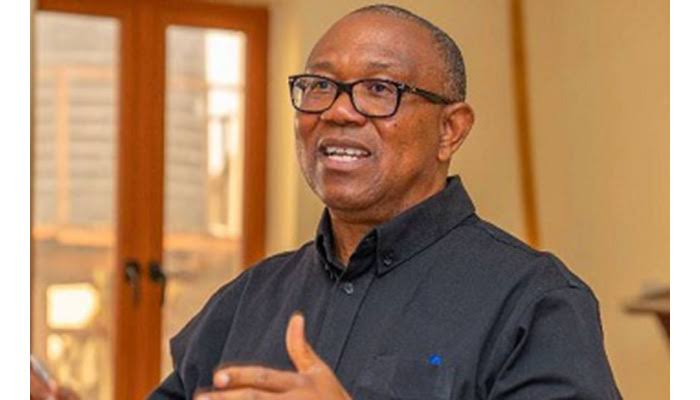
The air in Abuja crackles with anticipation—not just the dry Harmattan heat, but the unspoken tension of a nation holding its breath. In six months, Nigerians will return to the polls, and the stakes have never been higher. Not for a new president alone, but for the very soul of Africa’s most populous democracy. Peter Obi, the 2023 Labour Party presidential candidate and now the front-runner for the Nigerian Democratic Congress (NDC) in 2027, has issued a stark warning: Nigeria’s politicians have become Goliaths, and the time has come for Davids to take the field.
Obi’s analogy isn’t poetic license—it’s a call to arms. The biblical story of David and Goliath, where a young shepherd topples a towering warrior with a single sling, has long been a metaphor for the underdog’s triumph. But in Nigeria’s political landscape, the Goliaths aren’t just metaphors; they’re the entrenched forces of patronage, corruption, and systemic inertia that have stifled growth for decades.

What does it mean for a nation to be held hostage by its own leaders? For Obi, the answer is simple: stagnation. “These Goliaths are not just politicians,” he told a rapt audience in Lagos last week. “They are the architects of a system that thrives on exclusion, where the many toil while the few feast.” His words resonate in a country where over 40% of the population lives below the poverty line, despite being Africa’s largest economy by GDP.
From Election to Existential Struggle: The Weight of 2027
The 2027 election isn’t just another political cycle—it’s a referendum on Nigeria’s future. Obi’s warning comes at a time when the country is grappling with a currency crisis, soaring inflation, and a youth unemployment rate that hovers around 40%. The International Monetary Fund (IMF) has repeatedly urged Nigeria to diversify its economy, but the political class has been slow to act. “We are not just choosing a president,” Obi emphasized. “We are choosing whether Nigeria will remain a land of missed opportunities or finally break free.”
The irony isn’t lost on observers. In 2023, Obi himself was a David—an outsider who nearly toppled the establishment with a campaign built on transparency and youth mobilization. His near-victory proved that Nigerians are hungry for change, but the road ahead is fraught with obstacles. The Goliaths he speaks of aren’t just individual politicians; they’re the networks of influence that have shaped Nigeria’s political DNA for generations.
The Goliaths: Who Are Nigeria’s Political Titans?
To understand Obi’s warning, you must first recognize the faces of Nigeria’s political Goliaths. They are the men and women who have dominated the scene for decades, their names synonymous with power, privilege, and, for many, disappointment.
- Bola Tinubu: The former Lagos State governor and current President of Nigeria, Tinubu is a political juggernaut whose influence stretches across the Southwest and beyond. His supporters credit him with transforming Lagos into Africa’s largest megacity, but critics argue his administration has done little to address Nigeria’s broader economic woes.
- Goodluck Jonathan: Nigeria’s former president, Jonathan’s tenure (2010–2015) was marked by the rise of Boko Haram and a devastating oil price crash. His administration’s handling of the Chibok girls’ abduction remains a stain on his legacy, though he has since reinvented himself as a statesman.

Sunday Dare | Image credit: original source. - Sunday Dare: A key figure in the All Progressives Congress (APC) and former Minister of Youth and Sports Development, Dare has been at the forefront of efforts to modernize Nigeria’s sports and entertainment sectors. Yet his critics accuse him of being more interested in image-building than systemic reform.

2027: Politicians are Goliaths, Nigerians need David — Peter Obi | Image credit: original source.
These are the names that dominate headlines, the faces that appear on campaign posters, and the voices that shape policy. But for Obi, they represent something far more sinister: a system that prioritizes self-preservation over national progress. “A Goliath is not defined by size alone,” he said in a recent interview. “It is defined by its refusal to yield, its inability to see beyond its own interests.”
The David Generation: Can Nigeria’s Youth Break the Cycle?
If the Goliaths are the problem, then the Davids must be the solution. And in Nigeria, the David generation isn’t a metaphor—it’s a demographic reality. Over 60% of Nigeria’s population is under 25, a generation raised on social media, global connectivity, and a deep distrust of the political establishment. They are the engineers, the artists, the entrepreneurs who see a future beyond the old guard’s shadow.
Obi’s campaign in 2023 tapped into this energy, mobilizing young voters with promises of accountability and economic reform. While he fell short in the election, his message resonated. Now, as the 2027 race heats up, the question isn’t whether the youth will participate—it’s whether they can organize, whether they can overcome the Goliaths’ entrenched power structures. “This isn’t about age,” Obi told a group of university students in Port Harcourt. “It’s about vision. It’s about the courage to say, ‘Enough is enough.’”
The challenge, however, is daunting. Nigeria’s political landscape is a labyrinth of ethnic alliances, regional loyalties, and financial incentives. The Goliaths don’t just control the levers of power; they control the narratives that shape public perception. Breaking through that requires more than charisma—it requires a movement. And movements, as history has shown, are fragile things.
The Role of Institutions: Can Nigeria’s Democracy Survive?
Beyond the personalities, Obi’s warning touches on a deeper issue: the health of Nigeria’s democratic institutions. A true David, after all, needs more than a sling—it needs a fair playing field. Yet Nigeria’s electoral system remains plagued by allegations of rigging, intimidation, and vote-buying. The Independent National Electoral Commission (INEC) has made strides in recent years, but skepticism lingers. Can a nation trust its institutions when those institutions are staffed by the same political class that has failed it for so long?
The judiciary, too, is under scrutiny. Nigeria’s courts have become battlegrounds for political disputes, with rulings often appearing to favor the highest bidder. In 2023, the Supreme Court’s decision to uphold Tinubu’s victory despite widespread irregularities was a turning point for many Nigerians. It reinforced the perception that the system is rigged in favor of the Goliaths. “When the institutions that are supposed to protect the people become complicit in their oppression,” Obi argued, “then the fight for democracy is no longer a political battle—it is a moral one.”
Economic Realities: The Cost of Political Paralysis
Nigeria’s economic struggles are well-documented. Inflation has eroded purchasing power, the naira’s value has plummeted, and foreign investors remain hesitant to commit to a market they see as unpredictable. But the root of these problems isn’t just poor policy—it’s the political paralysis that prevents meaningful reform.
Consider the power sector, a critical driver of economic growth. Despite Nigeria’s vast energy resources, over 80 million Nigerians lack access to reliable electricity. Successive governments have promised solutions, but little has changed. Why? Because the Goliaths benefit from the status quo. Power generation contracts, fuel subsidies, and import waivers are lucrative sources of patronage. Reforming these systems would disrupt the very networks that keep the Goliaths in power.
Obi’s prescription is clear: break the cycle. “We cannot build a 21st-century economy with 20th-century politics,” he declared in a speech to the Nigerian Economic Summit Group. His plan includes diversifying the economy, investing in education, and tackling corruption head-on. But implementation is the hard part. Nigeria’s political class has a long history of making promises it doesn’t keep.
The Path Forward: Can Nigeria Find Its David?
The 2027 election is still over a year away, but the groundwork is already being laid. Obi’s NDC is positioning itself as the party of the Davids, while the ruling APC and opposition PDP scramble to retain their grip on power. Meanwhile, a new generation of leaders is emerging—not just in politics, but in civil society, the private sector, and the arts. These are the true Davids: the teachers, the activists, the innovators who refuse to accept Nigeria’s fate as a nation of Goliaths.
But will it be enough? History suggests that change in Nigeria comes slowly, often painfully. The 2014 elections, which saw Goodluck Jonathan defeated after years of misrule, were hailed as a turning point. Yet six years later, many Nigerians feel little has improved. The question now is whether the David generation can learn from the past—or whether they, too, will be swallowed by the Goliaths.
One thing is certain: Peter Obi’s warning isn’t just rhetoric. It’s a challenge. A challenge to Nigeria’s voters to demand more. A challenge to its leaders to serve, not rule. And a challenge to the world to recognize that Africa’s most populous nation is at a crossroads—and the choices made in the next 12 months will echo for generations.
As the Harmattan winds sweep across the savanna, carrying with them the whispers of change, one thing is clear: Nigeria cannot afford another Goliath. The time for Davids is now.
What do you think? Can Nigeria break free from its political Goliaths, or is the system too entrenched to change? Share your thoughts in the comments below.
Copyright notice: Images and source material are credited to their respective owners/source (original source where available). If you are the copyright owner and want an image or content removed, please contact us at topix.news/contact-us; we will review and remove it promptly.

Topix News Desk is a digital editorial team focused on delivering clear, timely, and useful news coverage for readers worldwide. Our reporting highlights African news with global context, including politics, business, economy, technology, health, sports, entertainment, travel, and culture. We aim to publish accessible, well-structured, and informative articles that help readers understand the stories shaping Africa and the world.