

A David vs. Goliath Moment: South Africa’s World Cup Knockout Bid
MONTERREY, Mexico – In a match that defied expectations and sent shockwaves through footballing circles, South Africa delivered an electrifying 1-0 victory over South Korea in their FIFA World Cup 2026 Group A clash, securing their first-ever knockout-stage berth in tournament history. The win not only propelled them into the Round of 32 but also set up an intriguing first-ever South Africa vs. Canada showdown in Los Angeles, a match that will test the resilience of both teams.
The result was not just a triumph for Bafana Bafana (South Africa’s national team) but a tactical masterclass that exposed the vulnerabilities of a South Korean side led by Hong Myung-bo, who made the bold—and controversial—decision to bench star forward Son Heung-min for the entire first half. The move, which stunned fans and analysts alike, ultimately backfired, as South Africa seized momentum and delivered a performance that will be remembered as one of the greatest underdog stories in World Cup history.
The Son Heung-min Enigma: A Tactical Gambit Gone Wrong
Before the match, Son Heung-min was the undisputed face of South Korea’s World Cup campaign. The 33-year-old—a 146-cap veteran, second-highest scorer in the team’s history (just two behind Cha Bum-kum), and a global superstar—was expected to dominate proceedings. His absence from the starting lineup, despite showing no signs of injury, sent ripples through the stadium and beyond.
Hong’s decision was framed as a tactical experiment, a bid to inject fresh energy into a side that had struggled against Mexico and the Czech Republic in their previous two games. However, the move proved disastrously misjudged. Son, who had been scoring goals in MLS but struggling in his World Cup role, was replaced by younger attackers, but the Koreans failed to capitalize on their numerical advantage.
The absence of Son’s goal threat and leadership left a critical void in South Korea’s attack. While the team boasted world-class talent—players like Hwang Hee-chan, Lee Kang-in, and Kim Min-jae—they lacked the creative spark to overcome South Africa’s defensive organization and counter-attacking prowess.
South Africa’s Resilience: A Team Built on Grit and Determination
Enter South Africa, a side that had entered the tournament as underachievers but had shown glimpses of brilliance in their first two games. Against Mexico, they had been outplayed but managed a last-minute draw, while their 1-1 draw with the Czech Republic had been a hard-fought effort. Yet, against South Korea, they elevated their game to another level.
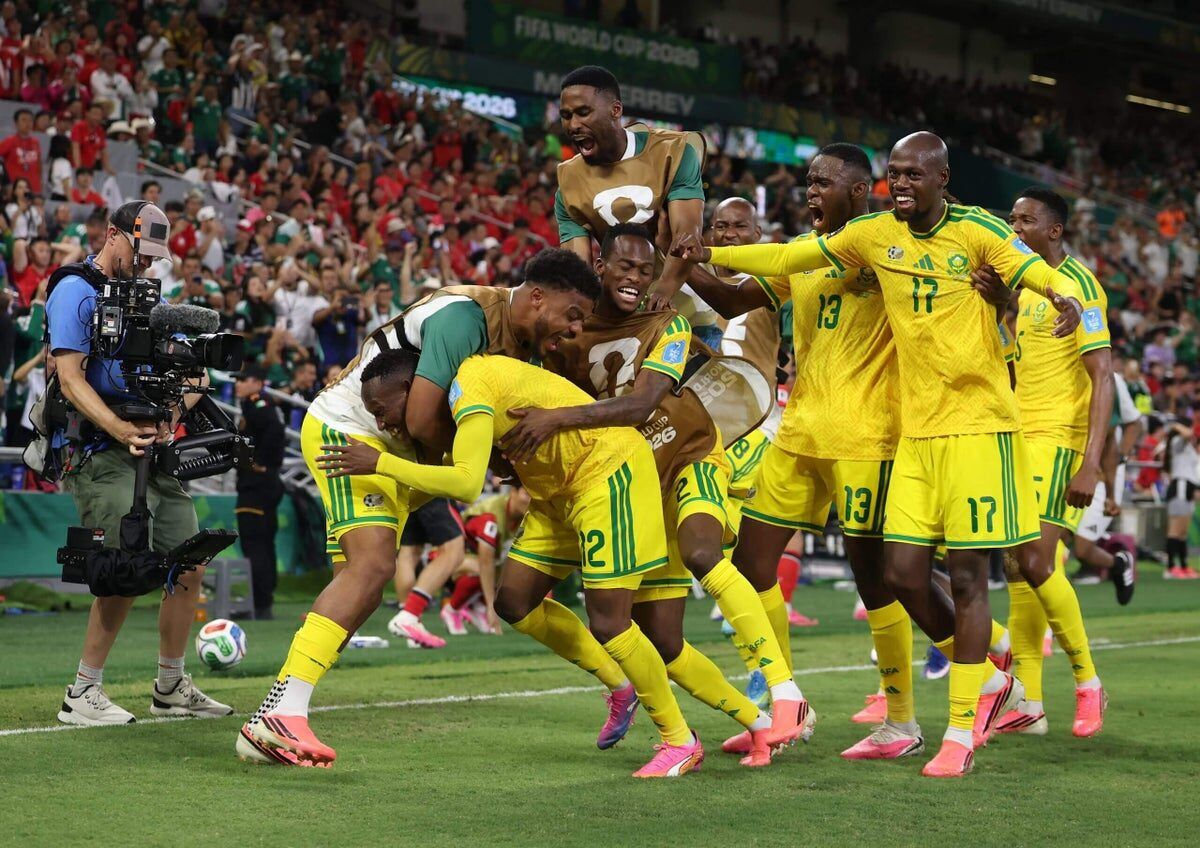
The key moment came in the 63rd minute, when Thapelo Maseko—a 22-year-old midfielder—burst into the box, controlled a perfect through ball, and slotted the ball past Kim Seung-gyu with a flick of the wrist. The goal was flawless in its execution, a moment of pure genius that silenced the stadium and sent South Africa’s players into unbridled celebration.
What made this victory even more remarkable was South Africa’s defensive discipline. Despite being outnumbered in talent, they held their shape, pressed high, and denied South Korea multiple scoring opportunities. Their counter-attacking threat, spearheaded by Teboho Mokoena (who was suspended for the previous match but returned for this game), was lethal. Maseko, Evidence Makgopa, and Thalente Mbatha all contributed to a midfield and forward line that dictated the tempo when they broke forward.
The Unforgettable Second-Half Drama
The match took an unprecedented turn when Mexico scored two goals in rapid succession in their Group A clash against Netherlands. The stadium erupted as fans—many wearing El Tri jerseys—celebrated the victories. The announcements over the PA system, complete with airport-style chimes, added to the chaotic atmosphere.
For South Korea, the psychological impact was immediate. The sudden shift in momentum—from a potential second-place finish to a desperate chase for a point—left them disoriented. The Mexican celebrations, which had been wild and uninhibited, seemed to distract the Koreans, who struggled to regain their composure.
South Africa, meanwhile, seized the opportunity. Maseko’s second-half dominance—where he controlled the game’s rhythm—meant that when the Koreans finally found their rhythm, it was too late. The 1-0 lead held firm, and by the final whistle, South Korea were left in third place, their World Cup dreams in tatters.
What This Means for the Round of 32: South Africa vs. Canada
The implications of this victory are huge. For the first time in their history, South Africa will face a co-host nation in the Round of 32, taking on Canada in Los Angeles. The match promises to be a clash of cultures and styles—Canada’s structured, possession-based football against South Africa’s physical, counter-attacking approach.
Jesse Marsch’s Canadian side, who have struggled in the group stage, will be relieved to face a team they can theoretically beat. However, South Africa’s resilience and tactical intelligence make them a dangerous opponent. Their ability to adapt mid-match, exploit defensive errors, and maintain composure under pressure will be critical.
For South Africa, this is not just about winning—it’s about proving they belong in the knockout stages. Their journey from Group A underdogs to World Cup quarter-final contenders has been nothing short of miraculous. If they can replicate this form, they could shock the football world once again.
The Broader Implications: A World Cup of Surprises
This match is a perfect example of how the World Cup continues to defy expectations. South Korea, a consistent powerhouse in recent tournaments, were humiliated by a team that had been written off. Meanwhile, South Africa—a nation with a rich footballing history but limited recent success—have delivered one of the greatest upsets in World Cup history.
The lesson for other teams is clear: never underestimate the power of resilience, tactical flexibility, and mental fortitude. South Korea’s overconfidence and lack of adaptability cost them dearly, while South Africa’s determination and execution redefined their tournament.
As the Round of 32 approaches, one thing is certain: this World Cup is far from over. The unpredictability of the tournament remains intact, and anything can happen—especially when underdogs refuse to back down.
Spot the Pattern: Connecting the Hidden Links in Football
Football is a game of patterns, strategies, and hidden connections—whether in tactics, player roles, or historical trends. Here are some key links that emerge from this match and broader World Cup narratives:
-
The Power of the Bench – South Korea’s decision to bench Son Heung-min was a high-risk, high-reward move. While it backfired, it highlights how coaches often experiment with formations and personnel to break opponents’ routines. Similarly, South Africa’s late substitutions (like bringing on Teboho Mokoena) proved decisive.
-
Psychological Warfare – The Mexican celebrations during South Korea’s match distracted the Koreans, showing how external factors (even unrelated to the game) can influence performance. This is a common theme in high-pressure matches, where mental resilience often decides outcomes.
-
Counter-Attacking vs. Possession Football – South Africa’s success relied on quick transitions, while South Korea’s struggle stemmed from their inability to sustain possession. This clash of styles is a recurring theme in modern football, where teams that adapt their approach often find success.
-
The Underdog Narrative – South Africa’s journey mirrors that of other World Cup underdogs (e.g., Morocco in 2022, Senegal in 2022). Their ability to overcome expectations through teamwork and tactical discipline reinforces the idea that greatness is not always about individual stars but collective effort**.
-
The Role of Midfielders as Game-Changers – Thapelo Maseko and Teboho Mokoena were pivotal in South Africa’s victory. Their ability to dictate play, create chances, and defend showcases how midfielders often hold the key to a team’s success in modern football.
-
Host Nation Dynamics – The Mexican fans’ reactions during South Korea’s match demonstrated how host nation support can psychologically impact opponents. This is a well-documented phenomenon in tournaments like the FIFA World Cup and UEFA European Championship, where home advantage plays a subtle but significant role.
-
The Evolution of World Cup Tactics – South Korea’s failure to adjust against South Africa reflects a broader trend where teams that rely on rigid systems struggle against adaptive opponents. The best teams in 2026 will be those that blend structure with creativity, much like South Africa did in this match.
This match was more than just a game—it was a masterclass in footballing intelligence, a testament to underdog spirit, and a warning to overconfident giants. As the World Cup progresses, one thing is clear: the beautiful game remains unpredictable, and greatness is earned, not given.
