

The world of rugby witnessed an electrifying clash of titans on Saturday, August 8, 2026, as South Africa’s formidable Springboks faced off against Argentina’s passionate Pumas in a high-octane Test match held in the vibrant heart of Buenos Aires. The encounter, played under the blazing Argentine sun, was not just a display of athletic prowess but also a cultural exchange that left fans on the edge of their seats.
A Clash of Rugby Giants
The match, a pivotal fixture in the ongoing Rugby Championship series, drew massive crowds to the Estadio José Amalfitani, where the atmosphere was thick with anticipation. South Africa, known for their disciplined play and tactical brilliance, faced Argentina, a team celebrated for their relentless energy, creativity, and fierce competitiveness.
From the opening whistle, both teams demonstrated their intent to dominate. The Springboks, led by their experienced captain, Siya Kolisi, sought to assert their authority on the field, while Argentina’s young stars, including Agustin Pichot and Emiliano Boffelli, aimed to disrupt their opponents’ rhythm with swift, dynamic play.
Key Moments and Tactical Battles
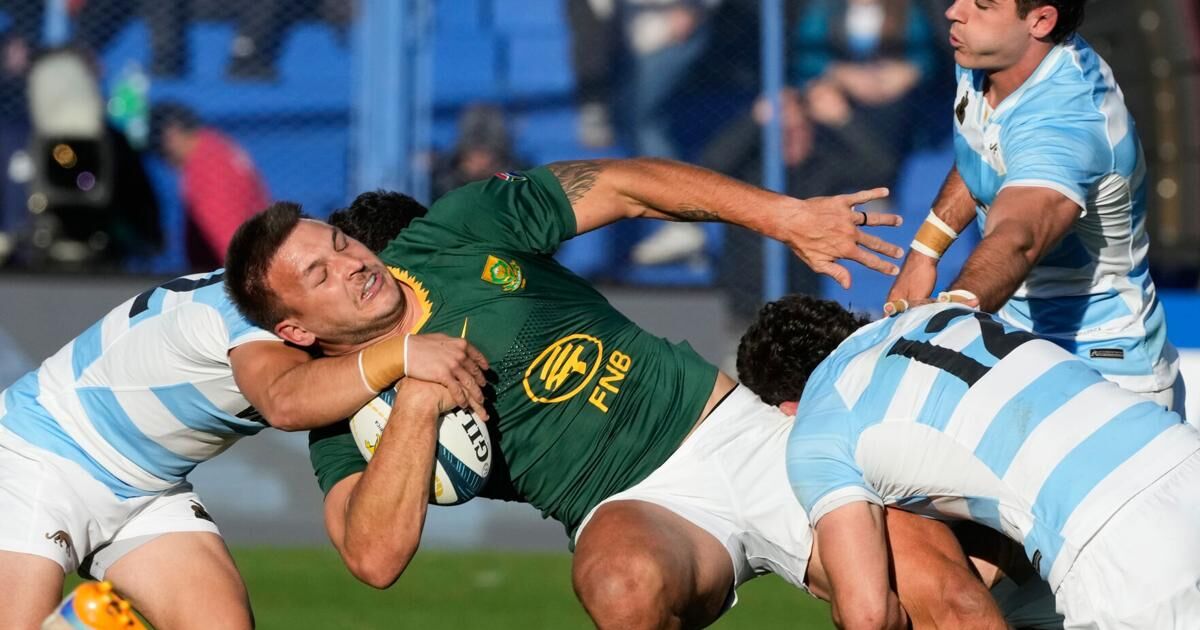
One of the most memorable plays of the match unfolded in the early stages when Andre Esterhuizen, South Africa’s towering lock, found himself under intense pressure from Argentina’s backline. In a display of sheer athleticism, Esterhuizen, the centerpiece of South Africa’s defensive structure, was tackled by Faustino Sanchez Valarolo (12) and Agustin Moyano in a high-impact collision that sent shockwaves through the crowd.

South Africa’s Andre Esterhuizen, center, is tackled by Argentina’s Faustino Sanchez Valarolo (12) and Agustin Moyano during a rugby test match in Buenos Aires, Argentina, Saturday, Aug. 8, 2026.
The tackle, captured in a stunning freeze-frame, highlighted the physicality and intensity of the contest. While Argentina’s forwards aimed to break through South Africa’s solid defensive line, the Springboks’ backline, anchored by Eben Etzebeth and Malcolm Marx, worked tirelessly to contain the Pumas’ attacking threats.
The Midfield Maestros
The midfield battle was a spectacle in itself, with Juan Martín Hernández and Nicolás Sánchez leading Argentina’s charge. Their ability to read the game and execute precise passes kept the Pumas’ offense unpredictable. In response, South Africa’s midfield duo of Handré Pollard and Faf de Klerk orchestrated counterattacks with precision, their strategic playmaking often leaving Argentina’s defense scrambling.
One of the match’s standout moments came when Juan Cruz Mallia, Argentina’s dynamic fly-half, executed a flawless kick-and-chase play, evading multiple Springbok defenders before grounding the ball for a crucial try. The crowd erupted as Mallia’s skillful maneuvering showcased the Pumas’ attacking flair.
Defensive Resilience and Offensive Firepower
Despite Argentina’s early momentum, South Africa’s defensive resilience proved to be their strongest asset. The Springboks’ pack play, a hallmark of their style, was nearly impenetrable, with their forwards consistently locking down Argentina’s ball carriers. Lionel Cota, Argentina’s experienced flanker, struggled to break through the Springboks’ defensive wall, highlighting the challenge of overcoming South Africa’s structured approach.
On the offensive end, South Africa’s backline, led by Elrich le Roux and Damian de Allende, capitalized on Argentina’s occasional defensive lapses. A late try by Aphiwe Dyanti, a rising star in the Springboks’ ranks, sent the home crowd into a frenzy, demonstrating the young player’s potential to become a future leader of the team.
The Final Whistle and Aftermath
As the clock ticked down to the final minutes, the match remained tightly contested. Both teams fought for every inch of territory, their players displaying the grit and determination that define rugby at its highest level. In the end, the Springboks’ experience and tactical acumen prevailed, securing a hard-fought victory with a narrow margin.
The result was a testament to South Africa’s consistency and Argentina’s growing prowess in the global rugby arena. The match not only highlighted the competitive spirit of both nations but also underscored the evolving dynamics of the sport, where younger teams like Argentina are increasingly challenging established powerhouses.
Cultural Exchange and Fan Engagement
Beyond the on-field action, the match served as a cultural exchange, bringing together fans from both countries under a shared love for rugby. The Estadio José Amalfitani buzzed with energy, with Argentine supporters cheering passionately for their team, while South African fans, though fewer in number, added a touch of their own national pride to the atmosphere.
The event also drew attention to the growing popularity of rugby in Argentina, where the sport has seen a surge in participation and fan engagement in recent years. The Pumas’ performance against the Springboks was a clear indication of their ambition to cement their place among the world’s rugby elite.
Looking Ahead
As the Rugby Championship series continues, the clash between South Africa and Argentina promises to be one of the most anticipated fixtures. Both teams have demonstrated their ability to compete at the highest level, and their rivalry is set to deliver more thrilling encounters in the seasons to come.
For now, fans can reflect on the spectacle of Saturday’s match—a reminder of why rugby remains one of the most captivating sports in the world, where every tackle, every try, and every strategic play contributes to the drama of the game.
This match was not just a game; it was a celebration of rugby’s rich history and its ever-expanding global influence.
