

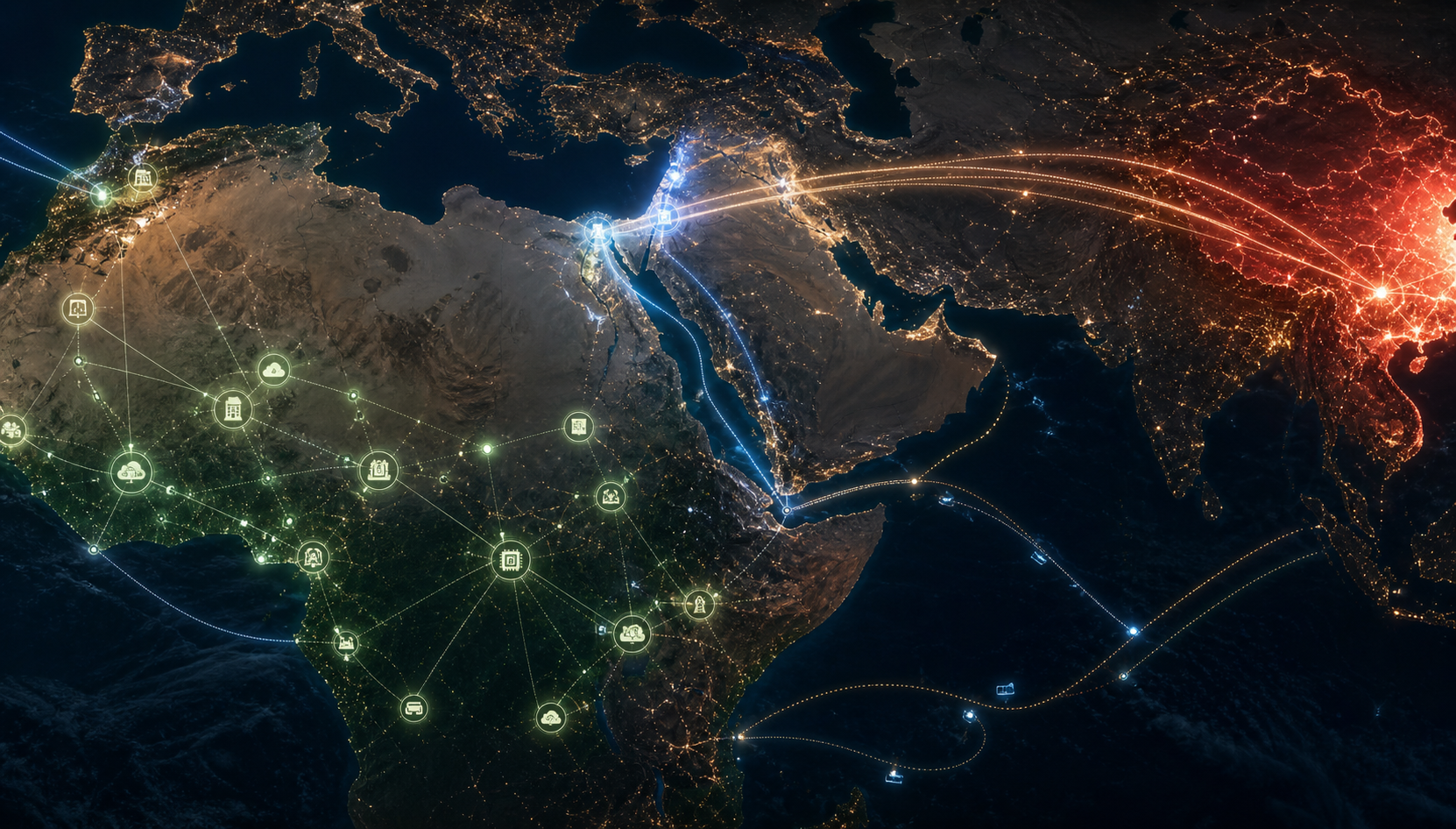
The Silent Redrawing of Israel’s Neighborhood: China’s Tech Influence in Africa and the Middle East
For years, Israel’s strategic assessment of China’s influence has been framed through familiar lenses—port infrastructure, large-scale construction projects, and geopolitical warnings from Western allies. These concerns, while valid, have oversimplified a far more insidious and transformative dynamic: China’s quiet but profound infiltration into the foundational technological and industrial systems of Israel’s immediate strategic environment. Unlike visible infrastructure projects, which can be debated and monitored, China’s influence is now embedded in the operational layers of economies—cloud platforms, AI-driven governance, telecom networks, battery supply chains, fintech, smart grids, and subsea cable networks. These systems are the unseen backbone of modern states, and their evolution holds critical implications for Israel’s security, economic ties, and diplomatic maneuverability.
Africa, often overlooked in Israel’s strategic calculus, is no longer a distant continent but a directly connected and interdependent region whose technological and industrial trajectories shape Israel’s shipping lanes, data sovereignty, energy security, cyber resilience, and even domestic market dynamics. The Red Sea, once viewed primarily through the lens of maritime security and Houthi attacks, is also a digital chokepoint—a critical conduit for 90% of Europe-Asia internet traffic, where Chinese state-linked firms are increasingly dominant. Meanwhile, Egypt’s AI-driven cloud infrastructure, Morocco’s battery megaprojects, and Africa’s telecom modernization efforts are not isolated developments but strategic realignments that will redefine regional power dynamics by 2030.
Egypt: The AI and Cloud Hub of Northern Africa
Egypt’s engagement with Chinese tech firms is a case study in strategic pragmatism—balancing technological advancement with national sovereignty. On June 25, 2026, Huawei Cloud launched Model-as-a-Service (MaaS) in Egypt, offering businesses access to customizable large language models (LLMs) without the need for in-house infrastructure development. This initiative targets seven critical sectors: finance, telecommunications, government administration, retail, logistics, customer service, and enterprise support. The implications are vast: AI-driven document processing, automated decision-making, client management, and data structuring will become standard operational protocols across Egypt’s economy, reducing reliance on Western tech giants while accelerating digital transformation.
This launch was part of a coordinated push by Huawei in Cairo:
– June 16, 2026: Huawei Cloud and Thndr, Egypt’s leading investment platform, signed a Memorandum of Understanding (MoU) focused on AI-powered fintech solutions, aiming to modernize Egypt’s financial sector with real-time transaction processing, fraud detection, and personalized banking services.
– 2024: Huawei Cloud inaugurated Egypt’s first large-scale public cloud region, emphasizing local data processing and storage to comply with Egypt’s data sovereignty laws. This move positions Egypt as a regional AI and cloud hub, attracting businesses seeking low-latency, compliant infrastructure without Western conditionality.
– May 2026: Huawei unveiled AI-optimized network solutions in Cairo, positioning Egypt as a Northern African gateway for AI-ready connectivity. The proposal includes:
– Campus and wide-area networks (WANs) optimized for AI workloads.
– Next-generation data centers with edge computing capabilities to reduce latency.
– Enhanced cybersecurity frameworks tailored for government and enterprise use.
– Automated network operations using AI-driven “copilots” for predictive maintenance and traffic management.
Egypt’s motivations are both economic and geopolitical:
– Capacity without dependence: Cairo seeks high-performance infrastructure without surrendering control to Western firms, which often impose data access restrictions or political strings.
– Localization without isolation: Chinese firms offer turnkey solutions, including training programs and financing, allowing Egypt to digitally modernize without overhauling its regulatory framework.
– Diplomatic maneuverability: Egypt avoids the moral and economic pressures associated with Western tech, such as human rights conditionality or export controls, while still accessing cutting-edge technology.
However, this strategic calculus carries hidden risks:
– Data localization paradox: While Egypt gains operational autonomy, its reliance on Huawei’s proprietary AI models and cloud architecture creates vendor lock-in, making future transitions difficult.
– Opaque AI systems: The integration of AI into sensitive sectors (e.g., finance, governance) introduces algorithm transparency concerns, particularly if China’s data-sharing policies conflict with Egypt’s national security interests.
– Hard-to-diversify infrastructure: Once embedded, cloud regions and AI networks become strategic assets—difficult to replace without disrupting critical services.
Israel must recognize that Egypt’s choices are rational but strategic, and their long-term impact extends beyond Cairo’s borders. As Egypt’s tech infrastructure evolves, it will indirectly influence Israel’s data flows, cybersecurity posture, and even its own fintech and AI adoption—whether through shared regional networks or supply chain dependencies.
Morocco: The Battery Megaproject and Industrial Ascendancy
While Egypt leads in digital transformation, Morocco is positioning itself as the industrial powerhouse of Africa’s energy transition. On July 24, 2026, the African Development Bank (AfDB) approved a €100 million loan to Gotion Power Morocco (GPM), a subsidiary of China’s Gotion High-Tech, for the construction of an integrated lithium iron phosphate (LFP) battery gigafactory in the Rabat-Salé-Kénitra Free Trade Zone.
This project is far more than a manufacturing facility—it represents Morocco’s strategic pivot toward industrial sovereignty in the global EV supply chain:
– Phase 1 (2026-2027): A 10 GWh capacity, with plans to scale to 100 GWh in subsequent phases.
– Local integration: The project aims for a 70% local industrial integration rate, creating over 600 direct jobs and fostering a domestic battery ecosystem.
– Regional dominance: Morocco seeks to become a key supplier for Europe’s EV market, competing with China, South Korea, and Europe’s own battery hubs (e.g., Germany’s North Sea Wind-to-Hydrogen projects).
For Israel, this development has two critical layers:
1. Consumer market impact: Israel is already experiencing rapid Chinese EV adoption, with Chinese automakers accounting for 77,625 sales in the first half of 2026—a 70.8% year-on-year increase. Chery became Israel’s top-selling automaker, while XPeng, BYD, and Changan dominated the electric vehicle (EV) segment, surpassing Tesla in certain categories. This shift reflects consumer preference for affordability and innovation, but it also signals supply chain dependencies that could be influenced by Morocco’s battery production.
2. Strategic industrial realignment: Morocco’s gigafactory is not just about localizing battery production—it is about controlling the upstream supply chain for lithium, cathode materials, and assembly. As Morocco’s capacity grows, it will compete with China for global EV dominance, potentially reducing Israel’s reliance on Chinese battery imports while still integrating into a Chinese-led industrial network.
The Red Sea’s dual role—as both a maritime and digital chokepoint—further complicates this dynamic. A 2025 Center for Strategic and International Studies (CSIS) report highlighted Egypt’s centrality in global subsea cable networks, noting that:
– 17% of global internet traffic passes through Egypt.
– Over 90% of Europe-Asia communications rely on cables transiting the Red Sea.
– Four cables were severed in March 2024, disrupting 25% of Asia-Europe-Africa traffic, while further cuts in September 2025 degraded connectivity across the Middle East and Asia.
China’s role in this infrastructure is growing:
– State-linked firms (e.g., China Mobile International, Huawei, China Telecom, China Unicom) are investing in subsea cable projects, including alternative routes to mitigate Red Sea vulnerabilities.
– Egypt faces competition from Israel, Jordan, Saudi Arabia, Oman, and India, including Google’s Blue-Raman system, which aims to diversify critical data pathways.
Israel’s Red Sea strategy—traditionally focused on Houthi attacks, Iranian proxies, and shipping security—must now account for digital resilience. The severing of cables has already demonstrated the region’s vulnerability, and future disruptions could sever Israel’s data links to Asia and Europe, with China’s tech firms poised to capitalize on the need for redundancy.
Africa’s Telecom Revolution: Huawei and the AI-Native Network
The most profound shift in China’s African tech expansion is occurring in telecommunications, where Huawei is transitioning from equipment supplier to network architect. On March 2026, Huawei and MTN Group, Africa’s largest telecom operator, signed a strategic MoU covering:
– AI-driven networks with autonomous operations (e.g., “network copilots” that optimize traffic in real time).
– Home broadband expansion to bridge Africa’s digital divide.
– Data monetization platforms to help MTN leverage its network assets.
– AI-ready data centers to support edge computing and local AI processing.
– Fiber and autonomous network operations, reducing human intervention in critical infrastructure.
This is not merely an upgrade—it is a paradigm shift:
– Telecom vendors are no longer selling hardware but entire network intelligence frameworks, including:
– Predictive traffic management (AI predicts congestion and reroutes data).
– Self-healing networks (automated repairs after failures).
– Dynamic pricing models (AI adjusts data costs based on demand).
– Enhanced cybersecurity (AI detects and mitigates threats in real time).
– For Israel’s cyber and intelligence communities, this evolution is familiar territory—AI-driven networks are no longer passive pipes but active, learning systems that sense, route, price, and secure traffic with minimal human oversight.
The implications for Israel are twofold:
1. Regional cyber risk: As African telecom networks become more AI-dependent, they may introduce new vulnerabilities (e.g., AI model exploits, supply chain attacks on Huawei equipment). Israel’s cyber defense strategies must account for third-party risks in neighboring states’ infrastructure.
2. Data sovereignty challenges: If MTN and other African operators outsource network intelligence to Huawei, Israel may face limited visibility into data flows transiting through Egypt, Morocco, or East Africa—critical for economic espionage, crisis response, and cyber threat intelligence.
The Strategic Paradox: Why Israel Must Pay Attention
Israel’s historical debate on China has been defensive: How much Chinese involvement is too much within Israel itself? This question, while important, has blinded policymakers to a broader reality:
– Israel’s neighbors are not passive recipients of Chinese tech—they are active participants, pursuing legitimate development goals (e.g., digital sovereignty, industrial upgrading, cost efficiency).
– China’s appeal is not just economic—it is political. Many African and Middle Eastern governments reject Western conditionality (e.g., human rights clauses, export controls) and prefer Chinese “no-strings-attached” partnerships.
– The strategic risk is not encirclement—it is misreading the region. A country can maintain peace with Egypt, trade with Africa, rely on Red Sea routes, and cooperate with the U.S. while unwittingly embedding itself in a tech-dependent ecosystem that limits its strategic options.
The real danger is that by the time Israel notices the shift, the infrastructure will already be in place. The Red Sea’s digital chokepoint, Egypt’s AI-driven governance, Morocco’s battery megaprojects, and Africa’s AI-native telecom networks will have become the new normal—hard to reverse, expensive to replace, and critical to Israel’s security.
A Call for Strategic Awareness
Israel must adopt a dual approach:
1. Monitor, but do not caricature: Recognize that China’s tech expansion in Africa is not a monolithic threat but a complex interplay of economic, political, and technological factors.
2. Develop contingency plans: Assess digital redundancy options (e.g., alternative subsea cable routes, local cloud alternatives, AI interoperability standards).
3. Leverage partnerships: Collaborate with U.S., EU, and African allies to develop tech standards, cybersecurity frameworks, and supply chain diversification that mitigate Chinese dominance.
4. Invest in strategic foresight: The next China-Israel story may not unfold in Haifa or Washington—it could begin in Cairo’s data centers, Rabat’s battery plants, or the undersea cables beneath the Red Sea. Israel’s ability to navigate this evolving landscape will depend on understanding the unseen wires that are already being pulled.
The quiet revolution in Africa’s tech infrastructure is reshaping Israel’s strategic environment—one cloud contract, one battery gigafactory, and one severed cable at a time. The question is no longer whether China will influence Israel’s neighborhood—but how prepared Israel is to respond.
