

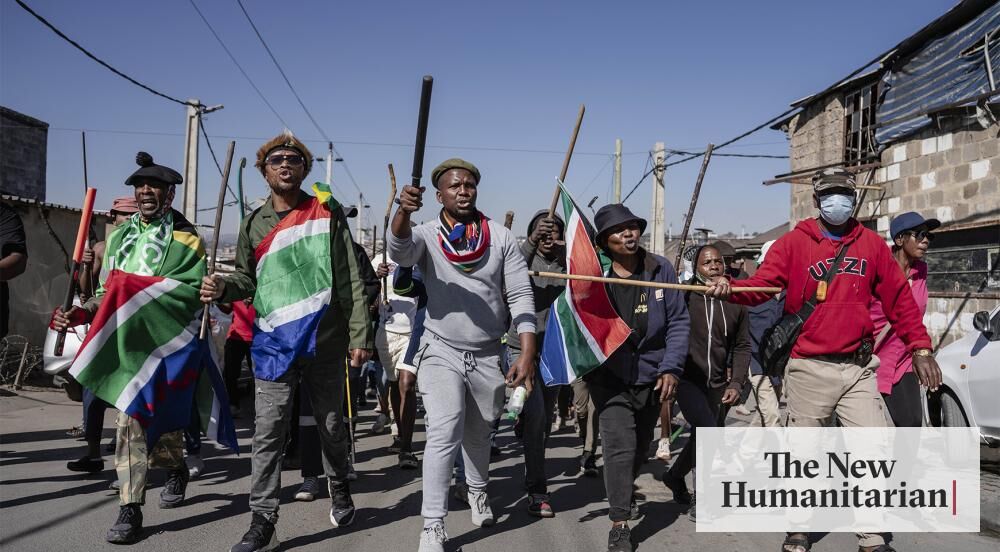
South Africa’s escalating anti-migrant sentiment, epitomized by the March and March movement, has morphed from sporadic violence into a structured campaign demanding the expulsion of undocumented migrants—despite mounting evidence of its devastating economic and social consequences. With a self-imposed deadline of June 30, 2024, for all undocumented migrants to leave, the movement has intensified its rhetoric, framing migration as an existential threat to national sovereignty and economic stability. Yet, the reality on the ground paints a far more complex—and damaging—picture.
A Movement Fueled by Fear, Not Facts
March and March, which positions itself as a “civic organization,” has set its sights on the upcoming November 4 local government elections, aiming to weaponize migration as a defining electoral issue. Spokesperson Sandile Dube has vowed that the movement will “fix the country” by ensuring “every South African job is occupied by a South African.” However, this narrative ignores the critical role migrants play in South Africa’s economy, particularly in sectors like informal trade, agriculture, and manufacturing.
The movement’s rhetoric aligns with a broader Afrophobic discourse that has gained traction across social media, radio talk shows, and public forums. Migrants are routinely vilified as criminals, tax evaders, and economic burdens—despite a lack of empirical evidence to support these claims. In fact, studies suggest that migrants contribute significantly to GDP, particularly through informal economies like spaza shops (small convenience stores) that dominate urban landscapes.

The Human Cost of Economic Xenophobia
For millions of South Africans, the fallout from the movement has been personal and devastating. Take the case of Maggie Mpharana, a Soweto resident who rented her garage to Harun Gebrelasse, a Somali trader operating a spaza shop. Gebrelasse, who held a valid visa and business permits, paid $180 monthly in rent and employed Mpharana’s teenage son. Yet, in June 2024, vigilantes beated him, looted his shop, and later torched it—despite his legal status.
“I don’t understand how that is fixing the country,” Mpharana told reporters. Her frustration reflects a broader truth: the movement’s violence disproportionately harms legal migrants, many of whom are first-generation entrepreneurs who have built livelihoods from scratch.
Spaza shops, which dot every street corner in South African cities, are lifelines for working-class communities. Estimates suggest that 150,000–200,000 such shops generate nearly 3 million jobs and contribute over 5% to South Africa’s GDP. They operate as micro-financial hubs, offering credit to regular customers—a service that formal banks often neglect. Yet, under March and March’s pressure, landlords are being coerced into evicting migrant tenants, forcing shop owners like Bayene, an Ethiopian asylum seeker, into uncertain futures.
“My landlord doesn’t want to kick me out, but some have complied,” Bayene said. “They’re afraid of their properties being burned.” Many traders have since closed shops or fled, leaving neighborhoods without essential services.

The Collapse of Informal Economies
The ripple effects extend beyond individual businesses. Shuab, a Somali wholesale trader in Soweto, operates one of five warehouses supplying hundreds of spaza shops in the area. Since March and March’s campaign began, his business has plummeted by 40%, forcing him to stockpile goods for fleeing shopkeepers.
“This is organized, but we don’t know who’s behind it,” Shuab said. Unlike past outbreaks of violence, where looting was followed by a return to normalcy, March and March’s tactics are calculated and sustained. Whether legal or undocumented, migrants are now targeted en masse, with landlords pressured into compliance under threat of arson.
The movement’s false narrative—that migrants drain resources while South Africans suffer—ignores the $600 million annual turnover of Jeppe Street, Johannesburg’s informal trading hub. Traders from Zambia, Malawi, and Mozambique contribute far more to the local economy than the $300 million generated by Sandton, Africa’s richest mall. Yet, March and March’s intimidation has slashed cross-border trade by at least 30%, according to a Zambian bus operator.
Economist Tanya Zack, who has studied Jeppe’s economy for years, argues that Johannesburg’s enforcement actions—such as demolishing informal stalls—legitimize exclusion without offering alternatives. “The city is destroying irregular stalls but has no vision for what comes next,” she said. “It’s pure law enforcement, not economic planning.”

A Nation Divided: Public Opinion vs. Policy Reality
While March and March claims to represent the “will of the people,” grassroots sentiment tells a different story. In Soweto’s Naledi neighborhood, residents like Happiness Tuso and Ntombi reject the movement’s extremism. “Yes, if you’re here illegally, it’s wrong,” Tuso said. “But I don’t believe what they’re doing is right. We know and trust the migrants in our community.”
Yet, systemic discrimination persists. Both women have faced racial profiling—Tuso, due to her dark complexion, and Ntombi, because she wears a hijab—being stopped and questioned by vigilantes in city centers. “It’s embarrassing, especially with my children,” Tuso said. “We have to prove ourselves by speaking Zulu, but my kids speak it poorly.”
This duality—of coexistence and hostility—highlights South Africa’s deeper structural failures. The country’s 60% youth unemployment rate (as of Q1 2024) and 80% of 9–10-year-olds unable to read for meaning create a fertile ground for scapegoating. As William Gumede, founder of the Institute for Social Dialogue, warned: “If all non-South Africans are kicked out, it won’t solve unemployment or service delivery. It will only deepen economic collapse.”
The Agricultural and Industrial Fallout
The impact extends beyond urban economies. In KwaZulu-Natal’s sugar belt, farmers report losing up to 80% of their cane-cutting workforce overnight due to xenophobic raids. The horticulture and textile sectors, already struggling with climate change and global competition, face further instability as skilled migrant workers—often from Zimbabwe, Mozambique, and Lesotho—are driven out.
Jassat Esat, who runs a textile factory, acknowledges the demand for local hiring but argues that skill gaps make foreign labor indispensable. “We employ based on training and work ethic,” he said. “If we lose these workers, the industry collapses.”
Meanwhile, agricultural employers have called on the Department of Home Affairs to issue legal hiring waivers, but political pressure has stifled progress. The result? Farms are going unharvested, and manufacturing plants are shutting down—all while unemployment remains stagnant at 41% for 25–34-year-olds.
Diplomatic Isolation and Economic Strain
Beyond domestic consequences, South Africa’s xenophobic backlash has isolated it on the continent. With $42 billion in annual trade with Africa, the country risks losing its regional economic leadership. Gumede warns: “We’re fighting the rest of Africa while destroying our own economy.”
March and March’s leader, Sandile Dube, acknowledges economic disruption but insists crime—particularly drug trafficking and human smuggling—justifies the campaign. “You can’t leave criminals behind,” he said. However, crime rates in South Africa have risen regardless of migration status, with local gangs and corruption far more pervasive than foreign involvement.
A Call for Reason in an Era of Populism
As South Africa heads into local elections, the March and March movement’s influence threatens to permanently alter the country’s social fabric. Journalist Mondli Makhanya captures the nation’s dilemma: “Reason and logic are losers in this debate. Populist voices dominate.”
Yet, as Ntombi reminded reporters: “We put too much blame on the government, but it’s not right to be dependent on it. You can open a business in your own home.” The real solution lies not in expulsion, but in policy reform—regularizing migrant labor, investing in education, and creating jobs that don’t rely on exploitation.
For now, South Africa stands at a crossroads. Will it choose fear and division—or economic recovery and unity? The answer may determine whether the country survives its own backlash.
