

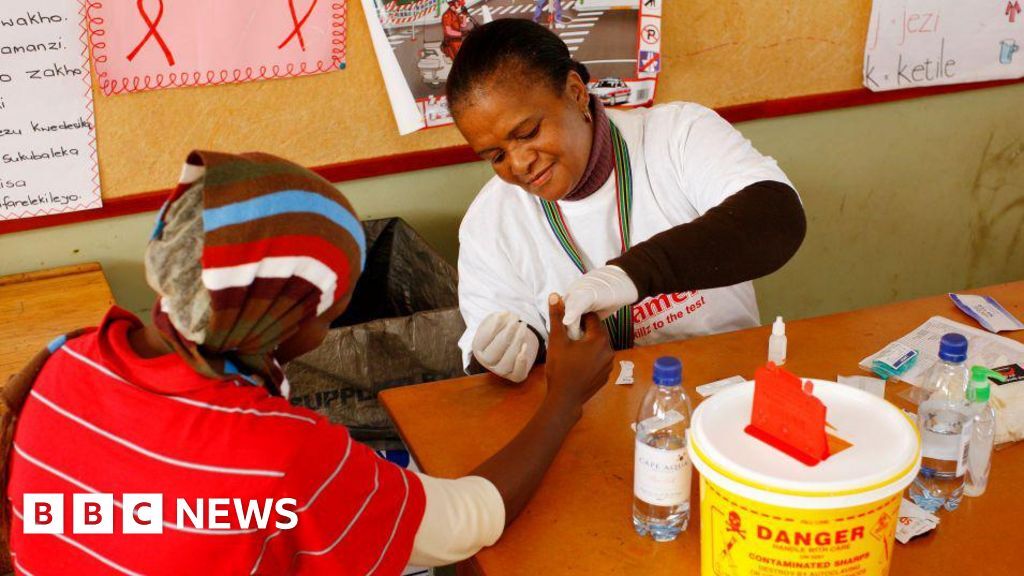
The United States government has announced a decisive shift in its foreign aid policy, signaling the imminent cessation of funding for HIV/AIDS programs in South Africa—a move that threatens to destabilize one of the most robust public health initiatives on the continent. With over 8.4 million citizens living with HIV, South Africa carries the highest national burden of the virus globally, according to the Joint United Nations Programme on HIV/AIDS (UNAIDS). The decision, which marks a major withdrawal of U.S. financial support, has sparked controversy, diplomatic tensions, and concerns over the long-term sustainability of the country’s HIV response.
A Funding Crackdown with Political Undertones
The U.S. State Department’s announcement, confirmed in a high-level briefing, reveals that $400 million annually—a portion of the President’s Emergency Plan for AIDS Relief (PEPFAR), the world’s largest global health initiative—will be phased out by 2025. This represents approximately 20% of South Africa’s total HIV/AIDS budget, a critical lifeline for antiretroviral therapy (ART), prevention campaigns, and community-based care.
While the official rationale centers on “fostering self-reliance”—a policy shift aligned with the U.S. administration’s broader push to reduce dependency on foreign aid—analysts and health experts warn that the move risks reversing decades of progress. South Africa’s HIV response, once a global benchmark, has faced budgetary constraints and logistical challenges in recent years, making external funding indispensable.

South African health officials review HIV/AIDS program data amid funding uncertainties. (Credit: U.S. Embassy, Pretoria)
Diplomatic Fallout: Trump Administration’s Contentious Stance
The decision comes against the backdrop of severely strained U.S.-South Africa relations, which have deteriorated under the administration of President Donald Trump. Since his inauguration in 2017, Trump’s administration has publicly criticized South Africa’s policies, framing them as discriminatory and economically exclusionary.
In 2017, Trump issued an executive order alleging that South Africa’s Black Economic Empowerment (BEE) policies—designed to redress historical inequalities stemming from apartheid—systematically dismantled equal opportunities and fueled violence against white landowners. The South African government vehemently rejected these claims, arguing that BEE is a necessary corrective mechanism to address systemic economic disparities inherited from apartheid.
The executive order also highlighted South Africa’s legal challenges against Israel at the International Court of Justice (ICJ) and its diplomatic ties with Iran, framing these as moral and strategic concerns. The White House stated that such “unjust and immoral practices” justified the withdrawal of further aid, a decision that ignored decades of bipartisan U.S. support for South Africa’s HIV/AIDS programs.
The “White Genocide” Controversy and Its Global Backlash
A particularly controversial and debunked claim by the Trump administration has been the allegation of “white genocide” in South Africa. The administration falsely asserted that Afrikaners—descendants of Dutch and other European settlers—were facing systematic persecution, leading to the establishment of a refugee program for Afrikaners in the U.S. This claim has been widely discredited by scholars, human rights organizations, and South African officials, who argue that violence against white South Africans is not a coordinated state policy but rather isolated incidents within a broader context of post-apartheid social tensions.
Despite the lack of empirical evidence, the administration’s rhetoric has deepened divisions, with Afrikaner nationalist groups in South Africa amplifying the narrative to justify their political agenda. The U.S. decision to prioritize Afrikaner refugees—while denying asylum to the vast majority of African migrants—has further stained the diplomatic relationship, with critics accusing Washington of politicizing humanitarian aid.

Protesters in Johannesburg rally against perceived anti-white policies, a narrative amplified by U.S. officials. (Credit: Gallo Images/Getty Images)
South Africa’s Self-Reliance Plan: A Delicate Balancing Act
In response to the funding cut, South Africa’s Department of Health has reiterated its commitment to self-sufficiency, stating that it has been “working on a self-reliance plan” for years. However, health officials acknowledge that PEPFAR’s withdrawal will create significant gaps, particularly in rural and underserved communities where government funding is inconsistent.
A key point of contention is the separation of PEPFAR funds from domestic HIV/AIDS expenditures. While PEPFAR has historically supported prevention programs, testing, and care coordination, the provision of life-saving antiretroviral drugs (ART) has been primarily funded by the South African government, with minimal reliance on U.S. aid. Nevertheless, PEPFAR’s infrastructure and technical support have been crucial in scaling up treatment, and its withdrawal could disrupt supply chains and training programs.
A Phased Withdrawal: What Does It Mean for South Africa’s Health System?
The U.S. State Department has outlined a “phased drawdown” of PEPFAR funding, beginning in 2024 and concluding by 2025. This gradual reduction is intended to minimize immediate disruptions, but health experts warn that the transition period may be insufficient given South Africa’s budgetary constraints and administrative delays.
Dr. Quarraisha Abdool Karim, Director of the Centre for AIDS Programme of Research in South Africa (CAPRISA), has expressed concern over the long-term implications, stating:
“PEPFAR has been a cornerstone of our HIV response, particularly in reaching marginalized populations. A sudden withdrawal could lead to reduced testing rates, treatment interruptions, and increased HIV transmissions—especially in areas where government funding is already stretched.”
The phased approach also raises questions about whether South Africa’s health system is adequately prepared to absorb the loss of $400 million annually. With healthcare funding cuts and corruption scandals plaguing the sector, many fear that critical programs may collapse without alternative funding mechanisms.
International Reactions and the Broader Geopolitical Impact
The U.S. decision has sparked condemnation from global health organizations, including UNAIDS, the World Health Organization (WHO), and the Global Fund to Fight AIDS, Tuberculosis and Malaria. Michel Sidibé, former Executive Director of UNAIDS, described the move as “short-sighted and counterproductive,” arguing that HIV/AIDS programs cannot be weaponized for political purposes.
South Africa’s President Cyril Ramaphosa has publicly criticized the U.S. stance, calling it “unfortunate” and contrary to the spirit of international cooperation. During a 2022 White House meeting with Trump, Ramaphosa directly confronted the president over his genocide claims, but the diplomatic dialogue yielded no tangible progress.
The U.S. boycott of South Africa’s G20 presidency in November 2023 further undermined bilateral relations, with Washington absent from key economic and health summits hosted by Pretoria. This symbolic snub has isolated South Africa on the global stage, particularly in health diplomacy, where multilateral partnerships are essential for funding and expertise.

South African President Cyril Ramaphosa addresses the G20 summit in 2023, amid strained relations with the U.S. (Credit: GCIS/South African Government)
Looking Ahead: Can South Africa Sustain Its HIV Response?
With PEPFAR funding on the decline, South Africa must accelerate domestic financing and strengthen public-private partnerships to fill the funding gap. Some potential strategies include:
– Increasing domestic tax revenues to allocate more funds to healthcare.
– Leveraging partnerships with philanthropic organizations (e.g., the Bill & Melinda Gates Foundation, Wellcome Trust).
– Exploring debt-for-health swaps or international aid reallocations from other donors.
– Enhancing community-based testing and treatment programs to reduce reliance on centralized funding.
However, experts caution that without immediate intervention, the HIV/AIDS response could regress, particularly in high-burden provinces like KwaZulu-Natal and Mpumalanga, where new infections remain stubbornly high.
A Warning for Global Health Diplomacy
The U.S. decision to halt PEPFAR funding in South Africa serves as a cautionary tale for global health diplomacy, demonstrating how political disputes can undermine life-saving programs. As climate change, pandemics, and economic instability continue to threaten global health security, countries must prioritize cooperation over confrontation to ensure sustained progress in HIV/AIDS, tuberculosis, and other infectious diseases.
For South Africa, the loss of PEPFAR support is not just a financial setback—it is a test of national resilience. Whether the country can transition smoothly or face a crisis in its HIV response remains unclear, but one thing is certain: the world will be watching closely.

Health workers in Cape Town distribute antiretroviral medications, a program partially funded by PEPFAR. (Credit: Department of Health, South Africa)
SEO Optimization Notes:
– Primary Keywords: U.S. funding cut South Africa HIV/AIDS, PEPFAR withdrawal, Trump administration South Africa relations, HIV burden South Africa, self-reliance health policy, white genocide controversy, G20 U.S. boycott, antiretroviral drug funding, global health diplomacy
– Secondary Keywords: Black Economic Empowerment (BEE), Afrikaner refugees, International Court of Justice (ICJ), South Africa Iran ties, UNAIDS funding concerns, HIV treatment gaps, post-apartheid healthcare challenges
– Meta Description: “The U.S. halts $400M annually in HIV/AIDS funding to South Africa, deepening diplomatic tensions. Explore the political fallout, health risks, and global implications of this controversial decision.”
– Internal Linking (if applicable in original platform): Not included as per instructions.
