

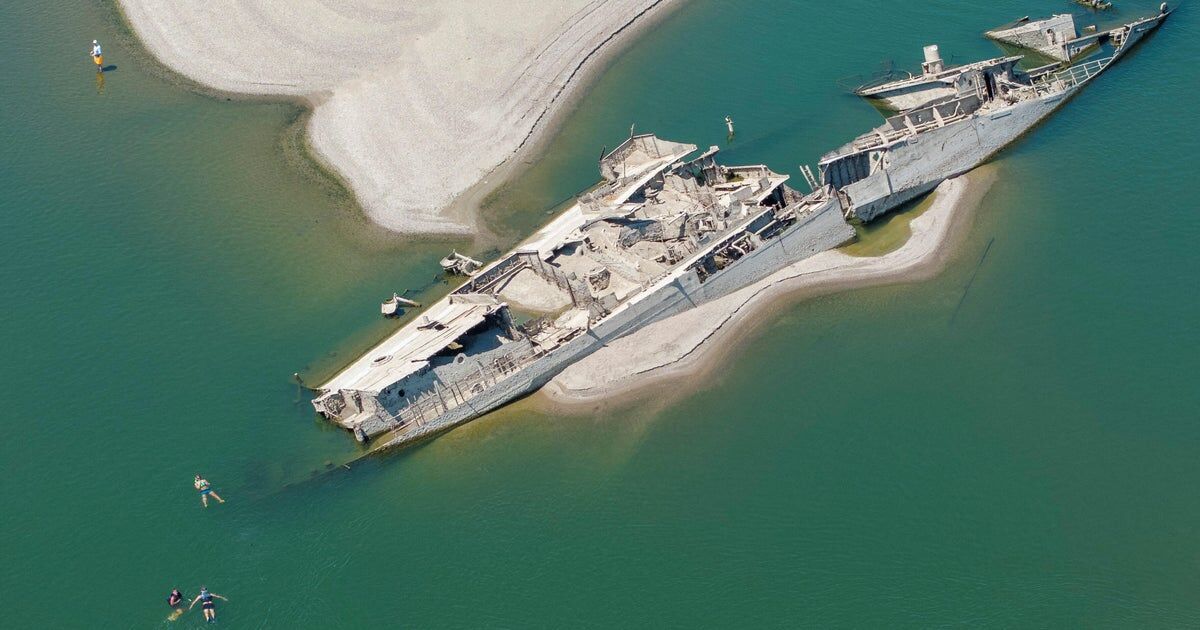
The Danube River, Europe’s second-longest waterway, has become a haunting spectacle as record-low water levels expose forgotten relics of history—including the rusted hulks of Nazi German warships and the fossilized remains of a prehistoric woolly mammoth. The dramatic exposure, triggered by an unprecedented drought gripping Central and Eastern Europe, has not only captivated historians and archaeologists but also underscored the escalating climate crisis threatening the continent’s vital waterways.
A River Running Dry: The Human and Environmental Toll
The Danube, which stretches over 2,850 kilometers (1,770 miles) through 10 countries, has seen its water levels plummet to historic lows. The drought, exacerbated by prolonged heatwaves linked to global warming, has forced governments across the region to implement emergency measures to prevent catastrophic consequences. Power plants relying on hydroelectricity face imminent shutdowns, while shipping routes—critical for trade and logistics—have become impassable for larger vessels.
In Serbia, near the port of Prahovo, where the river narrows into a dramatic gorge, the receding waters have laid bare the skeletal remains of dozens of World War II-era German battleships. These vessels, once part of the Nazi Black Sea Fleet, were deliberately scuttled in September 1944 as retreating German forces sought to obstruct Soviet advances in the Balkans. The decision to sink the ships was a desperate attempt to slow the Allied push, though it ultimately proved futile as Germany surrendered just six months later in May 1945.
The Ghost Fleet of Prahovo: A Dangerous Historical Time Capsule
Among the exposed wrecks, at least 20 ships—ranging from destroyers to smaller patrol boats—are now visible from the riverbanks. Some still carry live explosives, posing significant risks to divers, historians, and curious onlookers. The most striking discovery is the rusted hull of a former Nazi flagship, its broken mast once bearing the Swastika flag, now reduced to a skeletal frame jutting from the muddy shallows.
Local resident Ivica Gavrilović, who has spent his entire life along the Danube, described the scene as both fascinating and perilous. “People are extremely curious, but accessing these ships is extremely dangerous,” he told reporters while guiding a small boat through the treacherous waters. “The explosives are still active, and the structures are unstable. It’s not something you can just wade into.”
Historical records indicate that up to 200 German warships were sunk in the Danube gorge during the war, though most were later removed by Communist Yugoslav authorities in the mid-20th century. The remaining vessels, however, have persisted due to the explosive ordnance they still contain, making recovery efforts both technically challenging and financially prohibitive.
This is not the first time the Danube has revealed its wartime secrets. In 2022 and 2024, similar drought conditions exposed scattered Nazi ships near Prahovo, prompting concerns over environmental contamination and historical preservation. Authorities are now scrambling to secure the wrecks before the low water levels rise again, though the immediate priority remains maintaining navigable shipping lanes for the region’s economy.
A Prehistoric Discovery: The Woolly Mammoth of Bulgaria
While the Danube’s wartime relics draw immediate attention, the receding waters have also unearthed a prehistoric marvel—the well-preserved remains of a woolly mammoth in Bulgaria. Near the northeastern city of Ruse, along the Danube’s banks, archaeologists have recovered fragments of a young mammoth that lived during the Ice Age.
The discovery, led by Nikolay Nenov, director of the Regional Historical Museum, includes:
– A complete jawbone
– Fragments of tusks
– A portion of a shoulder blade
– A femur with its articular head intact
Nenov emphasized that the bones are exceptionally well-preserved, unlike many previous finds that were scattered or fragmented. “This is a rare case where the remains of a single mammoth were concentrated in one location,” he explained. “The dark coloration of the bones suggests the animal spent much of its time in a marshy environment, possibly near the river itself.”
Scientists believe the mammoth was young, likely a juvenile, and estimate its age at around 4,000 years old—a relatively recent period compared to the species’ 100,000-year history. Woolly mammoths, cold-adapted herbivores, once roamed across Eurasia alongside early humans, who hunted them for food, ivory, and bone tools. Their eventual extinction is attributed to climate change, human hunting pressure, and habitat loss.
This discovery is particularly significant because it provides new insights into the mammoth’s behavior and environment during the late Pleistocene epoch. The bones may also contain ancient DNA, offering potential clues about the species’ genetic adaptation to changing climates—a critical area of study as modern ecosystems face similar threats.
Climate Change and the Danube’s Future
The exposure of these historical and prehistoric relics is a visual manifestation of the climate crisis. Experts warn that prolonged droughts, rising temperatures, and erratic rainfall patterns are becoming the new norm in Europe, with the Danube River system among the most vulnerable.
Krsta Brandić, a resident of Prahovo, highlighted the immediate consequences: “The water levels are so low that even medium-sized ships can no longer navigate. If this continues, entire industries—from agriculture to tourism—will suffer.”
The European Union has urgently called for cross-border cooperation to mitigate the crisis, including water conservation programs, dam adjustments, and emergency desilting operations. However, long-term solutions require reducing greenhouse gas emissions and sustainable water management policies to prevent future droughts.
A River of Contrasts: History, Nature, and Crisis
The Danube’s drying banks serve as a powerful reminder of humanity’s complex relationship with nature. From the scattered wrecks of a defeated empire to the fossilized remains of a prehistoric giant, the river now offers a layered narrative of war, extinction, and resilience.
For historians, the exposed Nazi ships provide a chilling glimpse into the engineering of destruction during World War II. For paleontologists, the mammoth remains offer a window into a lost world. And for the millions who depend on the Danube for water, power, and trade, the crisis is a warning of what’s to come if climate action is not prioritized.
As the summer heat persists, one question looms large: How much of Europe’s hidden past—and future—will the Danube reveal before the waters rise again?

Rusted hulls of Nazi German warships emerging from the Danube near Prahovo, Serbia, as water levels drop to record lows. (CBS News)

A close-up of a broken mast from a scuttled German battleship, once bearing the Nazi flag, now exposed in the Danube’s shallow waters.

Archaeologists examining the well-preserved jawbone of a woolly mammoth discovered near Ruse, Bulgaria, alongside other fossil fragments.

Aerial view of the Danube gorge at Prahovo, where multiple WWII shipwrecks are visible due to extreme drought conditions.

Local residents and historians assessing the risks posed by unexploded ordnance on the exposed Nazi shipwrecks.
