

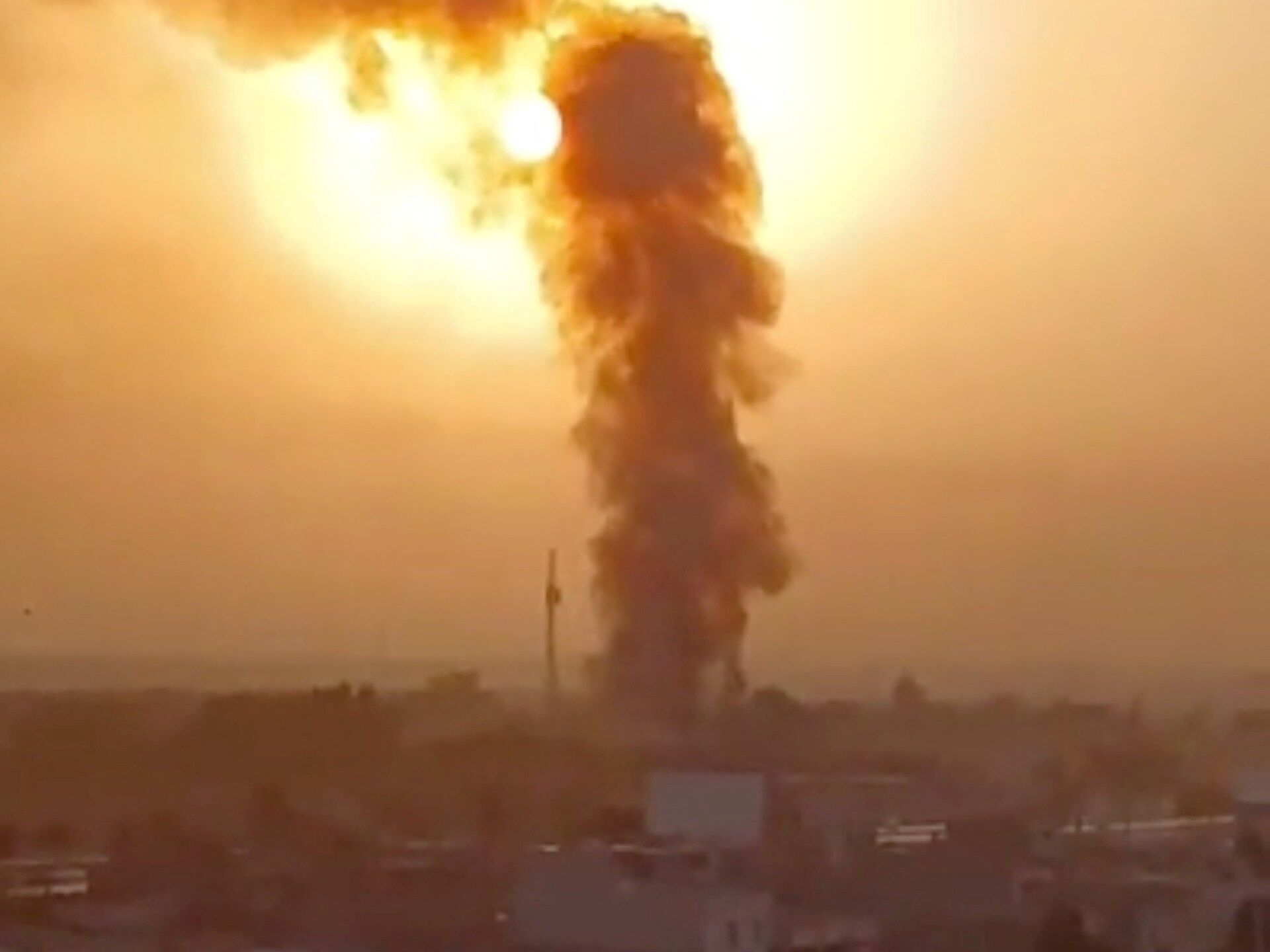
The escalating tensions between Iran and the United States have reached a critical juncture following a series of retaliatory military strikes. On Thursday, Iran’s Islamic Revolutionary Guard Corps (IRGC) announced that it had launched precision strikes against military installations in Kuwait and Jordan in response to recent U.S. airstrikes that resulted in significant casualties, including civilians. Meanwhile, the U.S. has vowed a swift and decisive response, with former President Donald Trump warning of further military action if Iran’s aggression continues.
IRGC Confirms Strikes in Kuwait and Jordan
In a statement released by the IRGC’s Quds Force, the group claimed responsibility for two coordinated attacks targeting U.S. and allied military assets in the region. The strikes were described as retaliatory measures following the U.S. airstrikes in Jordan that killed multiple Iranian-backed militiamen, including a Chinese national working at a facility in Kuwait.
The IRGC’s announcement came hours after reports emerged of explosions in Kuwait City, where a Chinese-owned industrial facility was struck, resulting in the death of at least one worker. Separately, in Jordan, the IRGC claimed to have hit a U.S. military base hosting American and Jordanian forces, though no immediate details on casualties were confirmed.
Casualties and Civilian Impact
The human toll of the escalating conflict has grown heavier. In Jordan, U.S. airstrikes on an Iranian-backed militia stronghold killed three Iranian nationals, including a high-ranking commander, according to regional security sources. However, the most devastating blow came when a U.S. drone strike in Iraq’s Anbar Province struck a family home, killing two parents and their toddler, raising international condemnation.
In Kuwait, the strike on the Chinese firm’s facility—likely a logistics or military support hub—has raised concerns over collateral damage to foreign workers. While the IRGC has not explicitly confirmed civilian casualties, local reports suggest that at least one worker was killed, with others injured. The incident has sparked diplomatic tensions, particularly as China has not yet publicly commented on the attack, though Beijing has historically maintained a neutral stance on Iran-U.S. conflicts.
U.S. Threatens Further Retaliation
The U.S. response has been swift and unyielding. Former President Donald Trump, who has been vocal in his support for a hardline approach toward Iran, tweeted that the U.S. would “strike back hard” if Iran’s actions escalate. While the current administration has not issued an official statement, military officials have indicated that U.S. forces remain on high alert in the region, with additional airstrikes and defensive measures being prepared.
General Michael Langley, a retired U.S. Air Force officer and defense analyst, stated in an interview with a regional outlet that “Iran’s strikes are calculated to provoke a U.S. escalation, but Washington must avoid overreaction that could spiral into a broader conflict.” Meanwhile, Jordan and Kuwait, both hosting U.S. military bases, have reinforced security measures and urged restraint from all parties.
Regional and Global Reactions
The strikes have sent shockwaves through the Middle East, with neighboring countries bracing for further instability. Saudi Arabia, which has maintained a tense relationship with Iran, has condemned the attacks while warning against any action that could destabilize the region. Turkey, a key NATO ally, has called for de-escalation, fearing a broader conflict that could disrupt regional energy supplies.
Internationally, Russia and China have avoided direct criticism of Iran, though both nations have historically supported Tehran’s nuclear and military programs. The United Nations, through its Secretary-General António Guterres, has expressed grave concern over the escalating violence, urging all parties to exercise maximum restraint.
Historical Context: A Pattern of Retaliation
This latest round of strikes follows a decades-long cycle of retaliation between Iran and the U.S. After the 2019 U.S. assassination of Qasem Soleimani, Iran launched ballistic missile strikes on Iraqi bases hosting American troops. Similarly, the 2020 U.S. airstrike that killed Soleimani led to Iran’s attack on Erbil Airport, though it was quickly repelled.
The current conflict also mirrors the 1980s Iran-Iraq War, where proxy battles and asymmetric warfare became common. Today, Iran relies on militia allies in Iraq, Syria, and Yemen, while the U.S. maintains a presence in Kuwait, Qatar, and Jordan. The risk of direct U.S.-Iran military confrontation remains high, particularly if Iran’s strikes continue to target American personnel or assets.
Economic and Strategic Implications
Beyond the immediate military and humanitarian consequences, the strikes could have long-term economic repercussions. Kuwait, a major oil exporter, has temporarily suspended some industrial operations due to security concerns. Meanwhile, China’s involvement in the Kuwait strike raises questions about foreign worker safety in conflict zones, particularly as Beijing has invested heavily in Middle Eastern infrastructure projects.
Strategically, Iran’s strikes appear designed to test U.S. resolve while proving its ability to strike beyond its borders. The IRGC’s long-range missile capabilities—developed despite U.N. sanctions—have made it a formidable adversary. However, the U.S. military’s superior air defense systems, including Patriot missiles and THAAD, could mitigate some of Iran’s offensive gains.
The Path Forward: Avoiding Full-Scale War
Experts warn that any further escalation could lead to a regional war, with Hezbollah in Lebanon, Houthis in Yemen, and Iraqi militias potentially joining the conflict. Diplomatic channels remain open, but trust between Tehran and Washington is at an all-time low.
Former Iranian Foreign Minister Mohammad Javad Zarif suggested in a recent interview that “direct negotiations are the only path to de-escalation,” though the U.S. has rejected diplomatic overtures in the past. Meanwhile, regional mediators, including Oman and Qatar, have been attempting to facilitate indirect talks, but progress has been slow.
Conclusion: A Fragile Calm Amid Rising Tensions
As of now, the immediate threat of a full-scale war has not materialized, but the risk remains high. The IRGC’s strikes in Kuwait and Jordan, coupled with the U.S. threat of retaliation, signal that the region is one miscalculation away from catastrophe.
For now, military forces in the Gulf remain on high alert, while civilian populations in Iraq, Syria, and the Arabian Peninsula continue to bear the brunt of the conflict. The world watches closely as Iran and the U.S. engage in a dangerous game of brinkmanship, with the potential for catastrophic consequences looming over the Middle East.
