

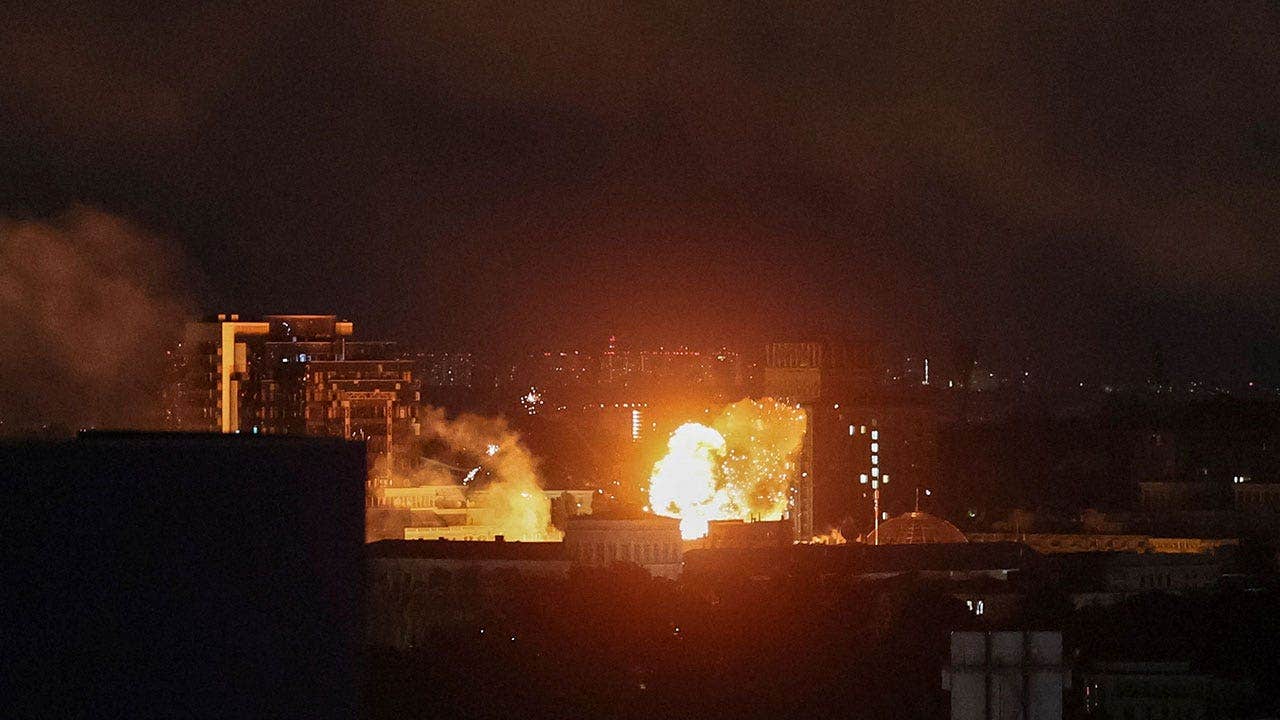
In a dramatic escalation of Russia’s prolonged invasion of Ukraine, Moscow launched a coordinated ballistic missile barrage on the capital city of Kyiv early Thursday, marking one of the most intense strikes since the conflict intensified in mid-2026. Ukrainian officials confirmed multiple explosions across the city, prompting emergency alerts and mass evacuations as residents rushed to underground shelters. The attack, which included high-precision strikes on critical infrastructure, underscores Russia’s determination to cripple Ukraine’s ability to resist further while testing NATO’s resolve amid mounting battlefield pressures.
A Night of Chaos: Kyiv Under Fire

Smoke and flames rise over Kyiv as Russian ballistic missiles strike residential and industrial zones, July 2, 2026. (Gleb Garanich/Reuters)
Kyiv Mayor Vitali Klitschko issued a frantic appeal to citizens via social media, urging them to seek shelter immediately as the city faced its most severe missile onslaught since Russia’s May offensive, which saw nearly 600 missiles and drones deployed in a single night. Witnesses reported multiple blasts across the city, with some areas experiencing prolonged tremors as missiles struck residential neighborhoods, military installations, and energy facilities. While Ukrainian authorities have yet to release official casualty figures, initial reports suggest limited direct civilian harm, though secondary explosions and structural damage are expected to worsen in the coming hours.
The Ukrainian Air Force confirmed that Russia had targeted Kyiv with a mix of hypersonic and conventional ballistic missiles, a tactic designed to overwhelm air defense systems and create psychological shock. The strikes followed a 24-hour warning from Ukrainian President Volodymyr Zelenskyy, who had previously indicated that Moscow was preparing a “massive overnight assault” after intelligence suggested Russia had amassed hundreds of missiles and drones in recent days.
Zelenskyy Warns of a “High-Probability” Escalation
In a direct message posted on X (formerly Twitter) on Wednesday, Zelenskyy cited intelligence from Air Force Commander Anatolii Kryvonozhko, who warned that Russia had been preparing for a coordinated strike for several days. The Ukrainian leader framed the impending attack as a “test of NATO’s unity and air defense capabilities”, emphasizing that the timing and scale of the assault were designed to exploit perceived gaps in Western military support.
“It is important that our partners fully understand what is happening and that the protection of lives directly depends on their readiness—or lack thereof—to help us with air defense missiles,” Zelenskyy wrote. His remarks came days after his high-profile visit to Washington, D.C., where he met with U.S. President Donald Trump at the White House. During the meeting, Trump had announced a major defense initiative: the U.S. would grant Ukraine a license to manufacture Patriot air defense systems domestically, a move analysts describe as a critical step in bolstering Kyiv’s ability to intercept Russian strikes.
The decision, announced at the NATO summit in Turkey, was framed as a long-overdue response to Russia’s relentless missile campaigns, which have increasingly targeted civilian infrastructure—including power grids, hospitals, and residential areas—in an effort to erode Ukrainian morale and strain Western resolve. Zelenskyy, in his follow-up statement, directly linked the missile strikes to NATO’s perceived hesitation, stating:
“Every partner knows what is needed and fully understands the consequences of marking time.”
Strategic Implications: A Shift in the War’s Dynamics
The timing of Russia’s attack—hours after Zelenskyy’s warning and days after the Patriot announcement—has led military analysts to speculate whether Moscow is testing NATO’s commitment or attempting to preemptively weaken Ukraine’s defenses before a potential summer counteroffensive. Seth Jones, a senior fellow at the Center for Strategic and International Studies (CSIS), told Topix GlobalWire that the strike reflects Russia’s growing desperation as Ukrainian forces, backed by Western arms, have regained momentum in key battlegrounds.
“Russia’s decision to strike Kyiv with such force suggests they are either attempting to break Ukrainian morale or force NATO into a more aggressive response,” Jones said. “The use of ballistic missiles in this manner is not just about destroying targets—it’s about signaling that they can strike anywhere, anytime, and that Ukraine’s air defenses are vulnerable.”
The Patriot missile production license, a $1.5 billion deal brokered by the U.S., is expected to accelerate Ukraine’s ability to intercept Russian strikes by allowing local manufacturing of Patriot PAC-3 interceptors, which are critical for downing hypersonic missiles and drones. However, analysts warn that full operational capability could take months, leaving Ukraine in a temporary window of heightened vulnerability.
The Human Cost: Civilians Brace for War’s Brutality
As Kyiv’s metro stations filled with thousands of refugees, residents described a city paralyzed by fear. [IMAGE_2]
Ukrainian civilians take shelter in an overcrowded metro station during a Russian missile strike, July 30, 2026. (Alina Smutko/Reuters)
“The sirens are constant now,” said Olga Petrovna, a 67-year-old retiree who spent the night in a reinforced subway tunnel. “They say the missiles are ‘smart,’ but they don’t care if they hit a school or a hospital. This is not a war—they are trying to erase us.”
The strikes have disrupted power and water supplies in parts of the city, with officials warning of potential blackouts lasting days. Meanwhile, Russian state media has framed the attack as a “necessary response to NATO’s aggression,” though independent observers note that Kyiv has not engaged in direct combat with NATO forces.
Looking Ahead: NATO’s Response and the Path Forward
The missile strikes have reignited debates within NATO over whether the alliance should expand its military support beyond weapons shipments. Some European leaders, including German Chancellor Olaf Scholz, have called for direct NATO air defense integration, while others, like French President Emmanuel Macron, have urged a more coordinated strike response against Russian missile depots.
Zelenskyy’s recent trip to Washington was not just a diplomatic visit but a plea for urgency. His meetings with Trump and other U.S. officials focused on accelerating arms deliveries, including long-range ATACMS missiles, F-16 fighter jets, and advanced air defense systems. The Patriot deal, while significant, is seen as only a partial solution—Ukraine will need thousands more interceptors to fully counter Russia’s missile arsenal.
As the dust settles over Kyiv, one thing is clear: Russia’s strike was not just an attack on a city—it was a calculated move to fracture NATO’s unity and force Ukraine into a position of surrender. Whether it succeeds remains to be seen, but the escalation marks a turning point in a war that has already reshaped Europe’s security landscape.
Topix GlobalWire – Independent, Unfiltered Global News
