

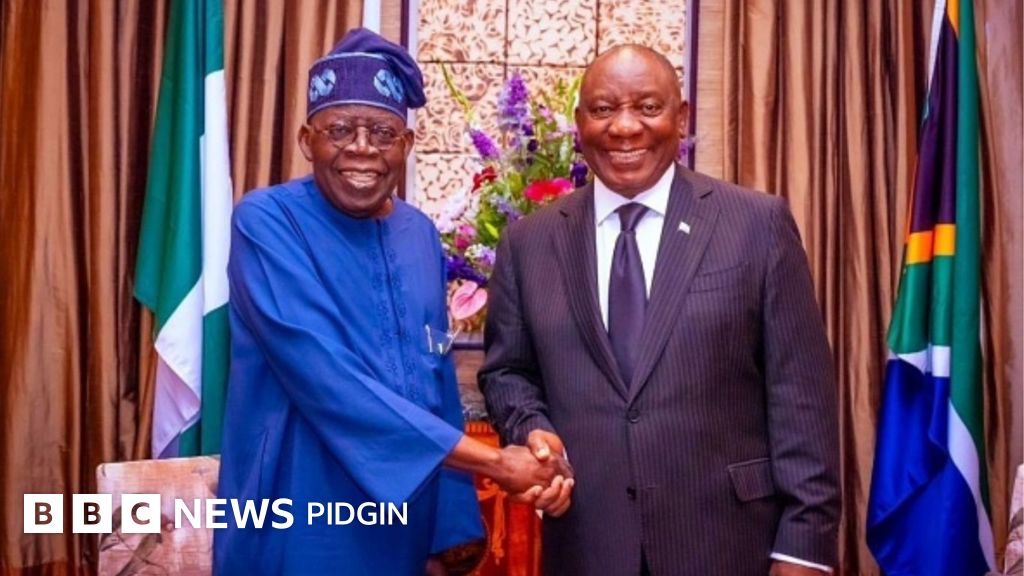
Source: Nigeria Presidency/Anadolu via Getty Images
South Africa’s escalating anti-migrant violence has reached a critical juncture, prompting President Cyril Ramaphosa to deliver a stark warning against scapegoating foreign nationals for the country’s socio-economic challenges. Speaking during the Ordinary Session of the 7th Legislature of the Pan-African Parliament on July 27, Ramaphosa condemned the recent surge in attacks on undocumented migrants, emphasizing that no nation can afford to let xenophobia undermine its stability or human rights obligations.
His remarks came in the wake of a high-profile incident in Cape Town on July 23, where Ibeh Chika Simon, a Nigerian national, was killed during a police operation. The violence, which has unfolded since April, has seen protesters—primarily targeting African migrants—blame foreign nationals for crime, unemployment, and strain on public services. The unrest has spiraled into theft, arson, and fatalities, deepening divisions within South Africa’s diverse population.
Ramaphosa’s Firm Stance: A Call for National and Continental Unity
Ramaphosa acknowledged that foreign nationals in South Africa have become targets of violence, intimidation, and vigilante attacks, driven by misplaced anti-migrant sentiments. While recognizing the genuine concerns some citizens express about illegal migration’s impact on social services and economic opportunities, the president rejected scapegoating as a solution.
In a strongly worded address, Ramaphosa outlined South Africa’s multi-pronged approach to managing migration crises:
– Crackdown on violence: The government has reiterated its zero-tolerance policy against intimidation, vigilantism, and attacks on foreign nationals.
– Legal enforcement: Strengthening immigration laws to diffuse tensions and ensure respect for human rights within the country’s borders.
– Pan-African cooperation: Stressing that unmanaged migration threatens the sovereignty, security, and social cohesion of African nations, Ramaphosa urged collective action across the continent.
“Our task is to manage migration in a way that upholds the rights and dignity of all, respects international conventions, and fosters social cohesion,” he declared. “This is not just South Africa’s responsibility—it is a shared duty for every African nation.”
Nigeria’s Diplomatic Response: Condemnation and Evacuations
The violence has escalated diplomatic tensions, particularly between South Africa and Nigeria, where hundreds of citizens have been affected. Nigeria’s Minister of State for Foreign Affairs, Sola Enikanolaiye, condemned the systematic attacks on Nigerian nationals, describing them as state-sanctioned failures.
During a meeting with South Africa’s Minister of International Relations, Ronald Lamola, Enikanolaiye highlighted:
– A pattern of impunity: Reports suggest that South African police often fail to intervene during mob attacks on Nigerian businesses and individuals, raising concerns over complicity in state responsibility.
– Humanitarian crisis: Since 2022 alone, 98 Nigerians have died in hate-related violence, a phenomenon Enikanolaiye labeled “Afrophobia.”
– Legal alternatives: The minister rejects violence as a solution, arguing that criminals—whether drug traffickers or other offenders—should be prosecuted under the law, not targeted for extrajudicial harm.
“Migration is a historical reality driven by push and pull factors,” Enikanolaiye stated. “But instead of killing people, we must enforce regulations—arrest, prosecute, and jail criminals. Nigeria will not tolerate the persecution of its citizens.”
South Africa’s Official Defense and Ongoing Crises
Minister Lamola reaffirmed Ramaphosa’s stance, asserting that the president has consistently condemned xenophobia, violence, and discrimination against any group within South Africa. However, he acknowledged three critical areas of concern that have fueled recent tensions:
1. Perpetuation of negative stereotypes about Nigerian nationals, despite their long-standing contributions to South Africa’s economy.
2. Escalating violence against foreign-owned businesses, leading to economic losses and public distrust.
3. Humanitarian evacuations: Nigeria has repatriated over 1,500 citizens, while Ghana has evacuated nearly 2,000 nationals, following similar unrest.
The Ghanaian government has also urged South Africa to take immediate action, citing widespread harassment, looting, and killings of its citizens. Other African nations, including Malawi, Zimbabwe, and Kenya, have expressed solidarity with affected communities, calling for unified African responses to curb the crisis.
A Regional and Continental Imperative
The Pan-African Parliament’s session underscored the urgency of a coordinated approach to migration governance. Experts warn that unchecked xenophobia could undermine Africa’s economic integration, particularly under initiatives like the African Continental Free Trade Area (AfCFTA).
Ramaphosa’s call for fair, firm, and effective immigration policies aligns with broader African Union (AU) frameworks, which emphasize human dignity, rule of law, and mutual respect. However, implementation remains a challenge, as domestic political pressures and economic frustrations continue to fuel anti-immigrant sentiment.
The Way Forward: Diplomacy, Accountability, and Solidarity
Both governments have agreed on a bilateral and Pan-African framework to address the crisis, including:
– Enhanced diplomatic engagement to prevent further escalation.
– Human rights protections for all foreign nationals, regardless of documentation status.
– Compensation for victims of the violence, as Nigeria has demanded reparations for lost lives and property.
Yet, long-term solutions require structural reforms, such as:
– Stronger border controls to curb illegal migration.
– Investment in local job creation to reduce economic desperation.
– Public awareness campaigns to counter xenophobic narratives with fact-based dialogue.
As South Africa grapples with internal divisions, the international community watches closely, recognizing that this crisis is not just a local issue—it is a test of Africa’s ability to uphold its shared values in an era of rising nationalism and instability.


