
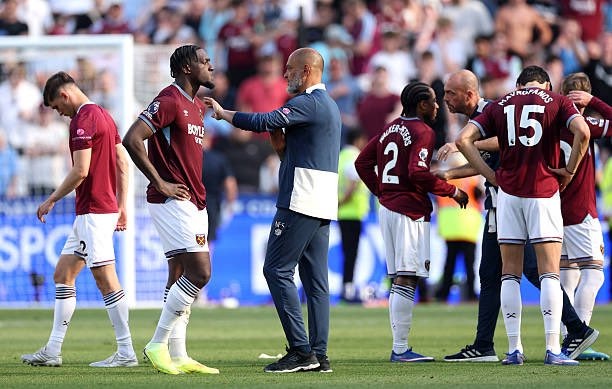
The final whistle at London Stadium on Saturday night did more than just signal the end of a 365-day Premier League campaign—it marked the brutal unraveling of a football club’s 15-year odyssey in English football’s elite. West Ham United, once a symbol of resilience and ambition in the capital, were relegated from the top flight after a half-century of near-misses and fleeting glories, their dreams of survival shattered despite a commanding 3-0 victory over a demoralized Leeds United side.
While the Hammers’ loyal supporters roared their approval for a performance that belied their desperate plight, the celebrations were hollow. For every chant of “We’ll be back,” there was a silent acknowledgment that this was the final curtain for a chapter that began in 2011—a year when the club first defied the odds to reclaim its place among England’s footballing aristocracy. The irony of relegation arriving on the same weekend that Arsenal secured their first league title in two decades was not lost on the 59,000 fans crammed into the stadium, nor the millions watching across the globe.

What unfolded on the pitch was a masterclass in contrasting fortunes. West Ham, playing with the desperation of a team fighting for its very existence, produced a display of attacking football that left Leeds shell-shocked. Taty Castellanos, the club’s record signing, opened the scoring with a clinical finish that summed up his season: relentless, opportunistic, and ultimately futile. Jarrod Bowen, the ever-reliable winger, doubled the lead with a strike that carried the weight of a player who had carried the team through turbulent times. Callum Wilson, the striker who had endured injury woes all season, capped the performance with a goal that should have been a celebration—had the context not been so cruel.
The Hammers’ relegation is not just a sporting tragedy; it is a financial and emotional earthquake for a club that has spent years cultivating an identity built on grit and local pride. West Ham’s rise from the Championship in 2011 was a fairytale for a fanbase that had known too much disappointment. Under managers like Sam Allardyce and David Moyes, the club became a model of stability in an era of chaos, qualifying for Europe and reaching the Europa League semi-finals. Yet, as the Premier League’s financial arms race intensified, West Ham’s ability to compete on and off the pitch began to fray. Their stadium, though modern, was a financial albatross, and their squad, once a blend of established talent and rising stars, became a revolving door of loans and short-term signings.
The relegation battle this season was a slow-motion car crash, punctuated by managerial changes, boardroom tensions, and a fanbase that oscillated between blind faith and simmering rage. When Moyes was sacked in December, replaced by the inexperienced Zvonimir Boban, the club’s hierarchy bet on a gamble that ultimately failed. The appointment of Boban, a former Milan executive with no managerial experience at this level, was a desperate Hail Mary—a last roll of the dice in a season where every point felt like a lifeline. It was a gamble that cost them dearly.
Meanwhile, across London, Arsenal were writing their own redemption story. The Gunners’ title triumph, secured with a 2-1 victory over Aston Villa, was a decade in the making. From the dark days of the Wenger era’s decline to the rebuilding under Mikel Arteta, Arsenal’s journey was one of patience, precision, and an unrelenting belief that their time would come. The scenes at the Emirates Stadium were euphoric—a club that had spent years being mocked for their “no trophies” narrative was finally vindicated. Pierre-Emerick Aubameyang, the Gabonese striker who had become a symbol of the club’s resurgence, scored the winner against Villa, capping a season where he rediscovered his lethal form.
For Arsenal, the title is more than just silverware; it is a statement. In an era where the Premier League’s financial disparity grows ever wider, the Gunners’ triumph is a testament to the power of smart recruitment and tactical evolution. Their squad, built around the likes of Declan Rice, Bukayo Saka, and Kai Havertz, is a blend of youth and experience, a team that plays with a swagger that was missing for years. The title also arrives at a pivotal moment for the club’s ownership, with the Kroenke family’s perceived neglect of the club’s heritage finally rewarded with tangible success.
But the juxtaposition of Arsenal’s joy and West Ham’s despair is what makes this season’s denouement so poignant. The Premier League, for all its global appeal, remains a ruthless beast—a league where the margins between glory and oblivion are razor-thin. West Ham’s relegation is a reminder that even the most storied clubs are not immune to the cold realities of modern football. Their fall from grace is a cautionary tale for clubs that believe financial prudence alone can sustain them in an era where the cost of survival is measured in hundreds of millions.
The Human Cost of Relegation: What Lies Ahead for West Ham
Relegation is not just a sporting setback; it is a seismic event that ripples through every corner of a football club. For West Ham, the immediate challenges are financial. The club’s revenue, already strained by the pandemic and the costs of moving to the London Stadium, will take a massive hit. The Premier League’s parachute payments—£100 million over three years—will provide some relief, but the reality is that West Ham will be operating in a financial straitjacket for years to come. The club’s ability to attract top talent will diminish, and the risk of a further drop into the Championship’s financial abyss looms large.
The human cost is perhaps the most tragic. Players who have given their all for the club will see their careers derailed. Castellanos, Bowen, and Wilson—three of the club’s most consistent performers—will now face an uncertain future. Will they follow the path of players like Michail Antonio, who defied the odds to become a club legend, or will they become cautionary tales of a system that failed them? For the fans, the pain is visceral. West Ham’s support is one of the most passionate in English football, a fanbase that has stood by the club through thick and thin. The thought of watching their team in the Championship, a league they have dominated in the past, is a bitter pill to swallow.
There are, however, glimmers of hope. West Ham’s academy has produced talents like Declan Rice and Ben Johnson, and the club’s investment in youth development could pay dividends in the Championship. The challenge for the new manager—whether it’s Boban or a fresh face—will be to rebuild a squad that can compete for an immediate return to the Premier League. The Championship is a brutal league, where the gulf between the top and bottom is vast, and the pressure to bounce back quickly will be immense. Yet, if there’s one thing West Ham’s history has taught us, it’s that this club has a habit of defying expectations.
Arsenal’s Triumph: A New Era or Just a Fleeting Moment?
Arsenal’s title win is a cause for celebration, but it is also a moment that invites scrutiny. The Gunners’ success this season was built on a foundation of defensive solidity and clinical finishing, but questions remain about their ability to sustain this level of performance in the coming years. The Premier League is a marathon, not a sprint, and the challenge for Arteta will be to ensure that this team does not become a one-season wonder.
The club’s ownership, too, will face scrutiny. The Kroenkes have long been criticized for their perceived lack of investment in the club’s infrastructure and fan experience. While the title is a welcome distraction, the demands for tangible improvements—better facilities, more affordable ticket prices, and a stronger connection with the local community—will only grow louder. The title win is a step in the right direction, but it is not the end goal. For Arsenal, the real test will be whether they can build on this success and restore the club to its former glory as a global footballing powerhouse.
One of the most intriguing subplots of Arsenal’s title win is the resurgence of Aubameyang. The Gabonese striker, once a polarizing figure at Barcelona, has rediscovered his form under Arteta, finishing the season as the club’s top scorer. His partnership with Gabriel Jesus and Eddie Nketiah has been a masterstroke, and his goal against Villa was a fitting end to a season where he has been the club’s talisman. Aubameyang’s journey is a reminder that football is a game of second chances, and his redemption arc will be one of the defining narratives of Arsenal’s title-winning campaign.
The Premier League’s Financial Divide: A League of Haves and Have-Nots
The stark contrast between Arsenal’s triumph and West Ham’s relegation underscores the growing financial divide in the Premier League. While clubs like Arsenal, Manchester City, and Liverpool can spend hundreds of millions on transfers and wages, others are left to scrape by on scraps. The Premier League’s revenue model, which distributes wealth unevenly, has created a system where the rich get richer and the poor are left fighting for survival.
For West Ham, the challenge is not just to survive in the Championship but to navigate a league where the financial disparities are even more pronounced. The Championship is a brutal environment, where clubs like Leeds and Leicester have shown that parachute payments alone are not enough to guarantee a quick return to the Premier League. The risk of a prolonged stay in the second tier is real, and the consequences for the club’s finances and reputation could be catastrophic.
This financial divide is not just a problem for relegated clubs; it is a threat to the long-term health of the Premier League. A league where only a handful of clubs can compete for trophies is a league that risks losing its competitive edge. The Premier League’s global appeal is built on the unpredictability of its outcomes, but if the gap between the top and bottom continues to widen, that appeal could fade. The relegation of West Ham is a stark reminder that even the most storied clubs are not immune to the cold realities of modern football.
What’s Next for English Football’s Top Flight?
The Premier League’s next season promises to be as unpredictable as ever. With Arsenal now the defending champions, the pressure will be on to see if they can build on their success. Meanwhile, clubs like Manchester City and Liverpool will be looking to reclaim their dominance, while the likes of Chelsea and Tottenham will be desperate to rediscover their form. The relegation of West Ham has opened the door for at least one new club to stake their claim in the top flight, and the Championship’s title race is sure to be a thrilling spectacle.
For West Ham, the road back to the Premier League will be a long and arduous one. The club’s fans, however, are no strangers to adversity. They have stood by their team through relegation battles, managerial changes, and financial struggles. The thought of watching their team in the Championship is a bitter pill to swallow, but if there’s one thing West Ham’s history has taught us, it’s that this club has a habit of defying expectations.
The Premier League’s loss is the Championship’s gain, but for West Ham, the journey back to the top will be a test of resilience, ingenuity, and sheer determination. As for Arsenal, their title win is a cause for celebration, but it is also a reminder that in football, no success is ever guaranteed. The road ahead is long, and the challenges are many—but for now, the Gunners can savor their moment in the sun.
One thing is certain: the 2025-26 season will be remembered as a season of highs and lows, of triumph and tragedy, and of the relentless, unforgiving nature of the beautiful game.

Topix News Desk is a digital editorial team focused on delivering clear, timely, and useful news coverage for readers worldwide. Our reporting highlights African news with global context, including politics, business, economy, technology, health, sports, entertainment, travel, and culture. We aim to publish accessible, well-structured, and informative articles that help readers understand the stories shaping Africa and the world.