

A Decade of Energy Crisis and the Rise of Decentralized Solutions
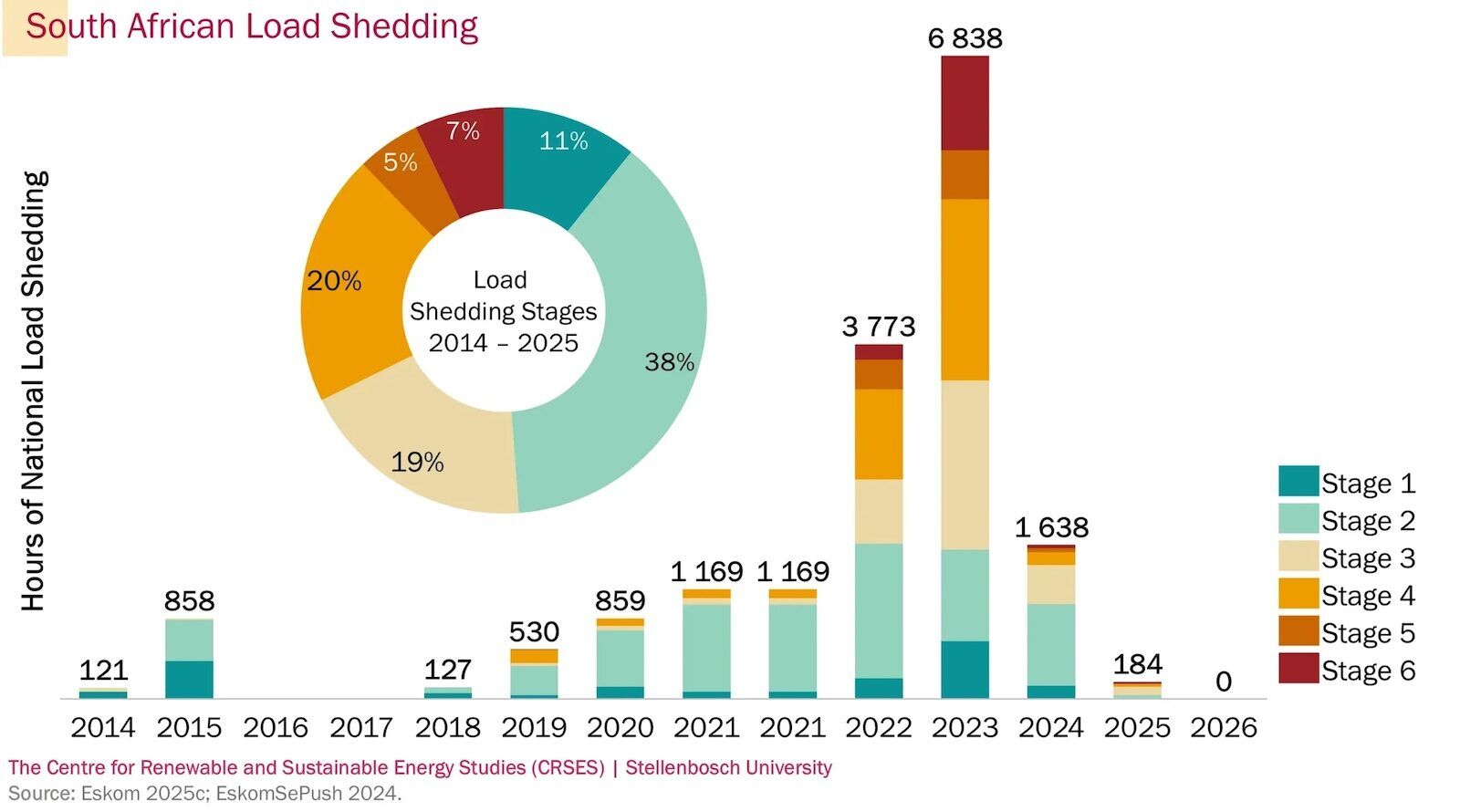
South Africa’s energy landscape has been defined by persistent challenges over the past decade, most notably the prolonged electricity rationing scheme known as load shedding. The crisis stemmed from Eskom’s inability to meet demand, forcing households and businesses to seek alternative power sources. In response, South Africa witnessed an unprecedented surge in residential and commercial solar adoption, with over 8.3 gigawatts (GW) of solar photovoltaic (PV) capacity installed across homes and businesses. Meanwhile, utility-scale solar projects contributed an additional 2.8 GW, solidifying South Africa’s position as a leader in decentralized energy innovation.
This rapid transition was not merely a reaction to grid instability but a strategic shift toward energy independence. With hundreds of thousands of solar systems now operational, the country’s energy mix has been fundamentally reshaped—batteries, once an optional upgrade, are now standard equipment, installed alongside over 90% of solar installations, a proportion unmatched globally.
Plentify’s Role in Optimizing South Africa’s Energy Transition
At the forefront of this energy revolution is Plentify, a South African energy technology firm specializing in AI-driven energy optimization. The company’s flagship products, SolarBot and HotBot, exemplify its commitment to maximizing energy efficiency for households and businesses.
- SolarBot is an intelligent inverter controller designed to enhance self-consumption of solar energy. By analyzing real-time weather patterns, load shedding schedules, and user behavior, SolarBot ensures that solar-generated power is used most efficiently, reducing reliance on the grid and lowering costs.
- HotBot, meanwhile, revolutionizes water heating by intelligently managing geysers (electric water heaters). Through predictive algorithms, HotBot preheats water during off-peak hours, aligning energy consumption with cheaper tariffs while ensuring hot water availability when needed.
These innovations have positioned Plentify as a key player in South Africa’s energy transition, but the company’s latest initiative—a virtual power plant (VPP) partnership with Deye—marks a paradigm shift in how distributed energy can be harnessed at scale.
The Deye-Plentify Virtual Power Plant: Africa’s Largest Residential Energy Aggregation System
In a groundbreaking collaboration, Plentify has been appointed as the exclusive VPP partner for Deye in South Africa, one of the world’s largest manufacturers of residential solar inverters and batteries. This partnership is poised to create Africa’s largest residential virtual power plant, aggregating over 160,000 Deye batteries already installed across the country.
The aggregate capacity of this VPP is estimated at 2.7 gigawatt-hours (GWh), a figure that dwarfs Eskom’s current 1.4 GWh Battery Energy Storage Programme—a multi-billion rand infrastructure project that has taken years to develop. The significance of this achievement cannot be overstated: Plentify and Deye are demonstrating how existing distributed energy assets can be repurposed to deliver grid-scale benefits without the need for new infrastructure.
Jon Kornik, CEO and co-founder of Plentify, underscored the strategic and economic implications of the partnership:
“With approximately 2.7 GWh of existing battery capacity, this partnership represents almost twice the capacity of Eskom’s current storage initiative—a multi-billion rand, multi-year investment. It proves that distributed energy resources can complement traditional infrastructure by rapidly unlocking value from assets that are already deployed. This is not just about energy storage; it’s about redefining grid resilience and flexibility.”
Why South Africa? The Unique Opportunity in a High-Adoption Market
South Africa’s energy crisis has accelerated the adoption of solar and battery storage at an unprecedented rate. Unlike many countries where batteries remain a luxury upgrade, in South Africa, they are standard equipment—installed alongside 90% of solar systems. However, most of these batteries operate at less than optimal efficiency, particularly during periods of reduced load shedding.
This presents a perfect opportunity for a VPP, where thousands of distributed batteries can be intelligently coordinated to:
– Balance electricity demand during peak hours.
– Strengthen grid stability by providing instantaneous backup power.
– Generate revenue for homeowners through participation in grid services programs.
Colin Chang, Deye’s Cloud Director, highlighted the global and local significance of this initiative:
“South Africa is a strategic benchmark for Deye’s expansion into emerging markets. Its unique energy challenges and high adoption rates make it an ideal testbed for our VPP technology. We’ve successfully deployed similar programs in Australia and France, but South Africa’s scale and energy transition dynamics offer a distinct opportunity. Plentify’s deep local expertise and proven VPP capabilities make them the ideal partner to unlock this potential.”
Chang further emphasized that success in emerging markets requires a blend of proven global technology and localized market understanding**—exactly what Plentify brings to the table.
How the Virtual Power Plant Works: Intelligence at Scale
The core mechanism of this VPP lies in AI-driven coordination of distributed batteries. Unlike traditional energy storage solutions, which operate in isolation, a virtual power plant aggregates multiple batteries into a single, controllable resource. This allows for:
- Demand Response Participation – Batteries can discharge power during peak demand, reducing strain on the grid and earning compensation from utilities.
- Grid Stabilization – By balancing supply and demand in real-time, the VPP helps prevent blackouts and voltage fluctuations.
- Peak Shaving – During high-energy consumption periods, the VPP smooths out demand, lowering costs for both homeowners and the grid.
- Renewable Integration – As South Africa’s solar and wind capacity grows, the VPP ensures excess renewable energy is stored and used efficiently, reducing waste and curtailment.
Plentify’s platform ensures that battery management is secure, efficient, and beneficial for all participants. Homeowners retain ownership of their energy assets while contributing to a larger, more resilient energy ecosystem.
Financial and Strategic Implications: A Model for Africa and Beyond
The economic potential of this VPP is substantial. By monetizing idle battery capacity, homeowners can earn additional income through grid services, while utilities benefit from reduced operational costs. This win-win model aligns with global trends in distributed energy resource (DER) management, where VPPs are increasingly recognized as cost-effective alternatives to traditional grid expansion.
Moreover, the recent Series A funding round secured by Plentify—raising nearly $15 million—signals strong investor confidence in the company’s technology and scalability. Led by Secha Capital, Buffet Investments, and Endeavor South Africa’s Harvest Fund, the funding will accelerate global expansion, reinforcing Plentify’s position as a leader in AI-driven energy optimization.
Jon Kornik reflected on the broader implications of this development:
“South Africa’s energy transition has been uniquely driven by necessity—load shedding forced innovation. Now, we’re seeing how batteries, once seen as a backup solution, can become an active part of the grid. This VPP is not just about energy storage; it’s about redefining how energy is produced, consumed, and managed—a model that can be replicated across Africa and beyond.”
The Future of Energy in South Africa: A VPP-Driven Transition
The Plentify-Deye VPP represents more than just a technological milestone—it is a testament to South Africa’s ability to innovate under pressure. As the country continues its energy transition, virtual power plants will play a critical role in:
– Reducing reliance on Eskom by decentralizing energy production.
– Lowering electricity costs for households and businesses.
– Enhancing grid resilience through distributed energy resources.
– Accelerating Africa’s renewable energy adoption by demonstrating scalable solutions.
With over 160,000 batteries already integrated, this VPP is just the beginning. As more solar and battery installations come online, the aggregate capacity will grow, further strengthening South Africa’s energy independence and setting a precedent for the continent.
In an era where climate change, grid instability, and energy affordability are global challenges, South Africa’s VPP initiative offers a blueprint for sustainable, scalable energy solutions—proving that innovation can emerge from necessity, and that distributed energy is the future.
