
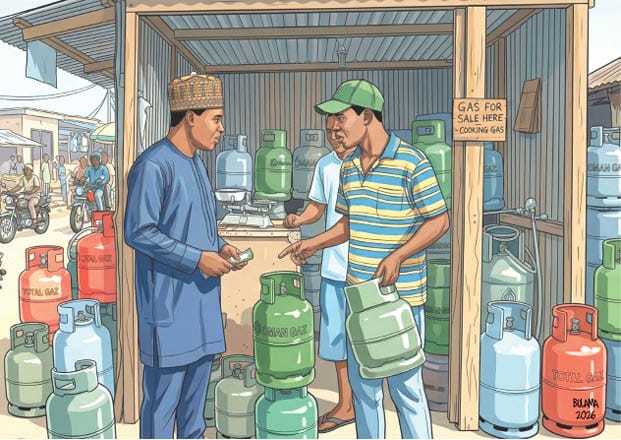
The kitchen is where a family’s daily rhythm begins—and ends. But in Nigeria today, that rhythm is being disrupted by a stubborn economic force: the soaring cost of cooking gas. For millions of households, the blue flame that once promised convenience and safety has become a financial burden, its price climbing even as the country’s gas production rises. What’s driving this paradox? And why, despite billions in new investments and increased output, does the average Nigerian still pay a premium at the cylinder exchange point?

From Plenty to Pain: The Gas Paradox in Nigeria
Nigeria sits atop one of Africa’s richest gas reserves, a geological gift that should, in theory, translate into affordable energy for its people. Yet the reality is starkly different. Official figures show domestic gas production has surged by over 30% in the past five years. New pipelines snake across the Niger Delta, and liquefied petroleum gas (LPG) terminals in Lagos and Port Harcourt operate at near-full capacity. So why does the cost of a 12.5kg cylinder—once a staple for middle-class homes—now rival the price of a sack of rice in some states?
The answer lies not in scarcity, but in a web of structural inefficiencies. Transportation costs, a fragmented retail network, and regulatory bottlenecks have turned what should be a simple supply chain into a labyrinth of hidden expenses. In Kano, traders report that gas prices spike by 15% during the rainy season, not because of production cuts, but because flooded roads delay deliveries. In Lagos, where demand is highest, informal middlemen often control distribution, adding layers of markup before the gas even reaches the consumer.
Even the government’s much-touted LPG expansion program, launched in 2020 to replace wood and charcoal, has stumbled under its own weight. Targets for 5 million new LPG users by 2025 remain unmet, with critics pointing to weak enforcement of safety standards and a lack of incentives for rural adoption. The result? A two-tier market: urban elites with access to subsidized cylinders, and rural families priced out entirely.
The Global Shadow: How International Markets Squeeze Local Prices
Nigeria’s gas crisis cannot be viewed in isolation. The country’s LPG market is deeply tied to global energy trends, where volatility is the only constant. In 2023, the war in Ukraine sent shockwaves through Europe’s energy sector, diverting LNG shipments away from traditional buyers. Nigerian exporters, desperate to fill the gap, found themselves competing with higher-paying importers in Asia and the Middle East. The effect was immediate: domestic prices rose by 22% within months, even as local production remained steady.
But the global ripple effect goes deeper. Nigeria’s refineries, long neglected, struggle to process crude into usable fuel, forcing the country to import refined petroleum products—including LPG—at inflated costs. The irony is glaring: a nation that flares more gas than it uses still imports the very product it could produce sustainably. Meanwhile, neighboring Ghana and Côte d’Ivoire, with smaller reserves but better distribution networks, have managed to keep LPG prices lower through strategic pricing and subsidies.
Analysts warn that without a coordinated policy response, Nigeria risks becoming a net importer of its own gas—a scenario that would further entrench price instability. “We are sitting on a goldmine,” says Dr. Amina Bello, an energy economist at the University of Abuja. “But unless we fix the infrastructure and regulatory gaps, we’ll keep paying the price—literally.”
The Human Cost: Families Adjusting to a New Normal
Behind the statistics are real lives. In Ibadan, 42-year-old market trader Hauwa Yusuf has reduced her gas usage to just twice a week. “Before, I could cook three meals a day without thinking,” she says. “Now, I ration the flame like it’s a luxury.” Her neighbor, a retired civil servant, has switched back to firewood, despite the smoke and health risks. “The gas is too expensive,” he explains. “But what choice do I have?”
In rural Zamfara, where electricity is unreliable and firewood is scarce, many households have returned to kerosene stoves—a step backward in both safety and environmental terms. Health officials report a rise in respiratory illnesses linked to indoor air pollution, a problem Nigeria had made progress on in the past decade. The World Health Organization estimates that 90,000 Nigerians die annually from household air pollution, a figure that could climb if gas remains out of reach.
The psychological toll is equally heavy. For a generation raised on the promise of modern energy, the return to primitive cooking methods feels like regression. “We were told gas would free us from smoke and drudgery,” says Lagos-based chef Emeka Nwosu. “Instead, we’re trapped in a cycle of scarcity and high costs.”
Policy Failures and Market Distortions: Who’s Really in Charge?
The Nigerian government has not been idle. In 2021, it launched the Nigerian Gas Flare Commercialization Programme (NGFCP) to monetize flared gas and boost supply. Yet progress has been slow. Out of 200 flare sites identified for commercialization, only a fraction have seen tangible results. Meanwhile, the Nigerian Midstream and Downstream Petroleum Regulatory Authority (NMDPRA) has struggled to enforce price caps, citing “market forces” as the primary driver of costs.
Critics argue that regulatory capture is part of the problem. Some industry insiders allege that a handful of companies with ties to political elites dominate the LPG import and distribution chain, creating artificial shortages to drive up prices. “It’s not about supply,” says an anonymous mid-level official in the petroleum ministry. “It’s about who controls the taps.”
The government’s response has been inconsistent. In early 2024, it announced a N50 billion ($110 million) intervention fund to stabilize LPG prices, only for the initiative to stall amid bureaucratic delays. Meanwhile, state governments have taken matters into their own hands. In Rivers State, Governor Siminalayi Fubara recently ordered the distribution of free gas cylinders to low-income households—a move hailed as a lifeline but criticized as unsustainable without broader systemic reforms.
What’s the Way Forward? A Roadmap Out of the Crisis
Solving Nigeria’s cooking gas crisis will require more than good intentions—it demands a multi-pronged strategy that addresses both supply and demand. Here’s what experts and stakeholders say needs to happen:
- Fix the Infrastructure: Expand pipeline networks to reduce transportation costs, particularly in the North, where distances and terrain inflate prices. Invest in rural storage facilities to prevent seasonal shortages.
- Regulate the Middlemen: Crack down on informal distributors who inflate prices. Licensing and transparency in the retail chain could cut costs by up to 15%.
- Incentivize Local Production: Offer tax breaks to small-scale LPG producers and encourage modular refineries to process gas locally, reducing reliance on imports.
- Subsidize Strategically: Targeted subsidies for low-income households, paired with education campaigns on safe usage, could ease the burden without distorting the market.
- Harmonize Policies: The federal government must work with states to create a unified pricing framework. Inconsistent policies across regions only deepen the crisis.
Some progress is already visible. In 2025, the Nigerian National Petroleum Company Limited (NNPCL) announced a partnership with private investors to build 100 new LPG depots across the country. If completed, these facilities could cut delivery times by half. Meanwhile, the Central Bank of Nigeria has introduced low-interest loans for LPG retailers, aiming to expand access in underserved areas.
Yet these steps, while welcome, are only the beginning. The deeper issue remains political will. “Nigeria has all the resources it needs to solve this problem,” says energy analyst Chinedu Okonkwo. “The question is whether those in power have the courage to break the cycle of inefficiency and corruption that keeps gas prices high.”
The Bigger Picture: Africa’s Energy Dilemma
Nigeria’s struggle with cooking gas is not unique—it’s a microcosm of Africa’s broader energy paradox. The continent sits on vast gas reserves, yet 600 million Africans still lack access to clean cooking fuels. The World Bank estimates that improving energy access could add $120 billion to Africa’s GDP annually. But progress is slow, hampered by weak infrastructure, policy inconsistencies, and the lingering shadow of colonial-era energy systems that prioritized export over domestic needs.
Countries like Senegal and Mozambique have shown that change is possible. Senegal’s “Clean Cooking Strategy” has reduced LPG prices by 20% through bulk procurement and smart subsidies. In Mozambique, a new offshore gas project is expected to double domestic supply within three years. Nigeria, with its larger population and economy, has the potential to lead—but only if it can overcome its own internal contradictions.
The stakes are high. For Nigeria, the cost of inaction is not just economic—it’s human. Every day that passes without affordable gas is another day families spend inhaling smoke, children miss school because of fuel shortages, and women bear the brunt of energy poverty. The blue flame that should symbolize progress has become a flickering reminder of what could have been.
A Glimmer of Hope—or Just Another False Dawn?
As Nigeria grapples with this crisis, there are signs that the tide may finally be turning. In May 2026, the federal government announced a new “Gas for Growth” initiative, promising $2 billion in investments over the next three years. The plan includes expanding pipeline networks, building 50 new LPG depots, and launching a national awareness campaign to promote gas adoption.
Yet skepticism lingers. Past initiatives have come and gone, leaving behind unfulfilled promises and frustrated citizens. Will this time be different? The answer may lie in the small victories already unfolding. In Benue State, a local NGO has partnered with private investors to set up micro-LPG plants, providing affordable fuel to rural communities. In Port Harcourt, a new women-led cooperative is distributing gas cylinders at subsidized rates, proving that grassroots solutions can work where top-down policies fail.
For now, the cooking gas crisis remains a stubborn reality for millions. But as Nigeria’s energy story continues to unfold, one thing is clear: the status quo is no longer sustainable. The question is not whether the country can afford to fix its gas problem—it’s whether it can afford not to.
Copyright notice: Images and source material are credited to their respective owners/source (original source where available). If you are the copyright owner and want an image or content removed, please contact us at topix.news/contact-us; we will review and remove it promptly.

Topix News Desk is a digital editorial team focused on delivering clear, timely, and useful news coverage for readers worldwide. Our reporting highlights African news with global context, including politics, business, economy, technology, health, sports, entertainment, travel, and culture. We aim to publish accessible, well-structured, and informative articles that help readers understand the stories shaping Africa and the world.