
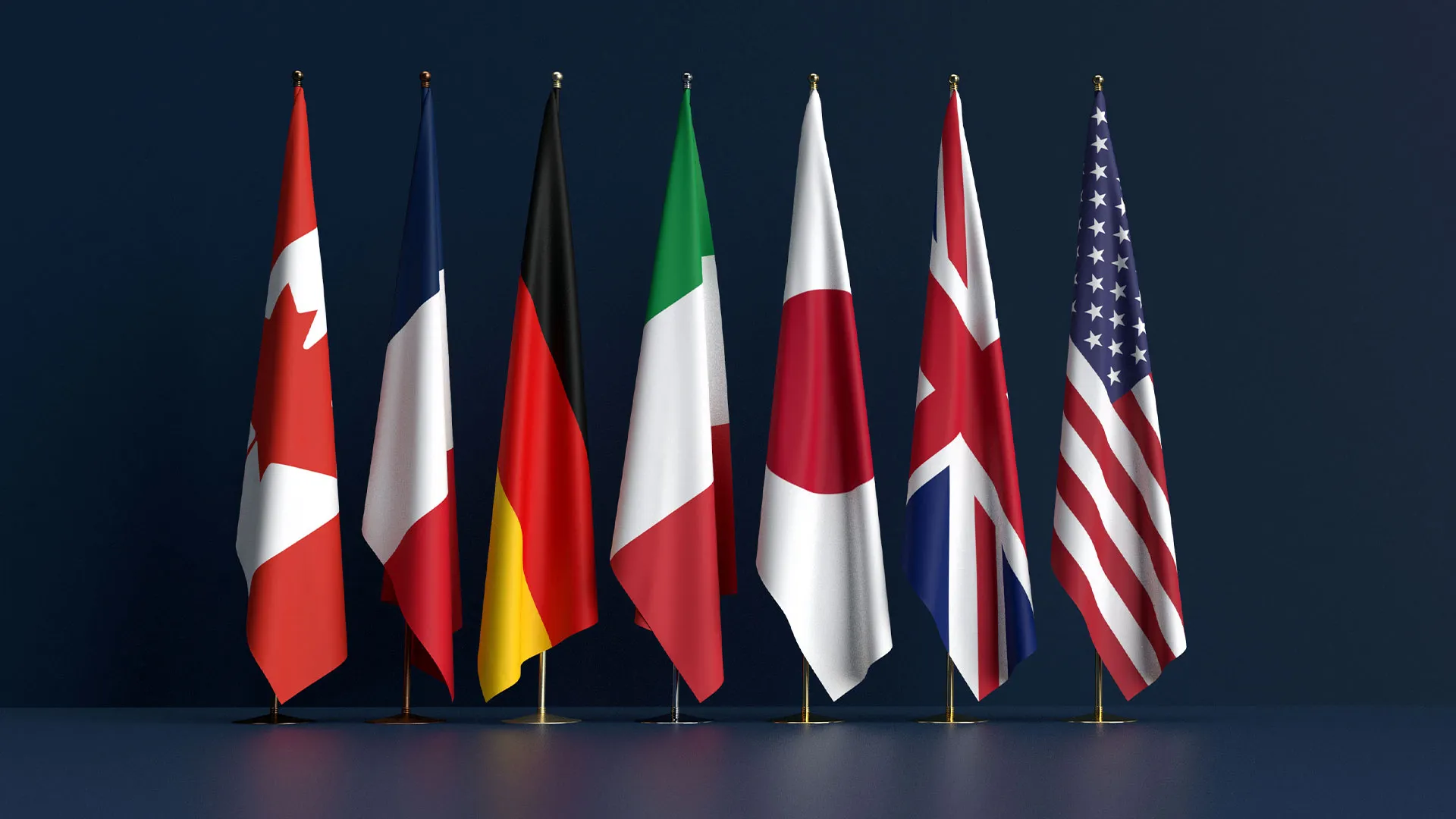
The world’s most exclusive economic club is feeling the weight of history. Once the undisputed architects of global financial order, the Group of Seven (G7) now faces a reckoning. Trade embargos, geopolitical fractures, and the unstoppable ascent of Asia are testing its cohesion—and its relevance. But does the G7 still shape the global economy in 2026, or has its golden era quietly slipped into the past?
From Post-War Architects to Relics of the Past?
Founded in 1975 as a forum for the world’s wealthiest democracies, the G7 was never meant to be permanent. Its original purpose—coordinating responses to the 1970s oil crisis—was pragmatic, not prophetic. Yet over decades, it evolved into something more: a de facto steering committee for the global economy. That role, however, is now under siege.
The group’s latest summit in 2026 took place against a backdrop of simmering tensions. The United States and China remain locked in a tariff war that has reshaped supply chains from the Pacific to the Atlantic. Europe, meanwhile, grapples with energy shortages and industrial decline, while Japan and Canada watch their once-dominant industries struggle against cheaper Asian competitors. The G7’s traditional levers—sanctions, trade deals, and coordinated stimulus—feel increasingly blunt in a world where power is diffusing.

Even the group’s membership seems out of step with today’s realities. Russia, once a member before its 2014 expulsion, now wields influence far beyond its borders through energy markets and military alliances. India, the world’s most populous democracy, sits on the sidelines, its economic growth outpacing the G7’s combined output. The absence of major African and Latin American economies—despite their growing clout—further exposes the club’s limitations.
The Rise of the Global South: A Silent Takeover?
While the G7 debates tariffs and debt relief, a quieter revolution is underway. The BRICS bloc—now expanded to include Egypt, Ethiopia, Iran, Saudi Arabia, and the UAE—has emerged as the G7’s most formidable rival. In 2026, BRICS nations accounted for over 40% of global GDP, surpassing the G7’s share for the first time. Their currency swap agreements, infrastructure investments, and alternative financial institutions are eroding the dominance of the U.S. dollar and Western-led institutions like the IMF.
Take Africa, for example. The continent’s two largest economies, Nigeria and South Africa, have long been marginalized in global forums. Yet in 2026, Nigeria’s naira became a top-performing currency after its central bank overhauled foreign exchange policies, while South Africa’s renewable energy sector attracted record foreign investment. Meanwhile, Ethiopia and Ivory Coast are becoming agricultural powerhouses, supplying rice and cocoa to markets once dominated by G7-backed agribusinesses. The message is clear: the Global South is no longer waiting for invitations to the high table.
The G7’s response? A mix of bewilderment and resistance. At its latest summit, leaders touted a new “Partnership for Sustainable Growth” aimed at countering BRICS’ influence. But critics argue the plan is too little, too late. “The G7 is still trying to solve 2008 problems with 1990s tools,” said an economist from the African Development Bank, who requested anonymity. “The world has moved on.”
Trade Wars and the G7’s Fractured Unity
Unity has never been the G7’s strong suit, but in 2026, its divisions are deeper than ever. The U.S. and the EU are locked in a bitter dispute over subsidies for green industries, with Washington accusing Brussels of “economic warfare.” Germany, once the group’s industrial backbone, now faces recession fears as its carmakers struggle to compete with cheaper Chinese electric vehicles. France, meanwhile, is doubling down on protectionist policies to shield its farmers from global competition—a move that has drawn sharp criticism from its G7 peers.
The group’s attempts to present a united front on Ukraine have also faltered. While Canada and Japan have maintained strong support for Kyiv, Italy and Japan have signaled growing wariness about open-ended military aid. “The G7 is no longer a monolith,” noted a senior diplomat from Senegal, who attended the summit as an observer. “What unites them now is less about shared values and more about shared fear.”
That fear is palpable. The G7’s share of global trade has fallen from 60% in the 1990s to just 30% today. Its collective GDP growth has stagnated, while emerging markets in Southeast Asia and Africa expand at twice the pace. The group’s once-unquestioned authority to set global economic rules is fading, replaced by a patchwork of regional alliances and bilateral deals.
Can the G7 Reinvent Itself—or Is It Too Late?
History suggests that institutions rarely die quietly. The G7 may not vanish overnight, but its influence is undeniably waning. The question now is whether it can adapt—or if it will become a relic of a bygone era. Some analysts argue that the group’s best hope lies in embracing the very forces it once resisted.
One possibility is expansion. The G7 has flirted with inviting India and Brazil in the past, only to backtrack. In 2026, pressure is mounting to include at least one major African economy—Nigeria or South Africa—to reflect the continent’s growing role. “If the G7 wants to matter in 2030, it needs to start acting like the 21st century,” said a Nairobi-based economist. “That means sharing the table, not just setting the menu.”
Another path is specialization. Rather than trying to be all things to all economies, the G7 could focus on niche areas where it still holds sway: climate finance, technological innovation, and global health. For example, the group’s pledge to mobilize $100 billion for clean energy in Africa could be a game-changer—if delivered. “The G7’s advantage isn’t size; it’s speed,” argued a policy advisor from Morocco. “When it acts, it can move markets. The problem is, it rarely acts.”
Yet even these reforms may not be enough. The world is increasingly multipolar, with power distributed among a dozen major players. The G7’s traditional role as the world’s economic conscience is no longer sustainable in a landscape where China, India, and the African Union are writing their own rules.
The African Perspective: A Seat at the Table—or a New Table?
For Africa, the G7’s decline is both a challenge and an opportunity. On one hand, the continent’s economies are gaining leverage. In 2026, Ethiopia secured a $10 billion deal with the UAE to develop its industrial zones, bypassing traditional Western lenders. Ghana and Tanzania are negotiating direct trade agreements with Turkey and Indonesia, reducing their dependence on G7 markets. “We don’t need permission to trade,” said Ghana’s trade minister. “We just need partners who respect our sovereignty.”
On the other hand, Africa remains vulnerable. Debt crises in Zimbabwe and Cameroon highlight the risks of over-reliance on non-Western creditors. The continent’s infrastructure gaps—from Uganda’s crumbling railways to Senegal’s unreliable power grid—still demand massive investment. The G7’s retreat could leave a vacuum that BRICS or private investors may fill, but not necessarily in ways that benefit local communities.
The solution, many African leaders argue, is not to beg for a seat at the G7 table but to build a new one. The African Continental Free Trade Area (AfCFTA), launched in 2021, is a step in that direction. By 2026, intra-African trade had grown by 35%, reducing reliance on G7 exports. “The G7 is a club of the past,” said the African Union’s commissioner for trade. “Africa’s future is being written in Addis Ababa, not in Berlin or Brussels.”
What’s Next for the G7—and the World?
The G7’s fate hinges on a single question: Can it evolve, or will it become a historical footnote? The signs are not encouraging. The group’s 2026 communiqué was a laundry list of familiar pledges—more aid, more climate funding, more “cooperation”—without concrete action. Meanwhile, BRICS countries are finalizing plans for a new development bank that could rival the World Bank, and African nations are forging ahead with their own currency initiatives to reduce dollar dependence.
One thing is certain: the world no longer waits for the G7 to lead. Whether through trade blocs, digital currencies, or regional alliances, new power centers are emerging. The G7’s relevance in 2026 is no longer a given—it’s a gamble. And in a world where the rules are being rewritten, the house always wins.
For now, the G7 remains a symbol of an era that is fading. Its legacy—of post-war reconstruction, of coordinated global governance—is undeniable. But its future? That’s a story still being told, one deal, one crisis, one summit at a time.
Key Takeaways: The G7 in 2026
- Declining Influence: The G7’s share of global GDP and trade has fallen sharply, while BRICS nations now account for over 40% of global output.
- Internal Fractures: The U.S. and EU are at odds over subsidies, while African and Asian economies pursue independent trade deals.
- African Agency: The continent is leveraging new partnerships to reduce dependence on G7 markets, with AfCFTA driving intra-African trade growth.
- Reform or Relevance?: The G7’s best hope may lie in specializing in areas like climate finance and technological innovation—or expanding its membership to include major emerging economies.
- No More Waiting: The world is no longer waiting for the G7 to set the agenda. New alliances and institutions are filling the void.
The G7’s story is far from over. But its next chapter will be written in a world where power is no longer concentrated in the hands of a few. Whether it adapts—or fades into obscurity—will depend on its ability to embrace change. For now, the world watches, and the verdict is still out.
Copyright notice: Images and source material are credited to their respective owners/source (original source where available). If you are the copyright owner and want an image or content removed, please contact us at topix.news/contact-us; we will review and remove it promptly.

Topix News Desk is a digital editorial team focused on delivering clear, timely, and useful news coverage for readers worldwide. Our reporting highlights African news with global context, including politics, business, economy, technology, health, sports, entertainment, travel, and culture. We aim to publish accessible, well-structured, and informative articles that help readers understand the stories shaping Africa and the world.