

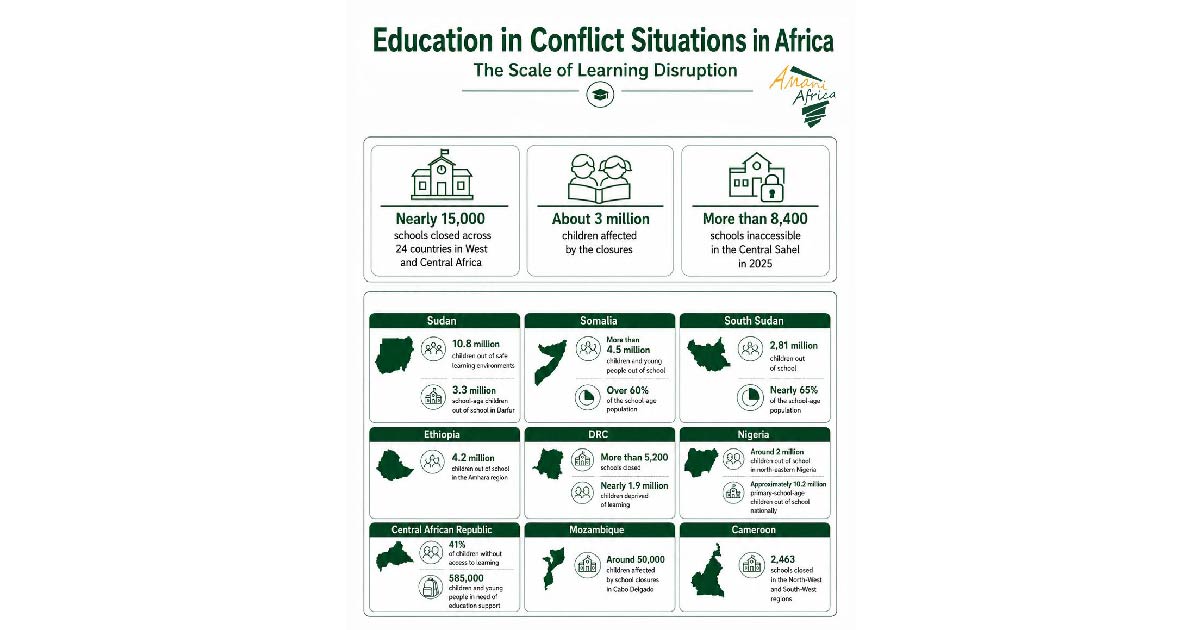
The African Union (AU) Peace and Security Council (PSC) is set to convene its 1357th meeting on August 3, 2026, focusing on the annual open session dedicated to education in conflict situations. This high-level discussion will assess progress on previous mandates, identify systemic gaps, and explore actionable strategies to ensure educational continuity and protection in war-torn regions across the continent. With 258 million school-aged children globally—including 128 million in Africa—disrupted by conflict, the session promises to be a pivotal moment in shaping policy responses to one of the most pressing humanitarian challenges of our time.
A Review of Past Commitments and Current Progress
The PSC’s last dedicated session on this topic was held on August 13, 2025 (Meeting 1296), where it issued three critical directives:
- Development of a continental policy on the protection and provision of education services during conflicts, including mechanisms to safeguard schools and learning environments.
- Periodic Scorecards on the Elimination of Harmful Practices, particularly tracking child marriage, forced recruitment, and other grave violations in conflict-affected areas.
- A comprehensive matrix of AU legal frameworks, strategies, and initiatives supporting inclusive education and learning continuity, accompanied by an implementation action plan for 2025–2034.
Since then, significant institutional and policy developments have emerged, necessitating a reassessment of progress and gaps. The upcoming session will likely evaluate whether these commitments have translated into tangible protection measures and sustainable educational recovery across Africa.
Key Institutional and Policy Advancements
1. Appointment of the AU Special Envoy for Children Affected by Armed Conflict (CAAC)
One of the most notable developments is the appointment of Ambassador Jainaba Jagne as the AU Special Envoy for CAAC on February 1, 2026. This role, long advocated by the PSC (most recently at Meeting 1229), positions Jagne as the AU’s lead political advocate on grave violations affecting children, including obstructions to education.
In a joint AU-UN statement in June 2026, Jagne emphasized the need to shift from commitments to implementation, calling for:
– Stronger Member State action in protecting children from conflict-related abuses.
– Child-sensitive early warning systems to prevent escalation.
– Protection of essential infrastructure, including schools and hospitals.
– Climate-resilient recovery to address long-term educational disruptions.
The PSC is expected to integrate Jagne’s advocacy into the development of the proposed policy framework and implementation mechanisms, ensuring accountability and coordination across AU member states.
2. The AU Decade of Accelerated Action for Education Transformation (2025–2034)
Launched in October 2025, the AU Decade of Accelerated Action aligns with the CESA 2026–2035 framework, which outlines six strategic pillars for education reform, including:
– Inclusive and equitable education for all, with a focus on conflict-affected populations.
– Digital and technological integration in learning systems.
– Teacher training and professional development.
– Psychosocial support for students and educators.
A high-level partners’ consultation in February 2026 reinforced the need for national education plans to incorporate education in emergencies (EiE) and conflict-sensitive learning recovery. The Nouakchott Declaration, adopted at the same event, further mandates:
– Integration of EiE into national strategies.
– Expansion of education-management information systems to track displaced and conflict-affected learners.
– Establishment of a continental accountability mechanism to monitor progress.
At the international level, UN Security Council Resolution 2601 (2021) remains a critical reference, condemning attacks on schools, affirming their civilian status, and demanding education continuity in conflict zones.
The Scale of the Crisis: Disruption and Its Human Cost
The June 2026 Education Cannot Wait (ECW) Global Estimates reveal a devastating scale of disruption:
– 258 million children and adolescents worldwide are affected by crises, with 93 million out of school.
– Africa accounts for 128 million of these children across 38 conflict-affected nations, including Sudan, Ethiopia, Nigeria, Cameroon, and the Democratic Republic of the Congo (DRC).
While these figures vary in scope and methodology, they collectively highlight:
– Mass school closures due to violence, displacement, and resource shortages.
– Increased child marriage and forced recruitment as alternatives to education.
– Psychosocial trauma among students, exacerbating learning gaps.
The Education Under Attack 2026 report further underscores the severity, noting that:
– 13 of the 28 countries with documented attacks on education are in Africa.
– The DRC and Ethiopia have the highest incidence of attacks, while Nigeria and Cameroon report the most students and educators harmed.
– Despite substantial AU participation in the Safe Schools Declaration, implementation remains inconsistent, with domestication and enforcement identified as primary gaps.
Four Critical Priorities for the PSC’s Discussion
To address these challenges, the PSC is expected to focus on four interlinked priorities:
1. Protecting Education: Enforcing the Safe Schools Declaration
The Safe Schools Declaration (SSD), endorsed by 120+ countries, remains a cornerstone of protection efforts. However, national adoption and enforcement vary widely.
Key actions may include:
– Incorporating SSD principles into national military doctrine and training, ensuring child-sensitive risk assessments in conflict planning.
– Strengthening early warning systems to detect and prevent attacks on schools.
– Investigating and holding accountable perpetrators of grave violations, including military use of schools.
– Safeguarding learners, teachers, and support staff through protection mechanisms and safe evacuation protocols.
The Fifth International Conference on the Safe Schools Declaration (Nairobi, November 2025) identified domestication and implementation gaps as major obstacles, suggesting that the PSC may push for binding national frameworks to close these gaps.
2. Sustaining Education Continuity: Flexible and Resilient Learning Models
Even when schools remain operational, displacement, infrastructure damage, and resource shortages disrupt learning. The PSC may explore:
– Emergency planning frameworks to ensure rapid reopening of schools post-conflict.
– Temporary, accelerated, and flexible learning models, including:
– Mobile and portable classrooms for displaced communities.
– Offline and low-tech solutions (e.g., radio-based education, printed materials).
– Portable student records to facilitate transitions between schools.
– Recognition of prior learning for children who have missed formal education.
– Community-based learning spaces to complement formal institutions.
However, technological limitations remain a challenge. While digital platforms (e.g., AU’s Digital Education Strategy) offer promise, unreliable electricity, poor connectivity, and device shortages hinder access. Professor Gaspard Banyankimbona, AU Commissioner for Education, Science, Technology, and Innovation (ESTI), has emphasized that technology is a tool, not a solution—human capacity and infrastructure must remain the foundation.
3. Learning Recovery and Inclusion: Addressing Structural Barriers
Recovery efforts must holistically address the psychosocial, gender, and disability-related barriers faced by conflict-affected learners.
Key considerations include:
– Foundational learning support to bridge gaps caused by prolonged school closures.
– Teacher training and well-being programs, as unsupported educators cannot deliver quality education.
– Psychosocial services to address trauma and mental health needs.
– Inclusive strategies for:
– Girls, who face higher dropout rates due to early marriage and domestic labor.
– Children with disabilities, often excluded from emergency education programs.
– Displaced learners, who require host-community integration to avoid overcrowding.
– Former child soldiers, needing reintegration and trauma counseling.
The BRIDGES Program in Sudan (launched May 2026) serves as a model, aiming to:
– Reopen 850 schools and restore learning for 328,000 children.
– Support 9,000 teachers through training and remuneration.
– Establish 1,800 safe learning spaces with remedial and alternative education.
This approach highlights the need for systemic strengthening, not just physical rehabilitation.
4. Financing and Measuring Impact: Closing the Resource Gap
Africa faces an annual education financing gap of $77 billion, exacerbated by conflict-related expenditures. The UNICEF 2026 projection warns of a $3.2 billion decline in global education aid (2023–2026), potentially displacing an additional 6 million children, including 1.9 million in West and Central Africa.
Key financing challenges include:
– Competing humanitarian priorities, where education often receives secondary funding.
– Financial barriers for families, with 40% of school withdrawals attributed to costs (39%) and conflict-related closures (38%).
– Lack of pooled emergency education funds to respond rapidly to crises.
The PSC may advocate for:
– Higher domestic allocations for education, particularly in conflict zones.
– AU Peace Fund support for EiE initiatives.
– Alignment with CESA 2026–2035 to ensure sustainable funding streams.
– Investment in education data systems to track progress and reallocate resources effectively.
Expected Outcomes: A Communiqué with Concrete Commitments
The PSC’s session is likely to conclude with a communiqué outlining actionable commitments, including:
- Condemnation of attacks on learners, teachers, and education facilities, with a demand for an end to the military use of schools.
- Reinforcement of the Safe Schools Declaration, urging national integration into military doctrine and child-sensitive policies.
- Appointment of the AU Special Envoy for CAAC (Jainaba Jagne) as the primary monitor of:
- Incidents of attacks and military use of schools.
- Implementation of Meetings 1229 and 1296 decisions.
- Collaboration with the ACERWC Special Rapporteur on Children in Conflict Situations.
- Integration of education continuity into:
- Mediation and ceasefire agreements.
- Humanitarian access protocols.
- Post-conflict reconstruction plans.
- Welcoming the AU Decade of Accelerated Action (2025–2034), with a call for:
- A joint action plan by the AU Commission (ESTI, HHS, and PAPS) to:
- Develop adequately financed, gender-responsive, and disability-inclusive emergency education plans.
- Protect and remunerate teachers.
- Strengthen host-community schools.
- Provide temporary, flexible, and offline learning for displaced children.
Conclusion: A Call for Urgent and Coordinated Action
The August 3, 2026, PSC session represents a critical juncture in Africa’s efforts to protect and restore education in conflict zones. With millions of children at risk, the Council must move beyond symbolic commitments to concrete, funded, and enforceable policies.
The success of these efforts hinges on:
✔ Political will to prioritize education in peace and security agendas.
✔ Financial sustainability, ensuring long-term funding for EiE.
✔ Institutional coordination, leveraging the AU Special Envoy, ACERWC, and UN partners.
✔ Community and local ownership, ensuring solutions are culturally relevant and inclusive.
As the AU Commissioner for ESTI, Professor Banyankimbona, has stated: “Education is not just about books and buildings—it is about people. Without them, no tool, no policy, no fund can save a child from the devastation of war.” The PSC’s deliberations must reflect this human-centered approach, ensuring that no child is left behind in the fight for educational resilience.
