

Africa’s Untapped Genomic Potential: Why National Genome Projects Are a Moral and Scientific Imperative
The field of genomics stands at the precipice of revolutionizing healthcare, offering unprecedented opportunities for personalized medicine, disease prevention, and therapeutic innovation. Yet, despite Africa’s unparalleled genetic diversity—stemming from millennia of human migration and adaptation—its populations remain woefully underrepresented in global genomic databases. This disparity is not merely a scientific oversight; it is a systemic failure with profound implications for health equity, economic development, and global scientific progress.
Africa’s genetic diversity, shaped by centuries of distinct evolutionary pathways, provides a unique lens into human evolution, disease susceptibility, and adaptive mechanisms. However, the exclusion of African genomes from large-scale genomic studies has created a critical knowledge gap, limiting the development of effective treatments and diagnostics for diseases that disproportionately affect the continent. This article examines the urgent need for nationwide genomic initiatives across Africa, exploring the challenges, opportunities, and strategic frameworks required to position the continent as a leader in global genomic research.
The Genomic Divide: Why Africa’s Underrepresentation Matters
Genomic data has become the cornerstone of modern medicine, enabling breakthroughs in cancer treatment, rare disease diagnosis, and pharmacogenomics—the study of how genetic variations influence drug responses. Yet, according to the GWAS Diversity Barometer, African individuals constitute only 0.15% of participants in genome-wide association studies (GWAS), a stark contrast to their genetic richness. This imbalance has far-reaching consequences:
-
Limited Disease Discovery: Many genetic variants associated with diseases like sickle cell anemia, malaria resistance, and cardiovascular conditions are understudied due to the lack of African genomic data. For instance, research on malaria susceptibility has identified critical genetic markers in African populations, yet these findings often fail to translate into global medical practice due to insufficient representation in clinical trials.
-
Ineffective Personalized Medicine: Pharmacogenomic studies reveal that medications optimized for populations of European descent frequently yield suboptimal or harmful results in African individuals. A one-size-fits-all approach to medicine is inherently flawed, particularly when genetic diversity is ignored. For example, certain cancer therapies that are highly effective in Asian or European patients may be less effective—or even toxic—in African populations due to underlying genetic differences.
-
Global Health Disparities: The neglect of African genomic data exacerbates existing healthcare inequalities. While the World Health Organization (WHO) and African Centers for Disease Control and Prevention (Africa CDC) emphasize the need for equitable genomic research, the absence of African genomes in global datasets perpetuates a cycle where medical advancements are tailored to wealthier populations, leaving African nations—and their citizens—behind.
-
Lost Economic and Scientific Opportunities: The Human Genome Project generated 3.8 million job-years, demonstrating genomics’ potential to drive economic growth. Africa, with its vast untapped genetic resources, could similarly benefit from localized genomic industries, including biotechnology, pharmaceutical manufacturing, and precision agriculture. However, without investment in national genomic infrastructure, these opportunities remain out of reach.
Challenges to Genomic Equity in Africa
Despite the clear benefits, advancing genomic research in Africa faces political, financial, and infrastructural hurdles:
- Limited Funding and Infrastructure:
- Many African nations lack the sequencing capacity, bioinformatics expertise, and data storage infrastructure required for large-scale genomic studies.
-
Public health priorities, such as combating infectious diseases (e.g., malaria, HIV, and COVID-19), often take precedence over long-term genomic investments, leaving genomic research underfunded.
-
Data Sovereignty and Ethical Concerns:
- Concerns over data exploitation, misappropriation, and lack of local control have led some African nations to adopt federated data-sharing models, where genomic analysis occurs within the country of origin. While this protects data sovereignty, it requires significant investment in local bioinformatics and cybersecurity capabilities.
-
Ethical frameworks must ensure that genomic data is collected with informed consent, transparency, and benefit-sharing agreements to prevent historical patterns of exploitation.
-
Brain Drain and Workforce Shortages:
- Africa’s highly skilled scientists and researchers often migrate to Western institutions due to limited career opportunities, exacerbating the brain drain that hampers local genomic capacity.
-
Building a sustainable workforce requires training programs, mentorship initiatives, and competitive salaries to retain talent.
-
Policy and Governance Gaps:
- Many African nations lack national genomic policies that integrate genomic research into healthcare systems. Without clear regulatory frameworks, genomic data collection and utilization remain fragmented and uncoordinated.
- Intergovernmental collaboration is essential, yet disparities in economic capacity and political will hinder continental-wide initiatives.
Progress and Promising Models: Lessons from Existing National Genome Projects
Several African nations have taken bold steps to establish national genomic initiatives, offering valuable lessons for scaling these efforts across the continent:
1. Tunisia: The Genome Tunisia Project
- Objective: Sequence 10,000 healthy genomes and thousands of clinical exomes to create a national reference genome database.
- Key Features:
- Integrates omics data (genomics, proteomics, metabolomics) into clinical practice.
- Emphasizes local governance and capacity building, ensuring that Tunisian researchers lead the project.
- Collaborates with Institut Pasteur de Tunis to strengthen sequencing and bioinformatics infrastructure.
- Impact: Positioned as a regional hub for North African genomic research, with potential applications in precision medicine and rare disease diagnosis.
2. Egypt: The Genome Egypt Project
- Objective: Sequence 100,000 healthy individuals and 200 ancient mummies to identify disease-associated genetic variants.
- Key Features:
- Combines modern genomics with ancient DNA studies, providing insights into Egypt’s genetic history and disease susceptibility.
- Partners with international institutions (e.g., Harvard Medical School) while maintaining data sovereignty.
- Aims to integrate genomic data into Egypt’s National Health Information System.
- Impact: Could serve as a model for African nations seeking to merge historical and contemporary genomic research.
3. Senegal: The SEN-GENOME Project
- Objective: Sequence 1,000 genomes from 31 ethnolinguistic groups across Senegal’s 14 administrative regions.
- Key Features:
- Adopts a decentralized approach, ensuring broad representation of Senegal’s genetic diversity.
- Focuses on population genetics and disease susceptibility, particularly for malaria, sickle cell disease, and infectious diseases.
- Collaborates with West African Genetic Medicine Center (WAGMC) to build regional genomic networks.
- Impact: Demonstrates how smaller nations can contribute meaningfully to global genomic research through strategic partnerships and localized sequencing.
4. South Africa: Emerging National Genomic Initiatives
- Objective: Establish South Africa as a genomic leader in Africa, with projects like the South African National Bioinformatics Institute (SANBI) and African Population and Health Research Center (APHRC).
- Key Features:
- Leverages existing research infrastructure (e.g., KwaZulu-Natal Research Institute for Tuberculosis and HIV, University of Cape Town’s Genomics Center).
- Participates in global consortia (e.g., H3Africa) while prioritizing local data ownership.
- Focuses on HIV, tuberculosis, and cancer genomics, aligning with South Africa’s high burden of infectious and non-communicable diseases.
- Impact: Could serve as a regional genomic hub, supporting neighboring nations in building their own capacities.
5. Nigeria: Public-Private Partnerships in Genomics
- Objective: The Nigerian 100K Genome Project aims to sequence 100,000 Nigerian genomes, focusing on rare diseases, cancer, and infectious diseases.
- Key Features:
- A public-private partnership involving the Nigeria Genome Project Consortium, private sector investors, and international collaborators.
- Faces challenges in data governance and national coordination, highlighting the need for stronger policy frameworks.
- Potential to boost Nigeria’s biotech industry and create high-skilled jobs in genomics.
- Impact: If successfully implemented, could accelerate Nigeria’s transition into a genomic research powerhouse.
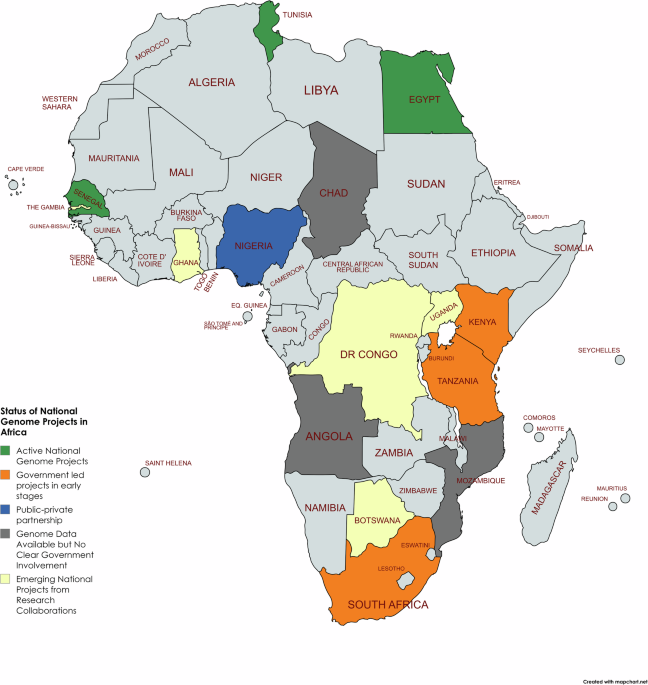
A continent-wide map illustrating the status of national genome projects in Africa, categorized by:
– Green: Countries with active national genome projects (e.g., Tunisia, Egypt, Senegal).
– Orange: Government-led projects in early stages (e.g., South Africa, Tanzania).
– Blue: Public-private partnerships (e.g., Nigeria).
– Yellow: Emerging national projects from research collaborations (e.g., Ghana, Uganda).
– Gray: Informally planned projects (e.g., Chad, Mozambique).
This visualization underscores the uneven distribution of genomic initiatives across Africa and the urgent need for broader implementation to ensure health equity.
Strategic Pathways to Scaling Genomic Equity in Africa
To harness Africa’s genomic potential, a multi-pronged approach is required, combining policy reforms, financial innovation, regional collaboration, and public engagement:
1. Strengthening National Genomic Policies
- Integrate genomics into national health strategies: Countries should allocate dedicated funding for genomic research within their health and education budgets.
- Establish regulatory frameworks: Clear data governance laws must ensure ethical collection, storage, and sharing of genomic data while protecting data sovereignty.
- Create national genomic councils: These bodies should coordinate research efforts, allocate resources, and ensure accountability.
2. Innovative Funding Mechanisms
- Health bonds and impact investing: Countries like Botswana have successfully used natural resource revenues to fund healthcare initiatives. Similar models could finance genomic research.
- Public-private partnerships (PPPs): Collaborations between governments, academic institutions, and biotech companies (e.g., Nigeria’s 100K Genome Project) can accelerate progress while ensuring local benefit-sharing.
- African Genomics Innovation Fund: A continental fund, supported by African Union member states and international donors, could provide long-term sustainable financing for genomic research.
3. Regional and Continental Collaboration
- Shared genomic hubs: Nations with advanced genomic infrastructure (e.g., South Africa, Egypt, Tunisia) can serve as regional centers for sequencing, data analysis, and training.
- Pan-African genomic networks: Initiatives like the African Genomics Centers of Excellence (GenCoE) and H3Africa should be expanded and funded to foster collaborative research.
- Standardized data-sharing protocols: Harmonizing data collection and analysis methods across Africa will improve research efficiency and global comparability.
4. Capacity Building and Workforce Development
- Genomics training programs: Universities and research institutions should offer specialized degrees in genomics, bioinformatics, and genetic counseling.
- Mentorship and exchange programs: Partnerships with Western institutions (e.g., Harvard, Oxford) can provide training opportunities while retaining talent in Africa.
- Retention incentives: Competitive salaries, research grants, and career advancement programs can help combat the brain drain.
5. Public Engagement and Ethical Considerations
- Genomics literacy campaigns: Educating the public about benefits of genomic research (e.g., better disease diagnosis, personalized treatments) can foster support for national projects.
- Community involvement: Genomic studies should be conducted with informed consent, ensuring that local communities benefit directly from research findings.
- Ethical guidelines: Frameworks like the WHO’s Technical Advisory Group on Genomics (WHO-TAG-G) should guide responsible data use, preventing exploitation and misuse.
The Road Ahead: A Call to Action for Global Genomic Equity
Africa’s genetic diversity is a global resource, and its exclusion from genomic research is not merely an African problem—it is a global failure. The time has come for bold, coordinated action to ensure that Africa is not left behind in the genomic revolution.
Key steps forward include:
✅ Expanding national genome projects across Africa, with clear funding, governance, and policy support.
✅ Strengthening regional collaborations to create shared genomic infrastructure and expertise.
✅ Investing in workforce development to build a sustainable African genomics workforce.
✅ Ensuring ethical and equitable data sharing to prevent historical patterns of exploitation.
✅ Aligning genomic research with national health priorities, such as combating infectious diseases, cancer, and genetic disorders.
By prioritizing genomic equity, Africa can transform its healthcare systems, drive economic growth, and position itself as a leader in global scientific innovation. The alternative—a world where medical advancements are tailored to a minority of the global population—is unacceptable.
The future of medicine is genomic, and Africa must be at the forefront of this revolution. The question is no longer whether Africa should invest in genomics, but how quickly and decisively it will act to claim its rightful place in the global genomic landscape.
References (Excerpt – Key Studies and Reports)
– Alimohamed, M.Z. et al. (2026). Advancing global genomic equity: making a case for national genome projects in Africa. Nature Communications.
– WHO Science Council (2022). Accelerating access to genomics for global health.
– H3Africa Consortium (2014). Building sustainable innovation in African genomics.
– Fatumo, S. et al. (2022). Promoting the genomic revolution in Africa through the Nigerian 100K Genome Project. Nature Genetics.
– Africa CDC (2024). Continental roadmap for genomic medicine.
– Gaye, A. et al. (2024). Toward building a comprehensive human pan-genome: the SEN-GENOME project. American Journal of Human Genetics.
