

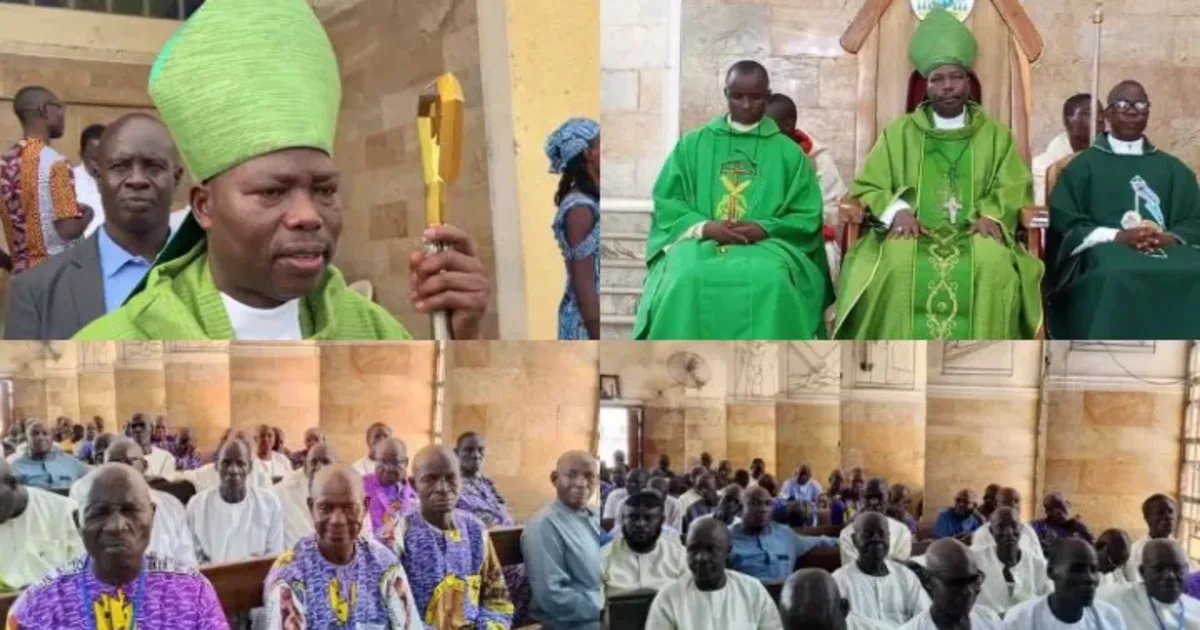
Nigeria’s persistent struggle against terrorism and insurgency has reached a critical juncture, with a prominent Catholic bishop accusing the government of lacking the political will to address the crisis despite possessing the military and logistical capacity to do so. Bishop Stephen Dami Mamza, the leader of the Diocese of Yola in northern Nigeria, delivered a stark critique during a recent Catholic Men’s Organization (CMO) meeting in Jos, emphasizing that the failure to combat armed groups like Boko Haram and the Islamic State’s West Africa Province (ISWAP) stems not from resource constraints, but from systemic neglect and political manipulation.
A Government Without Seriousness: Military Strength vs. Political Will
In an interview with ACI Africa, Bishop Mamza underscored the stark contrast between Nigeria’s military prowess and its inability to implement effective counterterrorism strategies. The Nigerian Armed Forces, he noted, have successfully intervened in peacekeeping missions across Africa, demonstrating their capability to neutralize insurgent threats. Yet, within Nigeria’s borders, the same forces appear hamstrung by bureaucratic inertia and political interference.
“In the security challenges we are facing, we all know that the government is unserious,” Mamza stated bluntly. “You cannot say that the government doesn’t have a hand in what is happening since the government is not prepared to resolve these issues and also give the military full authority to get rid of the terrorists.”
The bishop highlighted that Nigeria’s military advantages—ranging from air superiority to ground operations—are squandered due to a lack of political commitment. Instead of prioritizing national security, political actors, including both ruling and opposition parties, have politicized the crisis, using it as a tool for electoral gain rather than a matter of urgent public safety.
“Even the sitting government is politicizing the whole security issue. Even those who are in the opposition are also politicizing the security issues,” Mamza lamented. His words reflect a growing sentiment among Nigerians who feel abandoned by leaders who prioritize short-term political survival over long-term stability.
The Cost of Neglect: Lives Lost and Divine Accountability
The bishop’s remarks come amid a grim toll of violence, with thousands of lives lost to terrorism over the past two decades. Boko Haram and ISWAP have carried out countless attacks, displacing millions and destabilizing entire regions. Mamza warned that those in positions of power who fail to act decisively will face divine consequences, as God’s justice extends beyond earthly accountability.
“Our government is not sincere, and our government, on the last day, will be held accountable for the loss of lives in Nigeria at the moment,” he declared. His statement carries theological weight, framing the crisis not merely as a political failure but as a moral and spiritual one. The bishop emphasized that divine judgment is uncompromising, unlike human justice, which can be influenced by corruption, favoritism, or political expediency.
“God’s judgment is not human judgment,” Mamza explained. “God knows everything about us—not just what we see, but our thoughts, our secret emotions, and what is in our hearts. His judgment is just and fair.”
This perspective aligns with the CMO’s thematic focus on God’s justice, which, according to the bishop, applies equally to both perpetrators of violence and those who fail in their duty to protect the innocent. While human leaders may evade responsibility through political maneuvering, Mamza reminded his audience that no one is above divine scrutiny.
Transparency and Accountability: The Shadow of Fake Agencies
Beyond the broader issue of terrorism, Bishop Mamza drew attention to systemic corruption and institutional failures within Nigeria’s government. Reports have surfaced regarding alleged fake government agencies—entities that allegedly operate without legal authority, yet receive budgets and engage in diplomatic activities. Mamza cited this as a symptom of a deeper culture of waste, mismanagement, and opacity.
“Every year, they will be getting a budget, and then nothing is being used at the end of the year,” he said. “This is just one [example]. There might be so many that we don’t know.”
The bishop called for greater transparency and accountability, urging Nigerians to demand accountability from leaders who divert public resources while citizens suffer under insurgent attacks. He also invoked divine intervention, pleading for God to expose those responsible for such malfeasance.
“We pray that God will expose them.”
A Message of Hope Amidst Despair
Despite the bleakness of Nigeria’s security situation, Bishop Mamza offered a message of hope, rooted in faith. He reminded CMO members and all Nigerians that while injustice may appear to prevail in the short term, God’s justice is inevitable.
“The message of the Church is one of hope rooted in the certainty that God sees every act of righteousness and every act of evil,” he stated. “While His judgment is uncompromisingly just, it is also rich in mercy for those who repent and seek His forgiveness.”
His words resonate with a broader theological tradition that balances divine wrath with redemption, encouraging resilience in the face of adversity. For many Nigerians, particularly those in the northern regions most affected by terrorism, this message is a lifeline—a reminder that even in darkness, there is a path forward through faith and collective moral responsibility.
A Call for Unified Action
Mamza’s critique extends beyond religious circles, urging all Nigerians—regardless of political affiliation—to demand accountability. The bishop’s call for unified action against terrorism and corruption underscores the need for a national consensus on security priorities. Without it, he warns, the cycle of violence and neglect will continue, with devastating consequences for future generations.
As Nigeria grapples with one of the world’s most persistent insurgency crises, Bishop Mamza’s words serve as a wake-up call. The challenge now lies not just in military strategy, but in political will, moral courage, and a renewed commitment to justice—both earthly and divine.
Note: This rewrite maintains factual accuracy while expanding on the original content to provide a comprehensive, SEO-optimized, and highly detailed analysis of the bishop’s statements and their broader implications for Nigeria’s security and governance.
