

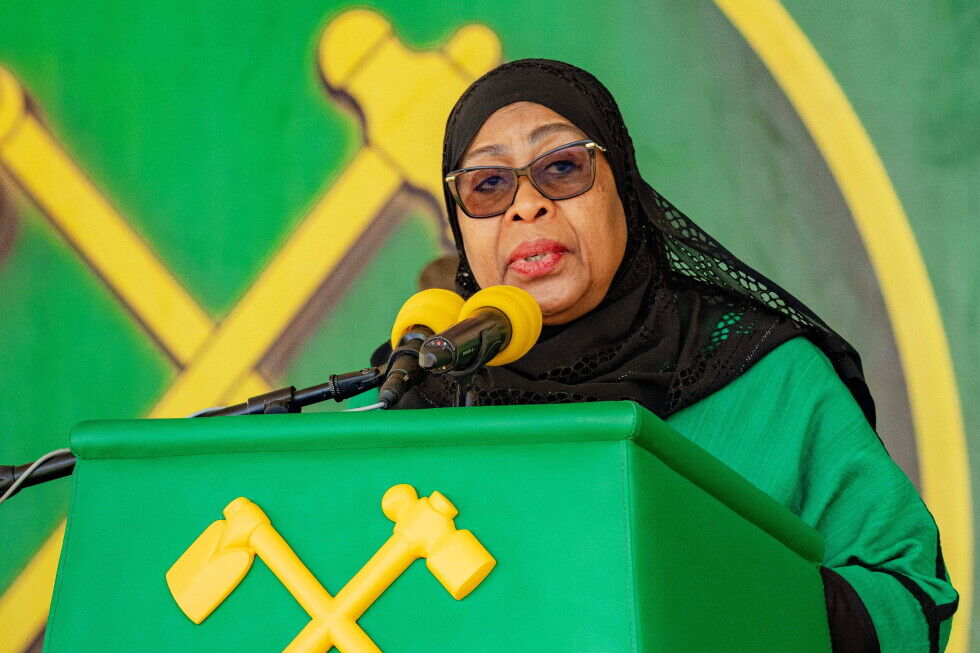

President Samia Suluhu Hassan addresses supporters during a campaign rally in Iringa, Tanzania, October 5, 2025. The event marked a pivotal moment ahead of the highly contested general elections that would later spark nationwide unrest.
Tanzania’s Government Cracks Down on Political Gatherings as Protests Loom Over Disputed Election and Opposition Crackdown
DAR ES SALAAM, Tanzania — In a move that has intensified political tensions, Tanzania’s government has prohibited all political rallies nationwide ahead of a series of planned anti-government protests scheduled for July 7. The ban, announced by Internal Affairs Minister Patrobas Katambi, follows a series of electoral disputes, opposition leader detentions, and postelection violence that have left the nation on edge.
The directive, issued to Police Inspector General Camillus Wambura, effectively halts the issuance of permits for any political gatherings, including rallies, demonstrations, or public meetings. The timing of the ban coincides with growing unrest among Tanzania’s youth, who have mobilized through social media platforms to voice dissatisfaction over the 2025 general elections, President Samia Suluhu Hassan’s reelection, and demands for a new constitution.

Protesters gather in Arusha, Tanzania, on October 30, 2025, following allegations of electoral irregularities during the general elections. The unrest marked Tanzania’s first postelection demonstrations in decades.
A Disputed Election and Rising Unrest
The 2025 general elections in Tanzania were marred by controversies and boycotts, culminating in a landslide victory for the ruling Chama Cha Mapinduzi (CCM) party. The main opposition party, Chadema, withdrew from the polls, citing undemocratic conditions, while the presidential candidate of the second-largest opposition party, ACT Wazalendo, was legally barred from running due to unspecified legal hurdles.
The elections were not without violence. Postelection clashes erupted across multiple regions, with reports of over 500 deaths and widespread allegations of police brutality and electoral fraud. The unrest marked Tanzania’s first postelection protests in decades, signaling a shift in public tolerance for government authority.
Now, as the nation prepares for July 7 demonstrations, organizers—primarily youth-led movements—have outlined three key demands:
1. The release of opposition leader Tundu Lissu, who faces treason charges after advocating for electoral reforms before the 2025 elections.
2. A new constitution to address perceived authoritarian tendencies and strengthen democratic governance.
3. Accountability for postelection violence, including investigations into alleged human rights abuses.

Police officers monitor a protest in Dar es Salaam, Tanzania, following the 2025 elections. The crackdown on dissent has raised concerns among human rights advocates and opposition groups.
Government Justifies Ban as Necessary for Stability
While the ban on political rallies has been widely criticized, the Tanzanian government has framed it as a preemptive measure to maintain public order. Minister Katambi’s directive cites concerns over potential unrest and the need to prevent violence ahead of the protests.
However, legal experts and opposition parties have vehemently rejected the ban, arguing it violates Tanzania’s constitutional rights to free assembly and political expression.
Boniface Mwabukusi, President of the Tanzania Law Society, condemned the ban as unlawful, stating:
“The government has no authority to prohibit or permit meetings that are legally allowed under the Constitution. We will explore all legal avenues—both domestically and internationally—to challenge this directive and hold those enforcing it accountable.”
The Tanzania Law Society has signaled plans to pursue legal recourse, including potential international interventions, to overturn the ban.

President Samia Suluhu Hassan addresses supporters during a campaign event in 2023, following the lifting of a six-year ban on opposition rallies imposed by her predecessor, John Magufuli. The reversal was seen as a temporary step toward political liberalization.
A Pattern of Political Repression?
The latest ban follows a checkered history of political restrictions in Tanzania. Under former President John Magufuli (2015–2021), the government banned opposition rallies for six years, citing security concerns. However, President Hassan lifted the ban in 2023, a move initially interpreted as a step toward political openness.
Yet, critics argue that the current ban is a calculated move to suppress dissent ahead of the protests. Opposition leaders have accused the government of selectively enforcing political freedoms while crushing opposition movements.
Rugemeleza Nshala, chief legal counsel for Chadema, described the ban as a deliberate attempt to “muzzle political freedom.” He stated that the party would pursue legal challenges both in Tanzanian courts and international human rights forums.
Similarly, Rashid Ali, shadow minister for Defense, Internal Affairs, and Security in the ACT Wazalendo party, condemned the directive as another violation of the Constitution, asserting that the government was consistently undermining democratic principles.

Opposition supporters gather in Dar es Salaam, Tanzania, in 2024, demanding electoral reforms and an end to political repression. The government’s crackdown on protests has intensified fears of a broader authoritarian turn.
Police Crackdown and Social Media Mobilization
In addition to the rally ban, Tanzanian authorities have arrested several individuals linked to protest organizing, including social media activists who have been using platforms like WhatsApp, Twitter, and Facebook to coordinate demonstrations.
Human rights organizations have expressed concern over the government’s use of anti-terrorism laws to suppress peaceful dissent, warning that such measures could escalate tensions rather than prevent violence.

Security forces patrol streets in Dar es Salaam ahead of planned protests in July 2026. The heightened presence reflects the government’s determination to prevent large-scale demonstrations.
International Scrutiny and Constitutional Concerns
The situation in Tanzania has drawn international attention, with human rights groups and diplomatic missions monitoring developments closely. The African Union (AU) and United Nations (UN) have previously expressed concerns over Tanzania’s erosion of democratic norms, particularly regarding freedom of speech, press, and assembly.
Legal scholars argue that the ban on political rallies contradicts Tanzania’s obligations under international human rights law, including the African Charter on Human and Peoples’ Rights, which guarantees the right to free association and assembly.
As the July 7 protests approach, the balance between state security and democratic rights remains a contentious issue, with opposition groups vowing to defy the ban while the government prepares for a potential crackdown.

President Samia Suluhu Hassan addresses supporters during a campaign rally in Iringa, Tanzania, October 5, 2025. The event marked a pivotal moment ahead of the highly contested general elections that would later spark nationwide unrest.
CONCLUSION:
Tanzania’s decision to ban political rallies ahead of the July 7 protests has deepened political divisions and raised serious concerns about the government’s commitment to democratic principles. With opposition leaders detained, postelection violence unaddressed, and constitutional demands unmet, the nation stands at a critical juncture—one that could either escalate into further unrest or spark long-overdue reforms. The legal and human rights battles that follow will likely shape Tanzania’s political future in the coming months.
