

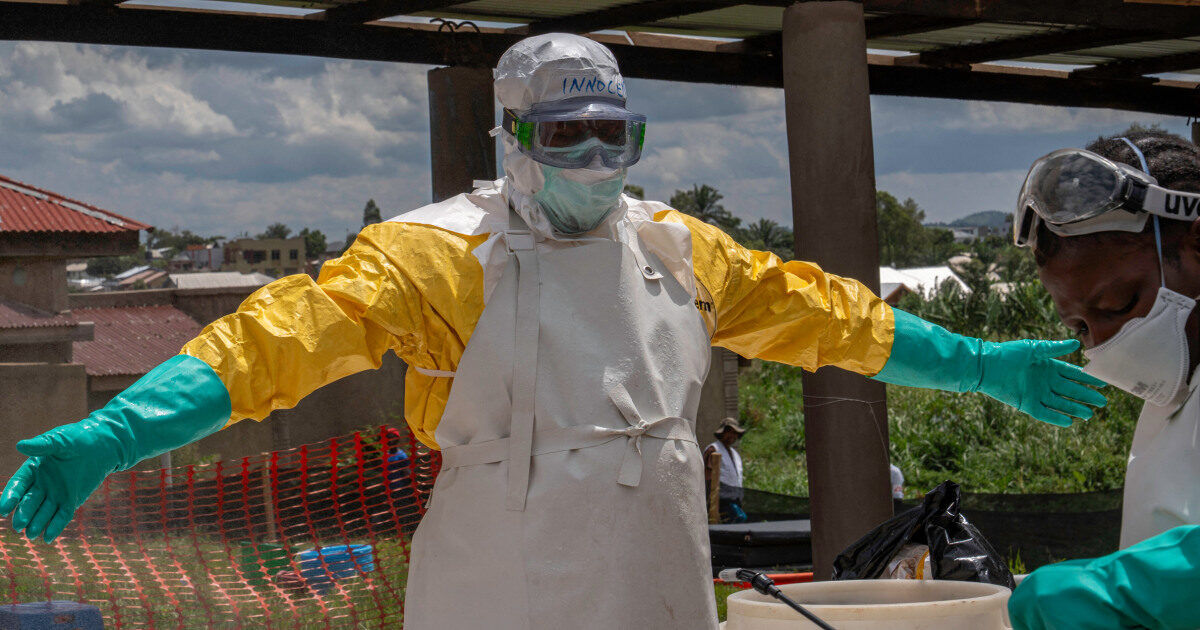
Kinshasa, Democratic Republic of the Congo — The U.S. Centers for Disease Control and Prevention (CDC) has confirmed that a U.S. citizen employed by a humanitarian organization in the Democratic Republic of Congo (DRC) has tested positive for the Ebola virus, marking the latest development in the country’s fastest-growing outbreak on record. The announcement comes as health officials and international partners scramble to contain the Bundibugyo variant of the virus, which has already claimed 648 lives and infected 1,830 people since its declaration on May 15, 2024.
Patient Evacuated to Germany for Treatment
The infected individual was airlifted to Frankfurt University Hospital in Germany on Monday morning, where they were admitted to the hospital’s highly secure isolation unit at approximately 3:00 a.m. local time (0100 GMT). German health authorities confirmed that the patient had contracted the Bundibugyo strain of Ebola while working in the DRC, a variant known for its higher mutation rate and lack of an approved vaccine or targeted treatment.
The CDC, in coordination with U.S. government agencies, Congolese health authorities, and humanitarian partners, is currently tracking close contacts of the infected individual to prevent further transmission. However, no additional details—such as the worker’s identity, specific role, or duration of exposure—have been released to protect privacy and security.
Outbreak Escalates: Record Numbers and Regional Spread
The current Ebola outbreak in the DRC is unprecedented in scale, surpassing previous epidemics in terms of speed of transmission and geographic spread. According to the Africa Centers for Disease Control and Prevention (Africa CDC), the outbreak has grown exponentially, with neighboring Uganda also reporting confirmed cases, raising concerns about cross-border transmission.
Earlier in the outbreak, a U.S. medical doctor working in the DRC tested positive and was similarly evacuated to Germany for treatment. However, the initial plan by the Trump administration to send exposed Americans to a dedicated Ebola treatment facility in Kenya was halted after a Kenyan court suspended the project, leaving evacuation protocols in flux.
Challenges in Containment: Conflict, Violence, and Funding Shortfalls
The Bundibugyo Ebola variant, which has been detected in this outbreak, presents unique challenges due to its genetic differences from the more common Zaire strain. Unlike the Zaire variant, which has seen experimental treatments (such as mAb114 and REGN-EB3) show promise in clinical trials, the Bundibugyo strain has no approved medical countermeasures, complicating response efforts.
Health officials warn that multiple factors are exacerbating the crisis:
– Ongoing conflict in eastern Congo, the outbreak’s epicenter, has disrupted healthcare access and increased violence against medical workers.
– Attacks on health facilities by armed groups have forced some clinics to shut down, reducing surveillance and treatment capacity.
– A severe funding gap has left response teams understaffed and undersupplied, hindering contact tracing, vaccination campaigns, and safe burial practices.
– Misinformation and community resistance have slowed acceptance of Ebola vaccines (such as Ervebo, which is effective against the Zaire strain but not Bundibugyo).
Emerging Treatments and Clinical Trials
In a critical development, researchers recently launched clinical trials for experimental Ebola treatments in the DRC, aiming to assess efficacy against the Bundibugyo variant. While no vaccine is currently authorized for this strain, scientists are exploring adaptive strategies, including monoclonal antibody therapies and gene-based interventions, to counter the virus.
The World Health Organization (WHO) has classified the outbreak as a public health emergency of international concern (PHEIC), urging global cooperation to prevent further spread. However, limited resources, logistical hurdles, and security risks continue to hamper containment efforts.
Global Response and Future Outlook
The CDC’s involvement underscores the international dimension of the crisis, as Ebola’s transmission risks—particularly through air travel and cross-border movement—demand coordinated action. While Germany’s readiness to treat infected patients reflects a proactive approach, the lack of a proven treatment for Bundibugyo remains a major concern.
Health experts warn that without immediate intervention, the outbreak could worsen, particularly in high-risk areas where health infrastructure is already strained. The ongoing conflict, political instability, and funding shortages create an unfavorable environment for effective control.
As the number of cases continues to rise, the international community’s response will be critical in determining whether this outbreak can be contained before it spirals further. The CDC, WHO, and humanitarian organizations are urging urgent support to strengthen surveillance, improve access to care, and deploy emergency response teams to the hardest-hit regions.
The Bundibugyo Ebola outbreak remains one of the most complex public health crises in recent years, demanding immediate, sustained, and innovative solutions to prevent a regional or global resurgence of the deadly virus.
