
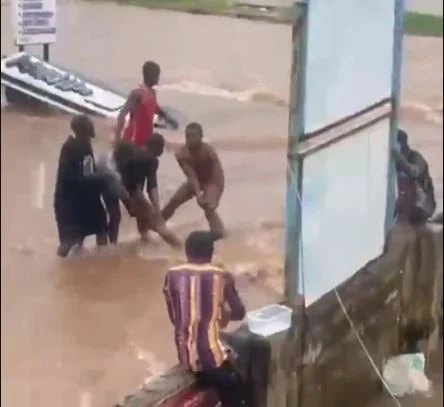
The sky over Okpanam, Delta State, had barely begun to clear when the true danger of the night’s downpour revealed itself. What started as a routine evening in this bustling community had suddenly turned into a life-or-death race against nature’s fury. A man, caught in the torrent of floodwaters that surged through the streets, found himself swept away from safety—until passersby turned into lifesavers in an instant.
Witnesses described the scene as chaotic yet strangely surreal, the kind of moment where time seems to slow down even as the situation accelerates beyond control. The man, whose identity remains undisclosed, had been walking near a drainage channel when the waters rose with terrifying speed. Within minutes, he was fighting to stay afloat as the current dragged him further from the curb. What followed was not a scripted rescue scene but a raw, unscripted display of human instinct—ordinary people stepping up when seconds counted.

This wasn’t just another flood warning in Nigeria’s Delta region, where seasonal rains often push rivers and drainage systems to their limits. The area has seen its share of disasters, from collapsed bridges to submerged homes, but this rescue stood out for its immediacy. The passersby, whose faces remain blurred in video footage, moved with a clarity of purpose that belied the panic around them. One person waded into the water, another grabbed a sturdy branch to extend as a makeshift lifeline, while others formed a human chain to pull the struggling man to safety. Within minutes, the crisis had passed—another life saved, another story of resilience etched into the community’s memory.
When the Weather Turns Against You: Delta’s Flood Crisis
Nigeria’s Delta State has long grappled with the dual challenges of geography and infrastructure. Nestled between the Niger Delta’s sprawling wetlands and the Atlantic coastline, the region is no stranger to heavy rainfall. But in recent years, the intensity and frequency of these downpours have escalated, pushing drainage systems to their breaking point. The result? Streets that double as rivers, homes that become islands, and lives hanging in the balance when the waters rise.

Experts point to a combination of factors: climate change, which has intensified rainfall patterns, and urbanization that has paved over natural water channels. In Okpanam, like many Delta communities, the problem is exacerbated by poor waste management, where blocked drains turn into flash flood accelerators. The man’s rescue was a stark reminder of how quickly a routine day can spiral into danger when nature’s forces collide with human oversight.

Local authorities have acknowledged the growing threat, with some communities now adopting early warning systems and community response teams. Yet, as this incident proves, the most effective first responders are often those already on the scene—neighbors, commuters, and passersby who refuse to look the other way. Their actions underscore a critical truth: in the face of disaster, solidarity can be as powerful as any emergency service.

From Bystanders to Lifesavers: The Psychology of Rescue
What compels ordinary people to risk their own safety to save a stranger? Psychologists studying emergency response often highlight a phenomenon called the “bystander effect,”—the idea that people are less likely to intervene in a crisis if others are present. Yet, in Okpanam, the opposite occurred. The sheer number of people on the scene may have been the catalyst for action, breaking through the hesitation that often paralyzes groups in moments of crisis.
Research suggests that in high-pressure situations, humans rely on social cues. When one person steps forward, others follow, creating a domino effect of courage. The passersby in Delta State didn’t have time to overthink their actions; the urgency of the moment demanded instinct over deliberation. Their quick thinking likely saved a life—and in doing so, reinforced a community’s faith in its own resilience.

This incident also raises questions about the role of training in such rescues. While formal emergency response teams are vital, community-based preparedness programs could equip more people with the skills to act decisively. Simple techniques, like using ropes or branches to extend reach in floodwaters, can make the difference between a successful rescue and a tragedy. The Okpanam rescue wasn’t just a stroke of luck; it was a testament to how ordinary people, armed with the right knowledge and courage, can become heroes.
Nigeria’s Floods: A Growing National Crisis
Delta State is not alone in its struggle with flooding. Across Nigeria, seasonal rains have become a recurring nightmare, with 2026 marking one of the worst years in recent memory. From Lagos to Kano, communities have watched as floodwaters swallow homes, displace families, and cut off access to essential services. The Nigerian Meteorological Agency has repeatedly warned of the risks, yet the scale of the problem often outpaces preparedness efforts.
The economic toll is staggering. Farmlands submerged, roads impassable, and markets disrupted—each flood season leaves a trail of financial devastation in its wake. For a country where agriculture employs millions, the loss of crops and livestock can push families into poverty for years. The Okpanam rescue, while a moment of triumph, is a microcosm of a larger struggle: Nigeria’s fight against the elements, and its ability to protect its people when the skies open up.
Government responses have varied, from temporary relief packages to long-term infrastructure projects. Yet, critics argue that reactive measures are not enough. Proactive solutions—like restoring natural water channels, investing in flood-resistant housing, and educating communities—are critical. The Okpanam incident is a reminder that while rescues can save lives in the moment, prevention is the only way to ensure fewer lives are put at risk in the first place.
The Ripple Effect: How One Rescue Inspires Others
In the days following the Okpanam rescue, the story spread beyond Delta State, becoming a symbol of hope in Nigeria’s broader struggle with flooding. Social media platforms buzzed with admiration for the passersby, their actions sparking conversations about community resilience and the power of collective action. For many, it was a rare moment of good news in a year dominated by headlines of displacement and disaster.
Local leaders seized the opportunity to highlight the need for stronger flood management systems. Community groups organized clean-up drives to clear blocked drains, while volunteers took to the streets to educate residents on flood safety. The rescue had done more than save a life; it had reignited a sense of agency among those living in flood-prone areas.
Even in the face of adversity, stories like this one offer a glimmer of optimism. They remind us that in a world often divided by borders and differences, humanity’s instinct to protect one another remains unshaken. The passersby of Okpanam didn’t set out to become heroes; they simply chose to act when it mattered most. Their courage is a lesson for us all—one that transcends geography and circumstance.
As Nigeria continues to grapple with the challenges of climate change and urbanization, incidents like this serve as both a warning and a beacon. They warn of the dangers that lie ahead if action is delayed, and they beacon toward a future where communities are empowered to protect themselves and each other.
What Comes Next for Delta’s Flood-Prone Communities
The road ahead for Delta State and other flood-affected regions is fraught with challenges, but the Okpanam rescue offers a blueprint for progress. Short-term measures, like improved drainage systems and emergency response training, can provide immediate relief. Long-term strategies, such as climate-resilient urban planning and investment in early warning systems, are essential for sustainable change.
Community leaders are calling for a multi-stakeholder approach, involving government agencies, non-profits, and residents in the fight against flooding. Grassroots initiatives, like the clean-up drives sparked by the rescue, demonstrate how local action can drive national change. The message is clear: solving Nigeria’s flood crisis will require more than infrastructure—it will demand a shift in mindset, where preparedness and solidarity become as routine as the rains themselves.
For now, the man rescued in Okpanam is safe, his story a testament to the power of human connection in the face of nature’s wrath. His ordeal and the swift actions of those around him serve as a reminder that even in the darkest moments, hope—and heroism—can emerge from the most unexpected places.
Copyright notice: Images and source material are credited to their respective owners/source (original source where available). If you are the copyright owner and want an image or content removed, please contact us at topix.news/contact-us; we will review and remove it promptly.

Topix News Desk is a digital editorial team focused on delivering clear, timely, and useful news coverage for readers worldwide. Our reporting highlights African news with global context, including politics, business, economy, technology, health, sports, entertainment, travel, and culture. We aim to publish accessible, well-structured, and informative articles that help readers understand the stories shaping Africa and the world.