
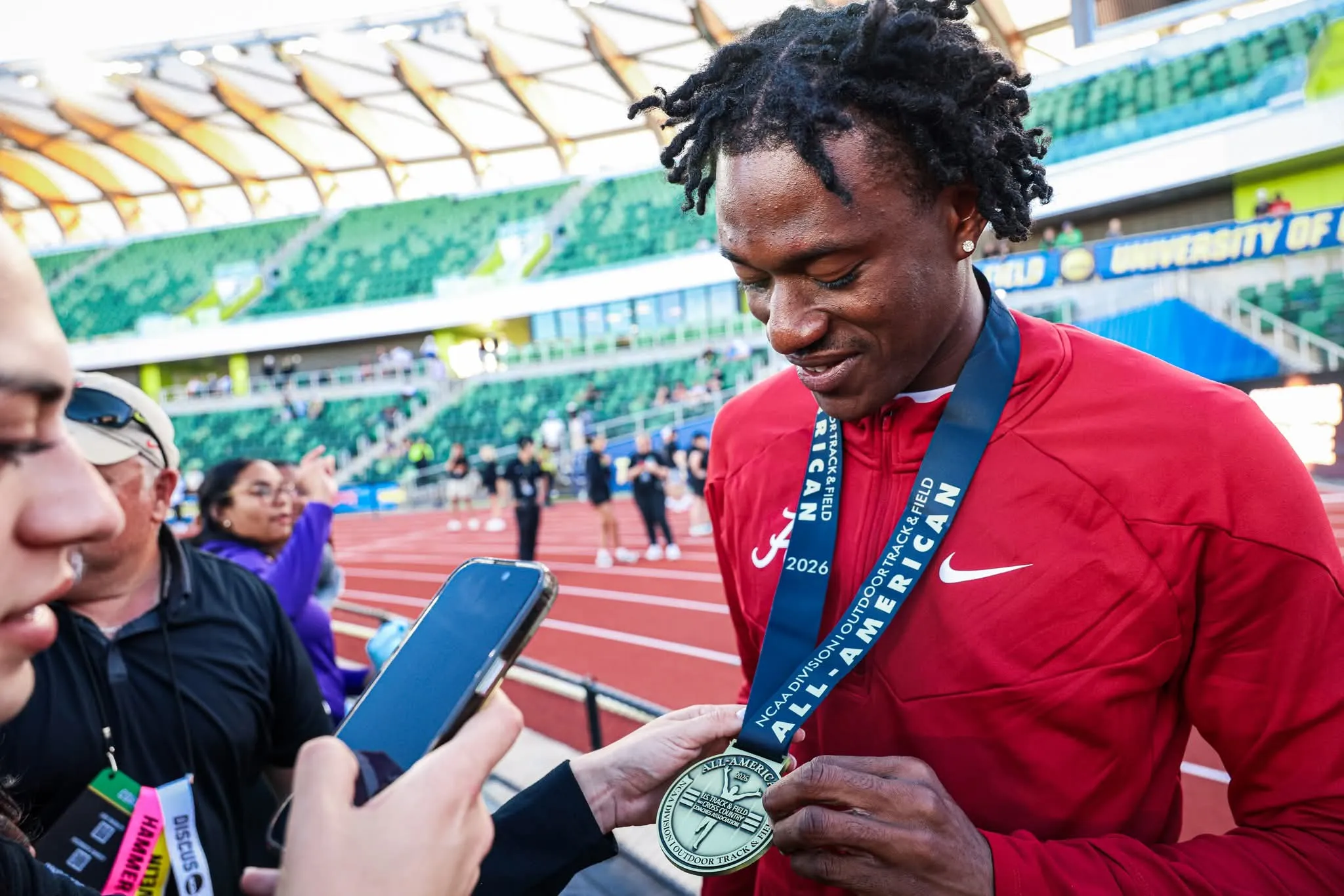
The air in Eugene crackled with electricity on a late spring evening, the kind of tension that only precedes moments destined to be etched into sporting lore. As the sun dipped below the horizon, casting long shadows across Hayward Field, two Nigerian athletes stood poised to do something no one had quite managed before: rewrite the record books in a single night. What unfolded next wasn’t just a victory; it was a statement—one that echoed across the Atlantic and sent ripples through the world of athletics.
Ajayi’s blistering 100m dash: A lightning bolt from Lagos to Oregon
When the starting pistol cracked at 8:37 PM local time, all eyes turned to the lane where Nigeria’s fastest man, Ajayi, had planted himself. The 22-year-old from Lagos had spent years chasing this moment, and as the runners exploded off the blocks, it was clear this wasn’t just another race. Every stride was a declaration—each step a challenge to the limits of human speed. By the 60-meter mark, the crowd gasped; by the finish line, the stadium erupted.

What made Ajayi’s performance extraordinary wasn’t just the time—9.92 seconds, a personal best—but the way he dismantled the field. His acceleration was relentless, his form immaculate, and his finish so dominant that even the most optimistic pundits had to double-check their stopwatches. The victory wasn’t just gold; it was a statement that Nigerian sprinters had arrived at the pinnacle of global track and field.
Ogazi’s 400m masterclass: A quarter-mile for the ages
While Ajayi’s race was a symphony of explosive speed, Ogazi’s performance in the men’s 400 meters was a masterclass in endurance and precision. The 24-year-old from Abuja had already etched his name into the record books the previous year, but on this night, he wasn’t just defending his title—he was obliterating it. The final lap was a blur of determination, as Ogazi sliced through the field with a stride that seemed to defy physics. When the clock stopped at 43.89 seconds, the world took notice.

That time wasn’t just a championship record; it was the second-fastest 400 meters in NCAA history. Only one man, Michael Johnson, had run faster in a collegiate setting, and Ogazi had just joined that elite company. The performance was a testament to Nigeria’s growing dominance in middle-distance events, a domain long dominated by American and Caribbean athletes. As Ogazi raised his arms in triumph, it was clear: this was more than a win. It was a seismic shift.
A continent’s pride on display: Nigeria’s NCAA sweep
The double gold in Eugene wasn’t just a personal triumph for Ajayi and Ogazi; it was a victory for an entire continent watching from afar. In a sport where African athletes have historically been celebrated for their endurance in longer distances, these performances proved that Nigeria is now a force to be reckoned with in the sprints as well. The NCAA Championships, often seen as a stepping stone for elite athletes, had just witnessed a historic moment—one that would inspire a new generation of Nigerian sprinters.
What made the night even more special was the depth of Nigeria’s performance. Beyond the two golds, Nigerian athletes featured prominently in the finals of multiple events, from the 200 meters to the 4×400 relay. The message was clear: Nigeria isn’t just producing world-class athletes; it’s building a track and field powerhouse. Coaches, analysts, and fans alike began to ask the same question: Could this be the beginning of a Nigerian dynasty in collegiate athletics?
The global ripple effect: How Eugene’s night will reshape African athletics
The impact of Ajayi and Ogazi’s performances will extend far beyond the confines of Hayward Field. For African athletics, this was a wake-up call—a reminder that the continent’s athletes are capable of dominating every discipline, not just the ones traditionally associated with African success. The NCAA Championships, often seen as a proving ground for future Olympians, had just become a stage for African athletes to announce their arrival on the world stage.
Already, sports analysts are speculating about the ripple effects. Could this inspire more African countries to invest in track and field infrastructure? Will we see a surge in young athletes from Nigeria, Ghana, and Kenya taking up sprinting as a viable path to international success? The answers may take time to unfold, but one thing is certain: the narrative of African athletics has just been rewritten.
Behind the scenes: The training, the sacrifices, and the dream
While the world celebrated Ajayi and Ogazi’s victories, few paused to consider the years of sacrifice behind their success. For Ajayi, the journey began in the crowded streets of Lagos, where he trained on makeshift tracks with little more than a dream and a pair of worn-out spikes. For Ogazi, it was the high-altitude training camps of Abuja that honed his endurance, turning him into the machine he is today.
Their coaches, often unsung heroes in the world of athletics, played a pivotal role. Ajayi’s coach, a former Nigerian sprinter himself, had spent years refining his protégé’s technique, turning raw speed into a weapon. Ogazi’s coach, meanwhile, had instilled in him a relentless work ethic, drilling him in the nuances of pacing and strategy. Together, they had crafted two athletes who were more than just fast—they were unstoppable.
Their stories are a reminder that behind every record-breaking performance lies a mountain of unseen effort. For young athletes across Africa, Ajayi and Ogazi are proof that greatness isn’t given—it’s earned. Their victories are a call to action for a continent that has long been a powerhouse in long-distance running but is now staking its claim in the sprints as well.
The road ahead: What’s next for Nigerian athletics?
With the NCAA Championships behind them, Ajayi and Ogazi now set their sights on even bigger stages. For Ajayi, the next challenge is the World Championships, where he’ll face the likes of Fred Kerley and Noah Lyles. For Ogazi, the Olympics loom large—a chance to add a global title to his already impressive resume. But their sights aren’t set solely on individual glory. Both athletes have spoken about their dream of leading Nigeria to team success in future competitions, including the African Games and the Commonwealth Games.
The question now is whether Nigeria’s athletics federation will seize this moment. With the right investment in infrastructure, coaching, and youth development, the country could soon become a sprinting juggernaut. The potential is there; the question is whether the will is as well.
One thing is certain: the world will be watching. After Eugene, no one can afford to overlook Nigerian athletics again. Whether it’s Ajayi’s blistering speed or Ogazi’s relentless endurance, the message is clear—Nigeria is here to stay, and it’s ready to rewrite the record books once more.
Africa’s moment: The sprinting revolution gathers pace
The NCAA Championships in Eugene may have been the spark, but the fire it ignited is spreading. Across the continent, young athletes are lacing up their spikes with renewed purpose, dreaming of the day they too can stand on a podium and hear their national anthem play. From the dusty tracks of Nairobi to the synthetic surfaces of Cape Town, the sprinting revolution is in full swing.
What’s particularly exciting is the diversity of talent emerging. While Nigeria has taken center stage in Eugene, athletes from Ghana, Kenya, and South Africa are also making waves in collegiate and international competitions. The days of African athletics being synonymous solely with marathon running are fading fast. In their place is a new era—one where the continent’s athletes are celebrated for their speed, their power, and their relentless pursuit of greatness.
For fans of the sport, this is an exhilarating time. The sprints have always been about drama, about the clash of titans, and about moments that leave you breathless. With African athletes now at the forefront, the drama is only set to intensify. The question isn’t whether this revolution will continue—it’s how far it will go.
One thing is for certain: the world of athletics will never be the same. And for that, we have two Nigerian sprinters to thank.
Copyright notice: Images and source material are credited to their respective owners/source (original source where available). If you are the copyright owner and want an image or content removed, please contact us at topix.news/contact-us; we will review and remove it promptly.

Topix News Desk is a digital editorial team focused on delivering clear, timely, and useful news coverage for readers worldwide. Our reporting highlights African news with global context, including politics, business, economy, technology, health, sports, entertainment, travel, and culture. We aim to publish accessible, well-structured, and informative articles that help readers understand the stories shaping Africa and the world.