
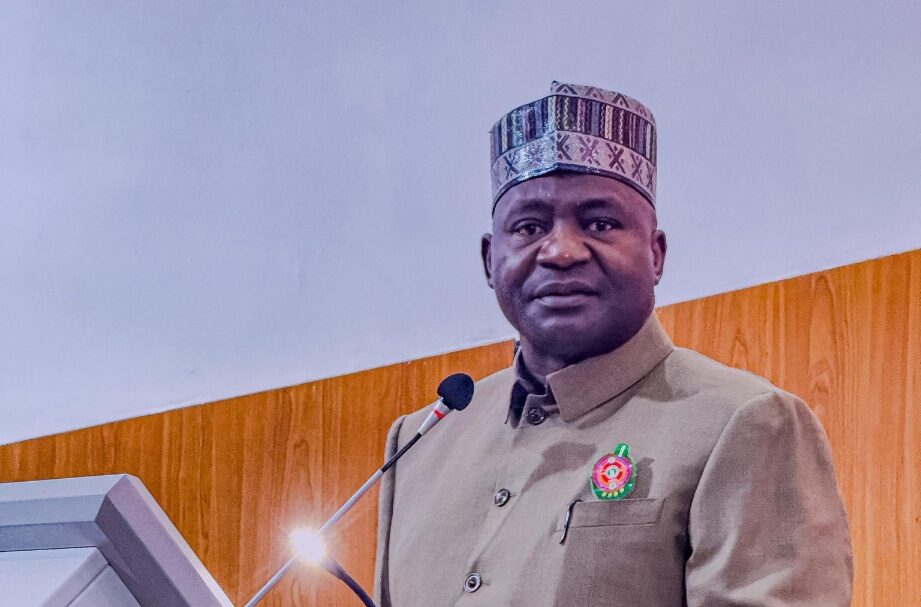
The shadows of Nigeria’s struggle against insurgency have deepened, not with foreign invaders at the gate, but with collaborators lurking within. Speaking at a high-level security briefing in Abuja, Defence Minister Christopher Musa delivered a blunt assessment: the country’s war against terrorism, banditry, and armed insurgents is being undermined by a web of local informers feeding intelligence to criminal factions. This revelation, coming amid a surge in violent attacks across the North West and North East, underscores a troubling paradox—Nigeria’s security apparatus, one of the continent’s most robust, is being outmaneuvered by its own citizens.
The timing could not be more critical. Just weeks after a coordinated attack on a military convoy in Zamfara left scores dead, Musa’s admission has sent ripples through West Africa’s security landscape. Analysts warn that if unchecked, such informer networks could embolden non-state actors to expand their reach, potentially destabilizing neighboring countries already grappling with porous borders and fragile governance.

What makes this crisis particularly insidious is its scale. Security experts estimate that for every high-profile attack claimed by groups like Boko Haram or ISWAP, dozens more are quietly enabled by individuals who blend into communities as traders, transporters, or even low-level government workers. The informers, often motivated by financial gain or coercion, provide real-time details on troop movements, supply routes, and counterterrorism strategies—turning what should be Nigeria’s strengths against it.
In the arid plains of Borno, where Boko Haram’s insurgency has raged for over a decade, the cost of this betrayal is measured in lives. Villagers report that fighters now move with near impunity, their attacks preceded by tip-offs that allow them to ambush military patrols or evade surveillance drones. A recent report by the Nigerian Security Tracker documented a 23% increase in civilian casualties in the first quarter of 2026 compared to the same period last year, a trend directly linked to the informers’ role in tipping off militants about impending operations.
But the problem extends beyond Nigeria’s borders. Across the Sahel, from Mali’s embattled north to Burkina Faso’s volatile east, security forces face a similar dilemma: how to distinguish friend from foe in communities where distrust has become the default. In Niger, where a military junta recently severed ties with former colonial power France, officials have privately acknowledged that jihadist groups rely heavily on local informers to navigate the vast desert regions. The result? A cycle of violence that shows no signs of abating, despite billions spent on regional counterterrorism initiatives.
The Defence Minister’s remarks have reignited debates about the effectiveness of Nigeria’s intelligence-sharing mechanisms. Critics argue that the country’s security agencies, long plagued by bureaucratic infighting and a lack of coordination, are ill-equipped to dismantle these networks. “We have the manpower, the weapons, even the drones,” said a retired army colonel who requested anonymity. “What we lack is the trust of the people we’re supposed to protect.”
The Human Cost of Hidden Alliances
Behind the statistics and security briefings lies a human toll that rarely makes headlines. In the village of Dutsen Wai, a farming community in Kaduna State, residents describe a climate of fear that has taken root over the past two years. “They come at night, not with guns, but with questions,” said a local elder, who asked not to be named for safety reasons. “They ask who travels to the market, who attends the mosque, who speaks to the soldiers. And then, the attacks follow.”
The informers, often young men with limited education, are lured by promises of quick cash or threats against their families. In some cases, they are coerced into service after being caught in minor crimes, their loyalty bought with the implicit threat of exposure to authorities. Security analysts note that the rise of these networks coincides with the proliferation of mobile money services, which allow payments to be made discreetly and untraceably across vast distances.
For women in conflict zones, the risks are compounded. In communities where men are frequently targeted by both militants and security forces, women have become inadvertent conduits for intelligence. In Maiduguri, a bustling city that has absorbed waves of internally displaced persons, traders at the Monday Market say they often overhear snippets of conversation that later prove crucial—but also dangerous. “We hear things,” said a vegetable vendor named Aisha. “But speaking up means risking everything.”
The psychological toll is equally devastating. In Zamfara, where bandit gangs have kidnapped hundreds in recent months, survivors describe a pervasive sense of paranoia. “You don’t know who to trust,” said a schoolteacher who was held for three weeks before escaping. “Your neighbor might be the one who told them where to find you.”
Regional Ripples: When Insecurity Crosses Borders
The tentacles of Nigeria’s informer networks stretch far beyond its borders, creating a regional security headache that no single country can solve. In Cameroon’s Far North Region, where Boko Haram and ISWAP have carried out deadly raids, local officials report an alarming increase in cross-border smuggling of weapons and fighters—all facilitated by informers who move freely between Nigeria and its neighbors.
The situation is equally dire in Chad, where the government has deployed thousands of troops to the Lake Chad Basin to combat insurgents. Yet, despite these efforts, attacks on military outposts continue unabated. Analysts point to a sophisticated system of informers operating in border towns, where traders and transporters double as intelligence gatherers for militant groups. “The enemy knows our every move before we do,” lamented a Chadian officer stationed near the Nigerian border.
Even in relatively stable countries like Ghana and Ivory Coast, the ripple effects are being felt. In Accra, security analysts warn that the country’s porous borders make it vulnerable to infiltration by informers tied to regional militant groups. “We are not immune,” said a Ghanaian counterterrorism expert. “If Nigeria’s informer networks grow, they will eventually spill over.”
The challenge is compounded by the region’s economic realities. In countries like Niger, where youth unemployment hovers around 40%, the promise of a few thousand naira or CFA francs can be enough to turn a desperate individual into an informer. “Poverty is the greatest weapon in the hands of these groups,” said a Nigerien economist. “Without addressing it, no amount of military strategy will work.”
Can Nigeria Break the Cycle?
The Defence Minister’s admission has forced a reckoning within Nigeria’s security establishment. Among the proposals under consideration is a revamp of the country’s community policing model, which would place greater emphasis on vetting local leaders and incentivizing grassroots intelligence. “We need to rebuild trust,” Musa stated in a follow-up interview. “That means treating communities as partners, not suspects.”
But trust is a fragile thing, especially in regions where the military has been accused of human rights abuses. In the Northeast, reports of arbitrary arrests and extrajudicial killings have alienated civilians, pushing some into the arms of insurgents out of sheer desperation. “When the soldiers come, they don’t ask questions,” said a farmer in Yobe State. “They take young men away, and we never see them again. Is it any wonder some turn to the other side?”
Another proposed solution is the expansion of Nigeria’s whistleblower program, which offers financial rewards for tips leading to the arrest of militants. However, skepticism abounds. “Who will come forward when the informers are already embedded in every village?” asked a security consultant based in Abuja. “The program is a start, but it’s not enough.”
The government is also exploring technological solutions, including the use of biometric identification systems to vet individuals in high-risk areas. But even these measures have limitations. In remote regions like the Sambisa Forest, where Boko Haram’s hideouts remain largely uncharted, technology can only do so much.
A more immediate concern is the lack of coordination among Nigeria’s security agencies. The country’s multiple intelligence outfits—the State Security Service, the Defence Intelligence Agency, and the Nigerian Intelligence Agency—often operate in silos, making it difficult to share critical information. “We are fighting the same enemy, but we are not sharing the same battlefield,” quipped a former intelligence officer.
The Broader African Context: A Continent at a Crossroads
Nigeria’s struggle is not unique. Across Africa, governments are grappling with the dual challenge of combating insurgency while navigating the complexities of local complicity. In Somalia, Al-Shabaab’s control over parts of the country is sustained in part by informers embedded in Mogadishu’s markets and transport hubs. In Mozambique, the rise of Islamic State-affiliated militants in Cabo Delgado has been fueled by networks of informers who provide logistical support to the group.
Yet, there are glimmers of hope. In Kenya, the government’s use of community policing initiatives in areas like the North Rift has led to a decline in cattle rustling and banditry. Similarly, in South Africa, the police’s collaboration with local vigilante groups has helped reduce gang violence in townships. These examples suggest that when communities are treated as allies rather than adversaries, security outcomes can improve.
But success requires more than just goodwill. It demands investment—in education, in economic opportunities, and in the institutions that underpin trust. In Nigeria, where the gap between the rich and poor is widening, and where corruption erodes faith in government, the road ahead is steep. “We cannot bomb our way to security,” said a retired general. “We need a holistic approach.”
What Comes Next?
The coming months will be critical for Nigeria and the wider region. With national elections looming in 2027, the government faces immense pressure to demonstrate progress in its fight against insurgency. Yet, the Defence Minister’s revelation has made it clear that military solutions alone will not suffice.
For now, the focus is on dismantling informer networks before they spread further. Security forces have launched targeted operations in high-risk areas, including mass arrests and the deployment of undercover operatives. But the risk of overreach looms large. In a climate of heightened suspicion, the line between legitimate security measures and human rights violations is easily crossed.
The international community, too, has a role to play. Regional bodies like the African Union and the Economic Community of West African States (ECOWAS) must prioritize funding for community-based counterterrorism programs. At the same time, donor countries should resist the temptation to impose solutions from afar, instead supporting locally driven initiatives that address the root causes of insecurity.
One thing is certain: the battle against informer networks will not be won with bullets alone. It will require a fundamental shift in how governments engage with their citizens—a shift that prioritizes transparency, accountability, and above all, trust. Until then, the shadows will continue to grow, and with them, the specter of violence that has already claimed too many lives.
For the people of Nigeria’s conflict zones, the message is clear: the enemy may not always wear a uniform. Sometimes, they wear the faces of neighbors, friends, or even family. The question is whether the country—and the continent—can rise to the challenge before it’s too late.
The stakes could not be higher. In a region where the future of millions hangs in the balance, the fight against informer networks is not just a security issue. It is a test of Africa’s ability to confront its demons—not with guns, but with the courage to confront the uncomfortable truths that lie within.
Copyright notice: Images and source material are credited to their respective owners/source (original source where available). If you are the copyright owner and want an image or content removed, please contact us at topix.news/contact-us; we will review and remove it promptly.

Topix News Desk is a digital editorial team focused on delivering clear, timely, and useful news coverage for readers worldwide. Our reporting highlights African news with global context, including politics, business, economy, technology, health, sports, entertainment, travel, and culture. We aim to publish accessible, well-structured, and informative articles that help readers understand the stories shaping Africa and the world.