
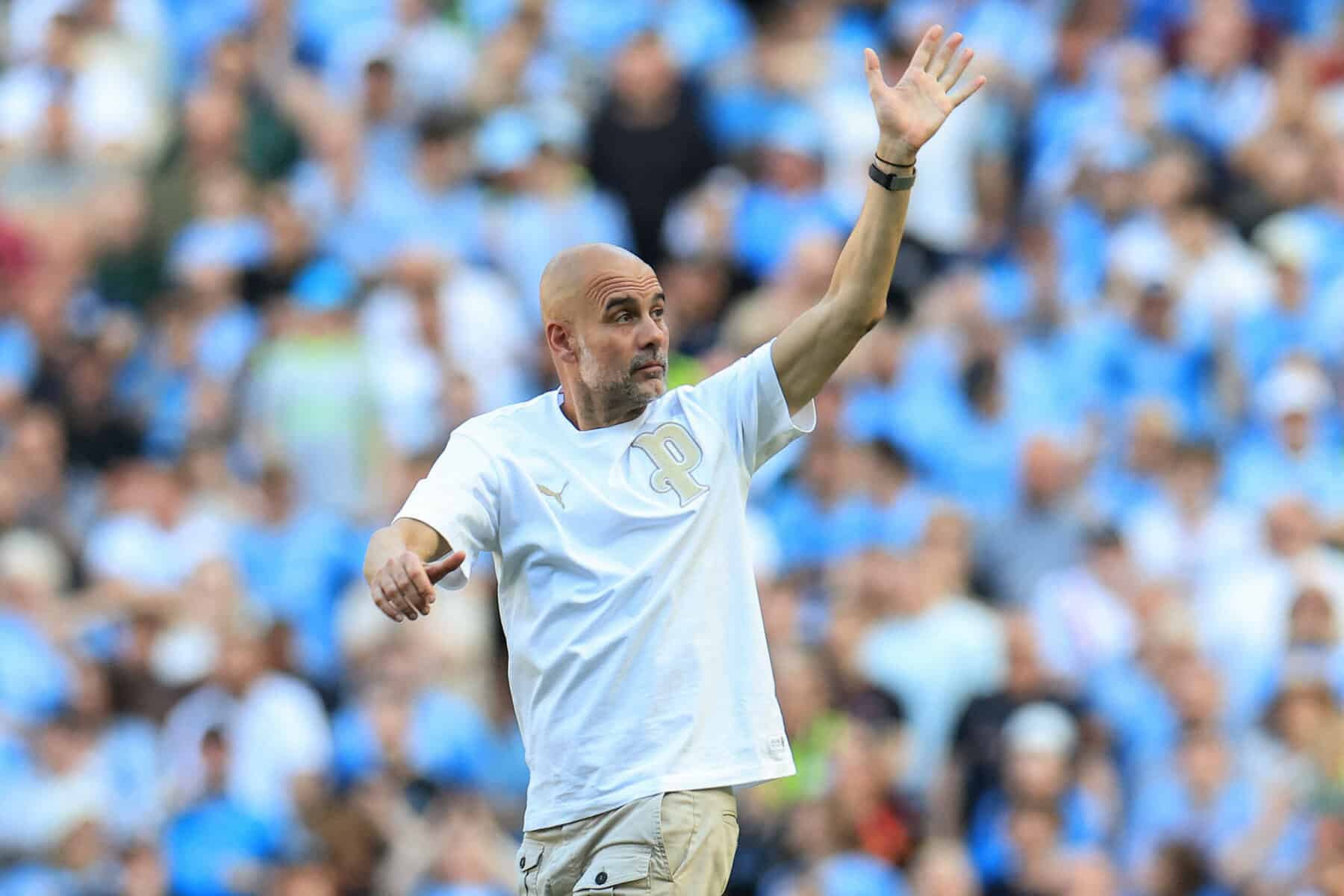
Manchester City’s farewell to Pep Guardiola began with a thunderous ovation, a colossal banner unfurled in the Etihad Stadium, and a promise etched in blue: “Game changer. History maker. City forever.” The tribute, designed to immortalize the Spanish tactician’s legacy, was supposed to be the crowning moment of his final home game. Instead, it became a bitter footnote to a performance that left supporters reeling after a 3-1 defeat to Aston Villa.
Guardiola, clad in his signature black trench coat, emerged from the tunnel to a standing ovation that rattled the stadium’s rafters. The 4,000-seat away section, normally a sea of opposition colors, erupted in applause—a rare moment of unity in a season defined by division. The banner, a 20-foot canvas draped over the South Stand, was a masterclass in sentimentality: a sepia-toned photograph of Guardiola mid-stride, his arms outstretched as if embracing the club’s future. Below it, the words “City forever” glowed in electric blue neon, a promise that transcended the final whistle.
Yet, as the clock ticked toward full-time, the euphoria curdled into disbelief. Aston Villa, a side that had struggled for consistency all season, exposed City’s frailties with clinical precision. The visitors took the lead through a 12th-minute strike from Ollie Watkins, a moment so sudden that the Etihad’s roar was swallowed by a stunned silence. John Stones, usually a paragon of defensive solidity, misjudged a header that ricocheted off his own knee before falling to Watkins. The Villa faithful, a mere 3,000 strong, erupted, their voices cutting through the Manchester drizzle like a blade.
Guardiola’s team, so often a machine of relentless efficiency, looked uncharacteristically disjointed. Erling Haaland, the club’s record-breaking striker, was starved of service, his usual predatory instincts blunted by Villa’s high press. The Norwegian’s frustration was palpable; a rare shot in the second half clattered off the crossbar, a near-miss that did little to mask his growing exasperation. Meanwhile, Rodri, the metronome of City’s midfield, was overrun by the energy of Douglas Luiz and the relentless running of Leon Bailey. The Spanish midfielder, usually the orchestrator of City’s dominance, was reduced to playing catch-up, his passes intercepted with alarming frequency.
The second half offered a glimmer of hope, albeit a fleeting one. Julian Alvarez, deputizing for the injured Haaland, slotted home a rebound in the 58th minute, sparking a brief resurgence in the Etihad’s mood. The home crowd, now a cacophony of desperate encouragement, urged their team forward. But Villa’s defense, marshaled by the imperious Tyrone Mings, held firm. Every City attack was snuffed out with a combination of brute force and tactical discipline, a reminder that even the best teams can be undone by a single moment of vulnerability.
As the final whistle blew, the contrast between Guardiola’s send-off and City’s performance could not have been starker. The players, their faces etched with exhaustion and disappointment, trudged toward the tunnel. Guardiola, ever the stoic, offered a perfunctory wave to the crowd before disappearing into the bowels of the stadium. The banner, once a symbol of adoration, now hung limply, its neon letters flickering in the dim light like a dying star.
What Went Wrong for Manchester City?
City’s defeat to Aston Villa was not just a setback; it was a microcosm of the season’s broader struggles. Injuries have plagued the club, with Haaland, Kevin De Bruyne, and now Alvarez all missing key moments. The squad, once a paragon of depth and versatility, has been stretched thin by a relentless fixture list. Guardiola’s reliance on a core of aging stars—Fernandinho, Fernandinho’s replacement Rodri, and the ever-present Kyle Walker—has left the team vulnerable to the physicality of sides like Villa.
The tactical setup, too, came under scrutiny. City’s usual dominance in possession was nullified by Villa’s aggressive pressing, a strategy that forced errors in midfield and stifled the team’s rhythm. Guardiola, known for his tactical flexibility, appeared outmaneuvered, his substitutions failing to shift the momentum. The introduction of Bernardo Silva and Phil Foden offered glimpses of creativity, but it was too little, too late. By the time Alvarez scored, the damage was already done.
Defensively, City’s frailties were exposed time and again. Stones, once a rock at the back, looked hesitant and error-prone. The center-back pairing of him and Nathan Ake struggled to deal with Villa’s directness, their usual composure replaced by a series of misplaced passes and poor decisions. The full-backs, too, were culpable. Rico Lewis and Joao Cancelo, both usually so assured in attack, were exposed by Villa’s counterattacks, their forays forward leaving gaping spaces behind them.
Psychologically, the defeat was a blow to morale. City’s players, accustomed to winning, seemed shell-shocked by the loss. The weight of expectation, both from the club’s hierarchy and its fanbase, hung heavy in the air. Guardiola, ever the philosopher, has spoken in the past about the importance of resilience, but on this night, his team lacked the mental fortitude to turn the tide.
The Guardiola Paradox: A Legacy Built on Contradictions
Guardiola’s tenure at Manchester City has been a study in contradictions. He arrived in 2016 with a reputation as a tactical innovator, a man who could turn even the most modest of squads into a title-winning machine. Yet, his time at City has been defined as much by his failures as his triumphs. The Champions League, the ultimate prize in European football, has remained elusive, despite three consecutive semi-final appearances. Even in the Premier League, City’s dominance has been punctuated by moments of vulnerability, as seen in their 2021-22 title race with Liverpool, where a single point separated them at the end of the season.
This season, Guardiola’s contradictions have been laid bare. His team has scored more goals than any other in the league, yet they have also conceded more than their closest rivals. His attacking philosophy, built on possession and pressing, has been undermined by the physicality of English football. His man-management, once a strength, has been tested by a squad that appears increasingly disillusioned.
Yet, for all his flaws, Guardiola remains one of the most revered figures in football. His influence on the game is undeniable, from his tactical innovations to his ability to develop young players. The banner in the Etihad was not just a tribute to his past achievements; it was a recognition of his enduring impact on the club. Even in defeat, his presence was felt, a reminder of the standards he has set.
As Guardiola prepares to leave Manchester for new challenges in the United States, the question remains: what will his legacy be? Will he be remembered as the architect of City’s golden era, the man who delivered six Premier League titles and a domestic treble? Or will his tenure be defined by the trophies that slipped through his fingers, the moments of failure that cast a shadow over his achievements?
What’s Next for Manchester City and Pep Guardiola?
For Manchester City, the immediate future is uncertain. The club’s hierarchy has already begun planning for life after Guardiola, with rumors swirling about potential replacements. The names of Xabi Alonso, Thomas Tuchel, and even Mauricio Pochettino have been bandied about, each bringing their own philosophy to the Etihad. Yet, the challenge of replacing Guardiola is a daunting one. His tactical acumen, his man-management, and his ability to extract the best from his players are qualities that are not easily replicated.
For Guardiola himself, the next chapter promises new adventures. Reports suggest he is set to join MLS side New York City FC, a move that would see him return to his roots in the United States. The challenge of rebuilding a club from scratch, of instilling his philosophy in a new environment, is one that appeals to his restless ambition. Yet, the question remains: can he replicate his success in England in the cutthroat world of American soccer?
For the fans, the transition will be bittersweet. Guardiola’s departure marks the end of an era, a moment when the club must confront its identity without the man who defined it for nearly a decade. The Etihad will still be filled with noise and passion, but it will lack the guiding hand of a man who turned football into an art form.
As for the players, their futures hang in the balance. Haaland, the club’s talisman, is set to leave this summer, his move to Real Madrid all but confirmed. De Bruyne, too, is entering the final years of his contract, his future uncertain. The squad that Guardiola built is being dismantled, piece by piece, and the challenge of rebuilding it will fall to his successor.
One thing is certain: Pep Guardiola’s legacy at Manchester City will be debated for years to come. His send-off, once meant to be a celebration, has instead become a reminder of the fragility of success. The banner may have proclaimed “City forever,” but the reality is that football is a mercurial beast, and even the greatest of managers must one day step aside.

Topix News Desk is a digital editorial team focused on delivering clear, timely, and useful news coverage for readers worldwide. Our reporting highlights African news with global context, including politics, business, economy, technology, health, sports, entertainment, travel, and culture. We aim to publish accessible, well-structured, and informative articles that help readers understand the stories shaping Africa and the world.